Site Diary: What to Record Every Day and Why
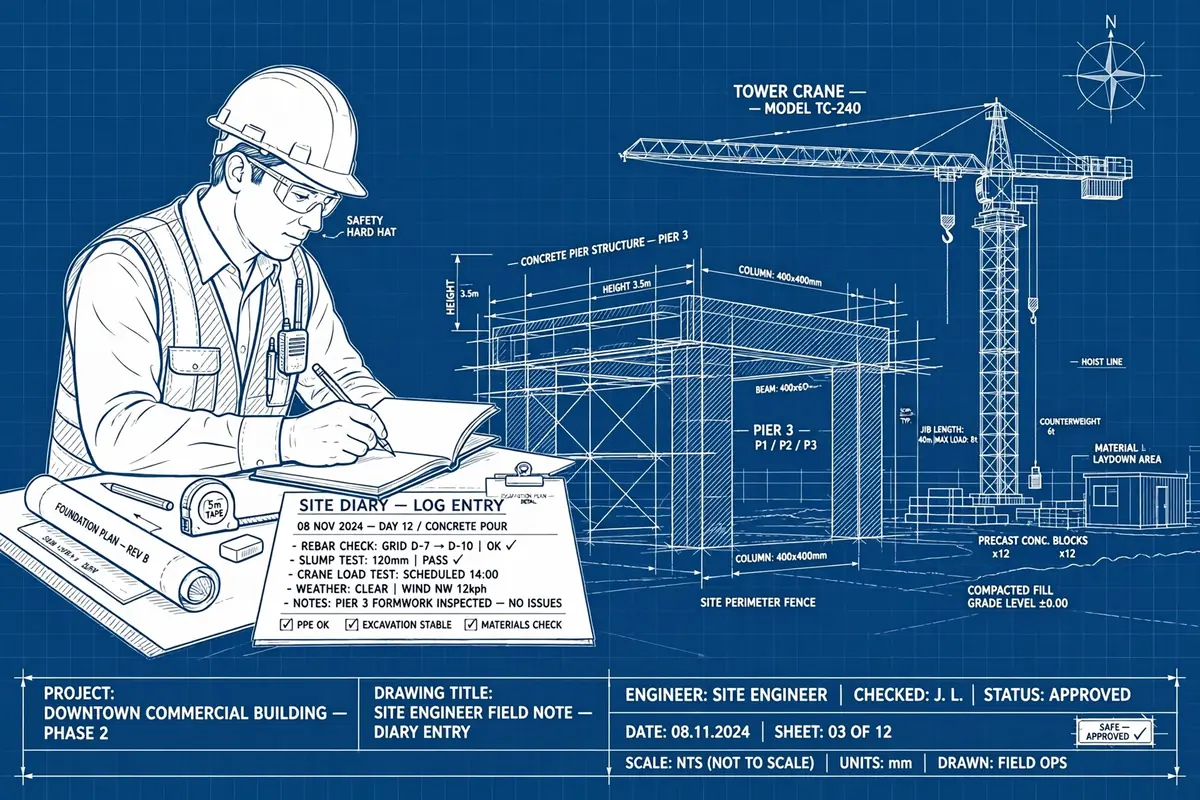
A good site diary protects your payment, your programme and your reputation. Here is exactly what to record every day, with a worked example.
Ask any experienced site engineer what saved them in their hardest dispute, and the answer is rarely a clever argument. It is usually a notebook. A site diary is the day-by-day record of what actually happened on site: who was there, what work was done, what the weather did, what went wrong, and who gave which instruction. When memories fade and claims arrive months later, the diary is the one document that speaks for the day itself.
Yet on many small and medium sites, the diary is treated as paperwork — filled in at the end of the week from memory, if at all. That defeats its purpose. A diary written three days late is not a record; it is a reconstruction. This guide explains exactly what to record every day, how to write it so it stands up, and how a single well-kept entry can protect your payment, your programme, and your professional reputation.
Why the site diary matters more than you think
First, the diary is evidence. Extension-of-time claims, variation claims, and defect disputes all turn on facts: was the site accessible on that date, was the drawing issued, did it rain, was the concrete delayed? A contemporaneous diary entry — written on the day, in plain language, with numbers — carries far more weight than anyone's recollection six months later.
Second, it is a management tool. A diary that tracks labour, plant, and quantities day by day shows productivity trends early. If blockwork output drops for three days running, you can ask why while there is still time to fix it, rather than discovering the slippage at the monthly progress meeting.
Third, it protects the engineer personally. If you instructed a contractor to stop work because the reinforcement was wrong, or you noted that a delivery arrived short, that note is your record that you acted. Engineers who keep no diary have no defence when someone later claims they were never told.
The daily header: get the basics right every time
Every entry should start with the same header information, without exception:
- Date and day number — for example, "Tuesday 12 May, Day 42 of 180". The day number makes programme analysis easy.
- Weather — morning, midday, and afternoon conditions, plus rainfall if measurable. "Rain 10:30–13:00, heavy" is useful; "bad weather" is not.
- Working hours — start and finish times, including any overtime or night work.
- Site conditions — ground conditions, access problems, standing water, or anything that affected work.
Write the weather as it affected work, not as a forecast. "Overcast, 31°C, no rain" tells a reader the pour could proceed. "Rain stopped concreting at 10:30, resumed 13:00" tells a reader exactly how much time was lost — and that matters for claims, as the worked example below shows.
Labour and plant: who and what was on site
Record labour by trade and number, not just a total headcount. "42 workers on site" tells you little. "12 masons, 8 steel fixers, 6 carpenters, 10 general labourers, 4 machine operators, 2 supervisors" tells you whether the gang matched the planned resource for the work actually done.
Do the same for plant: type, number, and hours worked, plus any breakdowns or idle time. A tower crane idle for half a day because of high wind is a cost and a programme fact. If you only write "crane on site", that fact is lost. Note deliveries too — what arrived, in what quantity, and whether it was checked. Short deliveries and rejected loads should be recorded on the day, with the delivery note number where possible.
Work done: quantities, locations, and drawing references
This is the heart of the diary. For each activity, record what was done, where, and how much. Always tie the work to a location and a drawing:
- Location: grid lines, level, or room — "Grid C–E / 3–5, first floor slab" rather than "slab work".
- Quantity: measured in the unit the work is paid in — cubic metres of concrete, square metres of blockwork, tonnes of reinforcement, linear metres of drain.
- Drawing: the drawing number and revision used, for example "Drg S-104 Rev C". If work proceeded to a superseded revision, say so — that is exactly the kind of fact a dispute turns on.
Be specific about what stage each element reached. "Columns C1–C6 concreted to first floor level" is a fact. "Column work ongoing" is a feeling. A future reader — a quantity surveyor measuring interim payment, or an engineer checking a programme — needs the first version.
Instructions, visitors, and decisions
Every instruction given or received on site should appear in the diary, with the name of the person who gave it and the time. Verbal instructions are the most dangerous kind: they are easily forgotten and easily denied. If the architect verbally approves a change to a door opening, write it down, and follow it up with a written confirmation or a request for instruction. The diary entry does not replace the formal instruction, but it proves the conversation happened.
Record visitors as well: the client, the structural engineer, the building inspector, the safety officer. Note what they inspected, what they said, and any action they required. "Building inspector visited 11:00, inspected footing reinforcement at Grid A, approved pour subject to two additional links at column C3" is a complete record. "Inspector visited" is not.
Tests, inspections, and quality checks
Tests and inspections are the diary's quality record. For concrete, record the pour, the mix, the slump result, and the number of cubes cast, with the cube reference numbers. For reinforcement, record that it was checked before concreting, and note any defects found and corrected. For soil and compaction, record test locations and results where known.
This matters because quality disputes are rarely about whether a test was done — they are about whether it was done on that element, on that day, to that specification. A diary that links the test to the element ("Slump 110 mm, 6 cubes ref. C-42, slab Grid C–E") answers that question. Refer to the relevant standard where it applies: concrete testing and acceptance is covered by ACI 318 and IS 456, and reinforcement detailing by BS 8666. You do not need to quote clauses in the diary, but naming the specification the work was checked against removes ambiguity.
Problems, delays, and safety events
Record problems honestly and factually, without blame. "Excavation at Grid F hit rock at 1.2 m depth, breaker ordered, work stopped 14:00" is a fact. "Contractor was slow again" is an opinion, and opinions in a diary help nobody and can harm you. Stick to what happened, when, and what was done about it.
Delays deserve special care. Note the cause, the start and finish time, and the activities affected. Was the delay caused by weather, late delivery, a design query, or lack of access? Each cause has different contractual consequences, and the diary is often the only record that separates them. The same applies to safety: record toolbox talks, incidents, near misses, and any stop-work instruction, with times and names. A diary that omits a safety incident is worse than no diary at all.
Worked example: what one good entry proves
Consider a ground floor slab pour on Day 42 of a housing project. The diary entry reads: slab Grid A–D / 1–4, 14.0 m long by 9.0 m wide, 150 mm thick. The theoretical concrete volume is:
Volume = 14.0 × 9.0 × 0.15 = 18.9 m³
Allowing 5% for wastage, the order quantity is 18.9 × 1.05 = 19.85 m³, rounded up to 20.0 m³ ordered. On the day, 20.0 m³ was delivered in three loads, 19.1 m³ was placed, and 0.9 m³ was returned. The actual waste is therefore 0.9 ÷ 18.9 = 4.8% of the theoretical volume — within the allowance, and fully explained by the record.
Now add the delay. Rain stopped the pour at 10:30 and work resumed at 13:00 — 2.5 hours lost from an 8-hour shift, or 2.5 ÷ 8 = 31% of the working day. Because the diary records the exact times, the weather, and the quantities placed before and after the stoppage, three questions are answered at once: how much concrete was used, why the pour finished late, and whether the delay was the contractor's fault. It was not — it was weather, recorded contemporaneously. That one entry settles a payment quantity, a programme question, and a potential claim, and it took five minutes to write.
A simple template you can use tomorrow
You do not need a complicated form. A diary page with these headings, filled in every day before you leave site, covers nearly everything:
- Date, day number, weather, and working hours
- Labour by trade and plant on site, with idle time and breakdowns
- Work done, with location, quantity, and drawing number and revision
- Materials delivered, checked, rejected, or short
- Instructions given and received, with names and times
- Visitors, inspections, and test results
- Problems, delays, and safety events, with causes and times
- Photographs taken, with a note of what each one shows
- Work planned for tomorrow
Photographs deserve a line of their own. A photo without a note is often useless a month later — nobody remembers which wall it showed. Write "Photo 14: honeycombing at column C3, first floor, before repair" and the photo becomes evidence. Store photos with the diary, dated, and back them up; a phone gallery that gets wiped is not an archive.
Common mistakes that ruin a good diary
Writing it late
A diary written on Friday for the whole week is guesswork dressed as a record. Write each day's entry on that day, even if it is brief. A short entry written on time beats a long entry written from memory.
Recording opinions instead of facts
Keep judgements out. "Work progressed well" means nothing. "Blockwork, ground floor, Grid A–B: 42 m² completed by 6 masons" means everything. If you must record a concern, record the fact behind it: "Only 3 of 6 planned masons on site; blockwork 42 m² against 70 m² planned."
Leaving gaps
Never leave a day blank, even if no work happened. "No work — site closed for public holiday" or "No work — access denied pending landowner agreement" is itself important information. A gap in the diary invites the assumption that nothing worth recording happened, and in a dispute, gaps get filled by the other side's version of events.
Keeping only one copy
If the diary is a paper book, photograph or scan each page weekly. If it is digital, make sure it is backed up and cannot be edited silently after the fact. A record that can be rewritten without trace is a record nobody will trust.
Paper or digital?
Either works, provided it is used daily. Paper notebooks survive dust, rain, and dead batteries, and a handwritten entry with a signature is hard to dispute. Digital diaries — apps or simple shared documents — are easier to search, photograph, and share with the project team, and they solve the backup problem automatically. Many engineers use both: a pocket notebook on site, transferred to the project record the same evening. What matters is not the medium but the discipline: same headings, same day, every day, no gaps.
Final thought
A site diary costs about ten minutes a day. It repays that time the first time a quantity is questioned, a delay is disputed, or an inspector asks what happened on a particular date. Start tomorrow: use the headings above, write facts with numbers, name the people and the drawings, and never leave a day blank. Months from now, when the project is finished and only the paper trail remains, your diary will be the most honest witness on the job — because it was there, on the day, when it happened.
Calculations and engineering guides are for planning and educational reference. Verify final designs against applicable codes with a licensed Professional Engineer.