Excavation Cost Per Cubic Yard: Soil, Access & Haul Explained
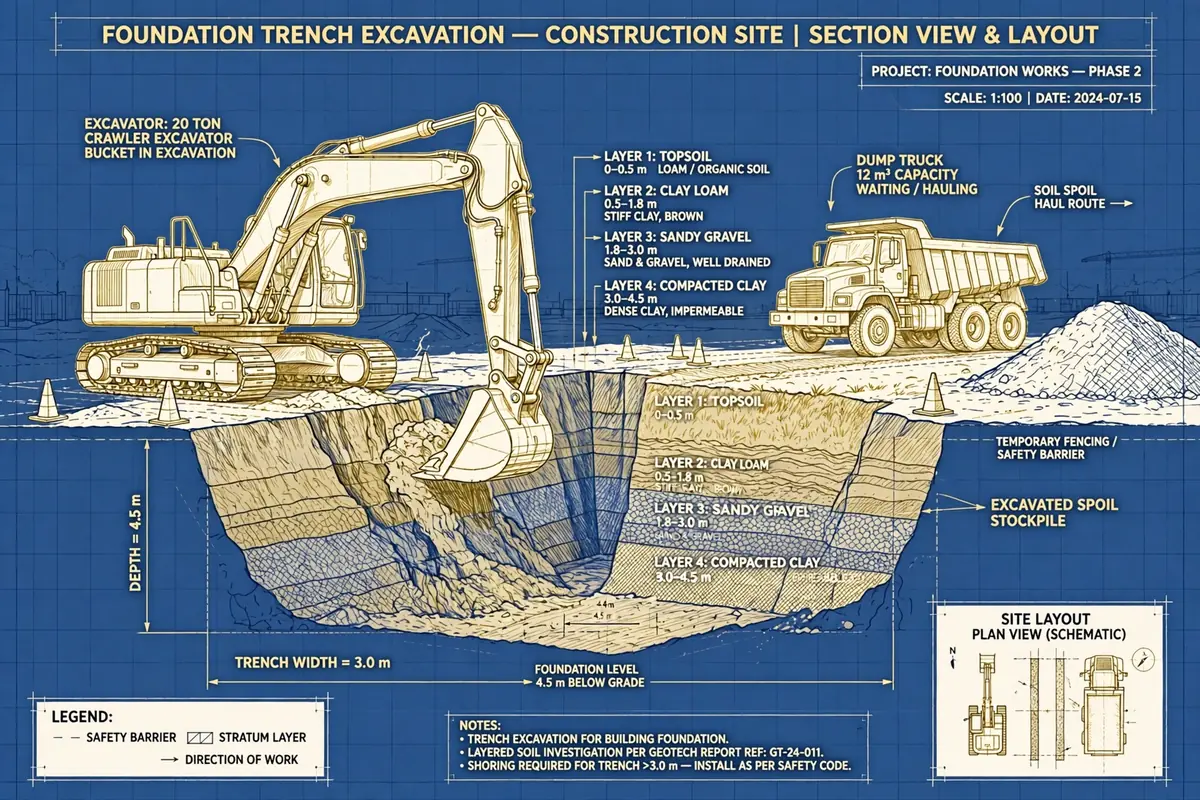
Excavation costs $50–$200 per cubic yard in the US. Soil type, site access and haul distance drive the price — here's the full breakdown with a worked example.
If you are pricing a foundation, a basement, a pool or a drainage trench, the first number any contractor will quote you is a cost per cubic yard. It sounds simple — one rate, one volume — but that single number hides at least five different costs, and two estimators can quote rates $100 apart for the same hole and both be honest. The difference is usually soil, access and haul distance, and if you do not understand how each one moves the price, you cannot tell a fair quote from a padded one.
This article breaks down what excavation really costs per cubic yard in the US, what drives the rate up or down, and how to work out a realistic budget for your own job — including a full worked example for a typical house basement.
What does excavation cost per cubic yard?
For straightforward residential and light commercial work in the US, excavation typically costs $50 to $200 per cubic yard (bank measure — more on that below). Most ordinary jobs land in the $70 to $120 per cubic yard band, all-in. Very easy work — shallow digging in soft topsoil, spoil stockpiled on site, no haulage — can come in under $50. Deep work in rock, tight city sites, or long haul distances can push past $200.
That range is wide because "excavation" is not one operation. A realistic price is built from digging, loading, hauling, dumping and backfill — and a quote that only covers digging is not comparable with one that covers the lot. Before you compare two numbers, ask each contractor exactly what is included.
Bank yards vs loose yards: the number that catches everyone out
Here is the single most misunderstood point in excavation pricing, and the one that causes most budget arguments on site.
Soil takes up more space once you dig it. Undisturbed ground is measured in bank cubic yards — the volume in the ground. Once the bucket breaks it up, the same soil swells and is measured in loose cubic yards. The increase is called the swell factor, and it decides how many truckloads you actually need.
- Topsoil / soft loam: swells about 10–15%
- Stiff clay: swells about 20–30%
- Sand and gravel: swells about 10–15%
- Broken rock: swells about 40–60%
So 100 bank cubic yards of stiff clay becomes roughly 125 loose cubic yards in the truck. A 12-cubic-yard dump truck carries 12 loose yards, not 12 bank yards — it takes about 11 loads to clear 100 bank yards of clay, not 8. Contractors who price by the bank yard absorb this in their rate; contractors who price haulage by the load do not. Either way, you pay for it — the only question is whether it is visible in the quote.
Rule of thumb: always confirm whether a quoted rate is per bank yard or per loose yard, and whether haulage and tipping fees are included. That one question eliminates most "surprise" extras.
What drives the price: the five cost factors
1. Soil type
Soil is the biggest single driver. Soft topsoil and loose sand cut quickly with a standard bucket, so a machine can move 40–60 cubic yards an hour. Stiff clay is slower and stickier — it clogs the bucket and needs more passes. Rock is a different job altogether: it needs a hydraulic breaker, a ripper, or in the worst case blasting, and production can fall to a few cubic yards an hour.
As a rough guide, digging-only rates run about $30–$50 per bank yard in soft soil, $50–$90 in stiff clay, and $100–$250+ in rock.
2. Depth and shoring
Shallow trenches are cheap. Once you go deeper than about 4–5 feet, OSHA requires protective systems — sloping, benching, shoring or a trench box — and that adds labour, equipment and time. Deep excavations also need wider working room, dewatering if groundwater appears, and longer cycle times because the machine has to reach further and lift higher. As a practical rule, expect the rate to climb noticeably once you pass 6 feet, and again past 10 feet.
3. Site access
A wide-open lot where a 20-ton excavator and full-size dump trucks can work side by side is the cheapest site to dig. A tight backyard where only a mini-excavator fits, spoil has to be carried out by wheelbarrow or a small dumper, and trucks can only load from the street will cost far more per yard — sometimes double — for exactly the same volume. Overhead lines, neighbouring buildings, fences and soft ground that needs bog mats all push the rate up.
4. Haul distance
Haulage is charged by the load, and the cost of a load is mostly time: loading, driving, tipping and returning. A tip site 2 miles away might cost $120–$180 a load; the same load 20 miles away can cost $300–$450. Multiply that by 30 or 40 loads and the haul distance alone can exceed the digging cost. This is why contractors ask where the spoil is going before they price — and why keeping clean spoil on site, if you have room for it, is the single biggest saving available.
5. Disposal and tipping fees
Clean soil is cheap to tip — often $5–$15 per loose yard at a fill site, and sometimes free if someone nearby wants fill. Contaminated soil, or soil mixed with demolition rubble, is a different matter: testing, licensed disposal and landfill tax can run $30–$80 per yard or more.
Worked example: excavating a house basement
Let us price a real job step by step, so you can see how the pieces add up.
The job: a rectangular basement, 40 ft long by 30 ft wide, dug 8 ft deep. The soil is stiff clay, the site has good truck access, and the spoil goes to a fill site 15 miles away. The contractor charges $60 per bank cubic yard for digging and loading, $180 per truckload for haulage, and the tip charges $10 per loose cubic yard.
Step 1 — volume in the ground (bank yards).
Volume = length × width × depth = 40 × 30 × 8 = 9,600 ft³. Divide by 27 (cubic feet per cubic yard): 9,600 ÷ 27 = 355.6, say 356 bank cubic yards.
Step 2 — digging cost.
356 bank yd³ × $60 = $21,360.
Step 3 — loose volume and truckloads.
Stiff clay swells about 25%: 356 × 1.25 = 445 loose cubic yards. At 12 loose yards per truck, that is 445 ÷ 12 = 37.1, so 38 loads.
Step 4 — haulage cost.
38 loads × $180 = $6,840.
Step 5 — tipping fees.
445 loose yd³ × $10 = $4,450.
Step 6 — total and all-in rate.
Total = $21,360 + $6,840 + $4,450 = $32,650. Divide by the bank volume: $32,650 ÷ 356 = about $92 per bank cubic yard all-in.
Notice how the headline digging rate ($60) is only two-thirds of the true cost. Haulage and tipping add another $32 per yard. If the tip site were 30 miles away instead of 15, the haulage alone would roughly double and the all-in rate would climb past $110 — same hole, same soil, very different price.
A smaller job for comparison
Take a drainage trench, 100 ft long, 3 ft wide and 4 ft deep, in a tight backyard where only a mini-excavator can work and spoil has to be barrowed to the street. Volume = 100 × 3 × 4 = 1,200 ft³ = 44.4 bank yards. At a realistic tight-access rate of $120 per yard all-in, that is 44.4 × $120 = about $5,330. The volume is one-eighth of the basement, but the rate per yard is higher — small, awkward jobs always are, because mobilisation, setup and minimum charges dominate.
How to get an accurate excavation quote
- Give the contractor the same information: a sketch with length, width and depth, the soil type if you know it, where trucks can get to, and where the spoil can go. Quotes based on different assumptions cannot be compared.
- Ask for the breakdown: digging, haulage, tipping and any shoring or dewatering as separate lines. A lump sum hides the risk; a breakdown shows it.
- Ask about rock: what happens if rock is hit? A fair contract states a rock rate in advance. The worst outcome is discovering it mid-dig with no agreed rate.
- Check for extras: mobilisation, traffic management, permits, utility location, testing and reinstatement are all commonly excluded from the headline rate.
- Confirm the measure: bank yards or loose yards, and how the volume will be measured — by survey before and after, or by counting truckloads. Agree it before work starts.
Ways to bring the cost down
Keep spoil on site. If you have room to stockpile or use the soil for landscaping and grading, you delete haulage and tipping entirely — often a third of the bill. Just be sure the stockpile is placed where it will not collapse back into the excavation or block access.
Dig in dry weather. Wet clay is heavier, stickier and slower to handle, and wet sites rut up under trucks. A few dry days can genuinely save a day of machine hire.
Combine the work. If you need a trench, a soakaway and a driveway sub-base, doing them in one mobilisation is far cheaper per yard than three separate visits.
Get the geotechnical report. A $1,500–$3,000 soil investigation feels expensive until it prevents a $20,000 rock surprise. For any excavation deeper than about 6 feet, it is money well spent.
Frequently asked questions
How much does it cost to excavate 100 cubic yards?
At a typical all-in rate of $70–$120 per bank cubic yard, budget $7,000–$12,000 for 100 bank yards, including haulage and tipping. Soft soil with spoil kept on site could be under $5,000; rock or a long haul could push it past $15,000.
Is excavation priced by the hour or by the yard?
Both. Small or uncertain jobs are often priced by the day — a mini-excavator with operator runs roughly $500–$800 a day, a 20-ton machine $1,200–$2,000 a day. Larger, well-defined jobs are usually priced per cubic yard, which is fairer for both sides once the volume is known.
Why did my quote double when the contractor saw the site?
Almost always access or soil. A site that looked easy on a plan can turn out to need a smaller machine, hand digging near services, bog mats, or a longer haul route — and each of those is priced in once the contractor has actually stood on the ground. A site visit before quoting is normal practice, not a sales trick.
Do I need a permit to excavate?
Usually, yes — excavation tied to a building permit is covered by that permit, but standalone digging, work near boundaries, or work deeper than a local threshold often needs its own approval. Always call 811 (or your local utility locator) before any digging, and check with your local authority about permits and shoring requirements.
The bottom line
Excavation cost per cubic yard is a useful headline, but it is not the whole price. For a typical US residential job, budget $70–$120 per bank cubic yard all-in, and always ask what the rate includes. The three questions that matter most are: what soil are we digging, how far is the spoil going, and can any of it stay on site? Get those three answers right and your estimate will be close — get them wrong and it can be out by half.
Calculations and engineering guides are for planning and educational reference. Verify final designs against applicable codes with a licensed Professional Engineer.