Concrete Block Wall Cost: Per-Block Price & Labour Breakdown
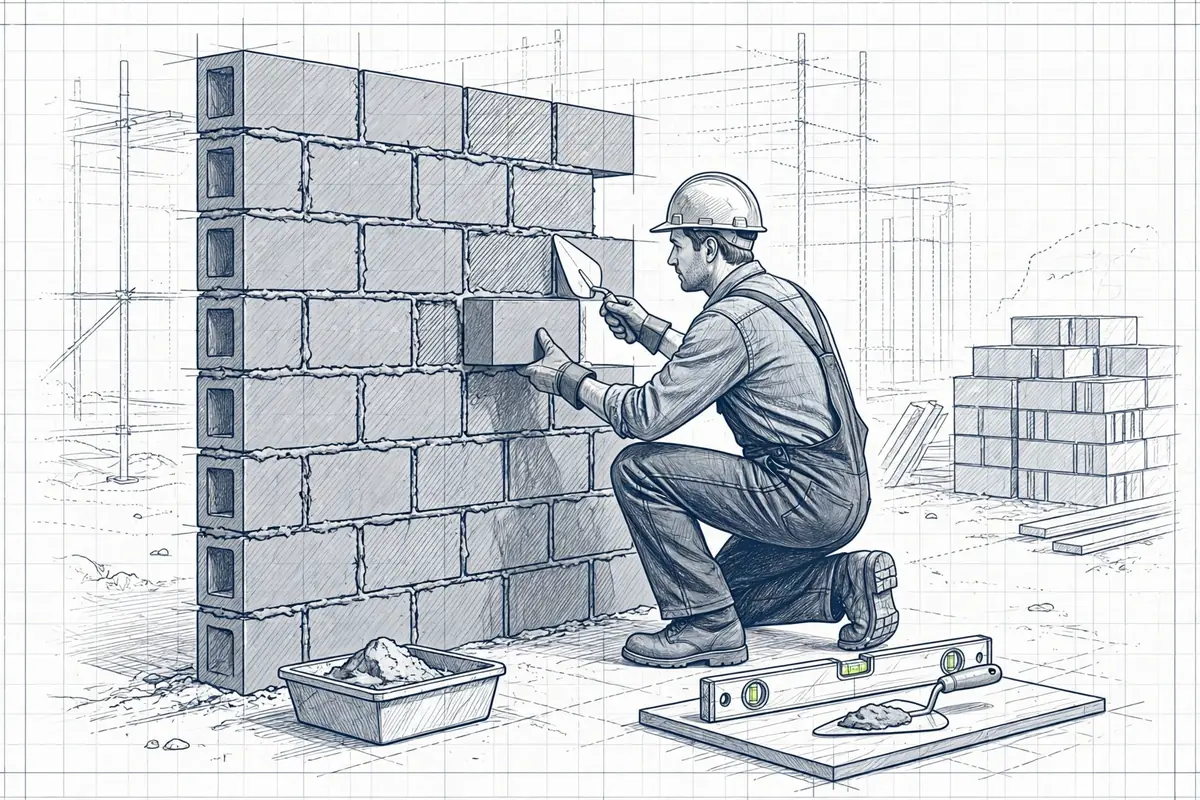
How much does a concrete block wall cost? Per-block prices, labour, mortar and footing, with a full worked example for a 100 ft wall.
If you are pricing a garden wall, a boundary wall, or the blockwork shell of a house, the first question is always the same: what does it cost per block? The honest answer is that the block itself is only a third of the story. A concrete block wall cost is made up of the blocks, the mortar, the footing underneath, the steel and grout inside the cores, and the mason's time. Price any one of those badly and the estimate falls apart.
This article breaks the cost down piece by piece, then works a full example: a 100 ft long, 8 ft high garden wall. All prices are US figures in dollars, current to late 2026, and they are the sort of numbers you would get from a builders' merchant and a local masonry contractor. Treat them as a budgeting range, not a quote — prices move by region and by site access.
What a concrete block wall costs per square foot
For a standard 8-inch concrete masonry unit (CMU) wall, laid and finished, expect $10 to $20 per square foot of wall face, with most straightforward residential work landing between $14 and $16 per square foot. That installed figure already includes blocks, mortar, the footing, reinforcement, and labour. A plain, unreinforced garden wall at the low end might come in near $11 per square foot; a load-bearing, fully grouted wall with a rendered finish can push past $20.
Why the wide range? Four things move the price most: wall height, because anything above 6 ft needs scaffolding and slows the mason down; reinforcement, because a structural wall needs vertical bars and grout-filled cores; access, because blocks delivered to a back garden by wheelbarrow cost more to place than blocks dropped beside the wall line; and finish, because a fair-faced wall needs careful work while a wall that will be rendered or painted can be built faster.
Per-block price: what one CMU actually costs
A standard 8 x 8 x 16 inch hollow concrete block retails for roughly $2.50 to $4.50 per block, with $3.25 a sensible mid-range figure for a standard-weight grey block bought in quantity. Lightweight blocks cost 10 to 20 percent more, and decorative or split-face blocks can run $5 to $8 each. Buy in bulk — a full pallet of 72 to 90 blocks — and the merchant will usually sharpen the price; buy twenty blocks at a time and you pay the top of the range.
One important conversion: a standard block covers 0.89 square feet of wall face once the 3/8-inch mortar joints are allowed for, which works out to 1.125 blocks per square foot. So a 100-square-foot wall needs 113 blocks before waste. Always add a waste allowance of 5 percent for cutting, breakage, and the odd block that arrives cracked. On a small job, round up to the next pallet — running short by six blocks costs more in a second delivery than the spare blocks ever will.
What else goes into the price
Mortar
Mortar is the cheapest line on the bill but the easiest to forget. A cubic yard of site-mixed mortar lays roughly 100 to 120 standard blocks, and ready-mixed mortar costs around $150 to $250 per cubic yard delivered. For most jobs, budget $1.25 to $1.75 per block for mortar, sand, and cement combined.
Footing
Every block wall needs a concrete footing, and the footing is often 10 to 15 percent of the total cost. A typical strip footing for an 8-inch wall is 24 inches wide and 12 inches deep, with two or three longitudinal bars. At $150 per cubic yard for ready-mix concrete, a 100 ft footing of that size needs about 7.4 cubic yards and costs roughly $1,100 for the concrete alone, before excavation, formwork, and steel.
Reinforcement and grout
A structural block wall is not just stacked blocks. Vertical reinforcement — typically #4 bars (1/2 inch) at 32 or 48 inch centres, set into the footing and grouted into the block cores — ties the wall to its foundation. Allow $0.50 to $1.00 per square foot for bars, grout, and the labour to place them. A wall that is fully grouted, with every core filled, uses far more grout and costs noticeably more than a wall grouted only at reinforced cores, so confirm with the engineer which cores need filling before you price it.
Labour
Labour is the biggest single cost, usually 40 to 55 percent of the total. A skilled mason lays 100 to 200 blocks a day depending on the wall — straight runs go fast, corners, piers, and openings slow everything down. At $50 to $75 per hour for a mason, plus a labourer at $25 to $35 per hour to mix mortar and keep blocks coming, a two-person crew costs roughly $90 to $110 per hour combined. A wall that takes a week of that crew's time carries $3,500 to $4,500 in labour alone.
Worked example: a 100 ft long, 8 ft high garden wall
Let us price a real wall. A homeowner wants a boundary wall 100 ft long and 8 ft high, built from standard 8 x 8 x 16 inch hollow blocks, with a concrete strip footing, vertical reinforcement at 48 inch centres, and no applied finish — fair-faced blockwork, both sides.
Step 1 — wall area. 100 ft x 8 ft = 800 sq ft of wall face.
Step 2 — blocks. 800 sq ft x 1.125 blocks per sq ft = 900 blocks. Add 5 percent waste: 900 x 1.05 = 945 blocks. At $3.25 per block: 945 x $3.25 = $3,071.
Step 3 — mortar. 900 blocks at roughly 110 blocks per cubic yard = 8.2 cubic yards. At $180 per cubic yard: 8.2 x $180 = $1,476. Round to $1,475.
Step 4 — footing. 100 ft long, 2 ft wide, 1 ft deep = 200 cu ft = 7.4 cu yd. At $150 per cubic yard: 7.4 x $150 = $1,110. Add excavation, formwork, and two #4 bars: allow $800, bringing the footing to $1,910.
Step 5 — reinforcement and grout. Vertical #4 bars at 48 inch centres means 25 bars, each 9 ft long including the lap into the footing, plus grout for the reinforced cores. Allow $650 for steel, grout, and placement.
Step 6 — labour. 900 blocks at 130 blocks per day for a two-person crew = 7 working days. At $90 per hour combined, 8 hours a day: 7 x 8 x $90 = $5,040.
Step 7 — total. $3,071 + $1,475 + $1,910 + $650 + $5,040 = $12,146. Add a 10 percent contingency for ground conditions and price movement: $12,146 x 1.10 = $13,361.
That works out to $16.70 per square foot installed, or about $14.85 per block once the mortar, footing, steel, and labour are counted. Notice how the block itself — $3.25 — is less than a quarter of the installed cost per block. Anyone who prices a wall by multiplying the block price by the number of blocks will underprice the job by roughly three-quarters.
Cost factors that catch estimators out
The first is height. A 4 ft garden wall is fast, easy work. At 8 ft the mason needs a scaffold, blocks have to be lifted to platform height, and output drops by a third or more. Above 8 ft, most codes require an engineered design, and the wall usually needs a reinforced bond beam at the top — another course of blocks, steel, and grout.
The second is openings and piers. Every gate opening, corner, and pilaster interrupts the rhythm of laying. A straight 100 ft run is the cheapest wall you will ever build; the same 100 ft broken into four sections with two gates and six piers can cost 25 percent more in labour.
The third is the ground. A footing on firm, dry soil is a day's digging. Hit soft fill, a high water table, or rock, and the excavation and footing costs can double. This is why the 10 percent contingency in the worked example matters — ground conditions are the one thing you cannot price accurately until you open the trench.
The fourth is the finish. A wall left fair-faced needs the neatest work and the best blocks. Rendering adds $4 to $7 per square foot per side. Painting a block wall is cheaper than rendering, but it needs a block filler or primer coat first, or the paint disappears into the pores of the concrete. Factor the finish in from the start — it is not a decoration added later, it is a real line in the budget.
DIY vs hiring a mason
Doing it yourself saves the labour line, which is roughly half the cost in the example above — about $5,000 on a $13,000 wall. But blocklaying is a skilled trade, and the savings only hold if the wall comes out plumb, level, and properly bonded. A wall that leans 20 mm out of plumb over 8 ft is a wall that will be noticed, and one that may need to come down. For a low garden wall under 4 ft, a careful DIY builder with a level, a string line, and patience can do a decent job. For anything structural, load-bearing, or over 6 ft high, hire the mason. The ACI 318 requirements for reinforced masonry — minimum reinforcement, grout strength, and cover to the steel — are not optional, and a building inspector will check them.
How to get an accurate quote
Give every contractor the same information: wall length and height, block type and size, whether the wall is structural, the footing size from the drawings, and the finish you want. Ask for the quote broken down into materials, labour, footing, and reinforcement, not a single lump sum — a breakdown lets you compare quotes properly and spot the one that forgot the footing. Get at least three quotes, and be suspicious of any price that is far below the others. In blockwork, a suspiciously cheap quote usually means the footing is too shallow, the reinforcement is missing, or the mortar mix is wrong, and all three of those failures show up within a year.
Frequently asked questions
How much does a concrete block wall cost per linear foot?
For an 8 ft high wall at $14 to $16 per square foot, the cost per linear foot is roughly $112 to $128. A 4 ft wall costs about half that per linear foot, since the footing and labour do not halve with the height.
How many blocks do I need for a 100 ft wall?
At 8 ft high, 800 sq ft of wall needs 900 blocks plus 5 percent waste, or 945 blocks. At 4 ft high, the same length needs 450 blocks plus waste, or 473 blocks.
Do I need a footing under a block wall?
Yes, always. Even a low garden wall needs a concrete footing below frost depth, or seasonal ground movement will crack it. The only exception is a single-course edging wall, which is landscaping, not a wall.
Is a block wall cheaper than a brick wall?
Usually, yes. Blocks are larger, so a mason lays a square foot of blockwork faster than a square foot of brickwork, and the material cost per square foot is lower. A brick wall of the same size typically costs 20 to 40 percent more installed.
How long does a block wall last?
A properly built and reinforced concrete block wall lasts 50 to 100 years. The weak points are the footing and the mortar joints — keep water away from the base, repoint joints when they crack, and the wall will outlast the house it surrounds.
Calculations and engineering guides are for planning and educational reference. Verify final designs against applicable codes with a licensed Professional Engineer.