House Foundation Cost per Linear Foot: Worked Example
How much does a house foundation cost per linear foot of footing? A full worked example with concrete, rebar, excavation and labour, US pricing.
Ask a contractor what a house foundation costs and you will usually get one of two answers: a lump sum for the whole job, or a price per linear foot of footing. The per-linear-foot figure is the useful one. It lets you compare quotes, sanity-check a bid against the size of your house, and see immediately how a wider or deeper footing changes the price. This article works through what actually sits inside that per-foot number, with a full worked example for a typical single-storey house.
What "per linear foot of footing" actually means
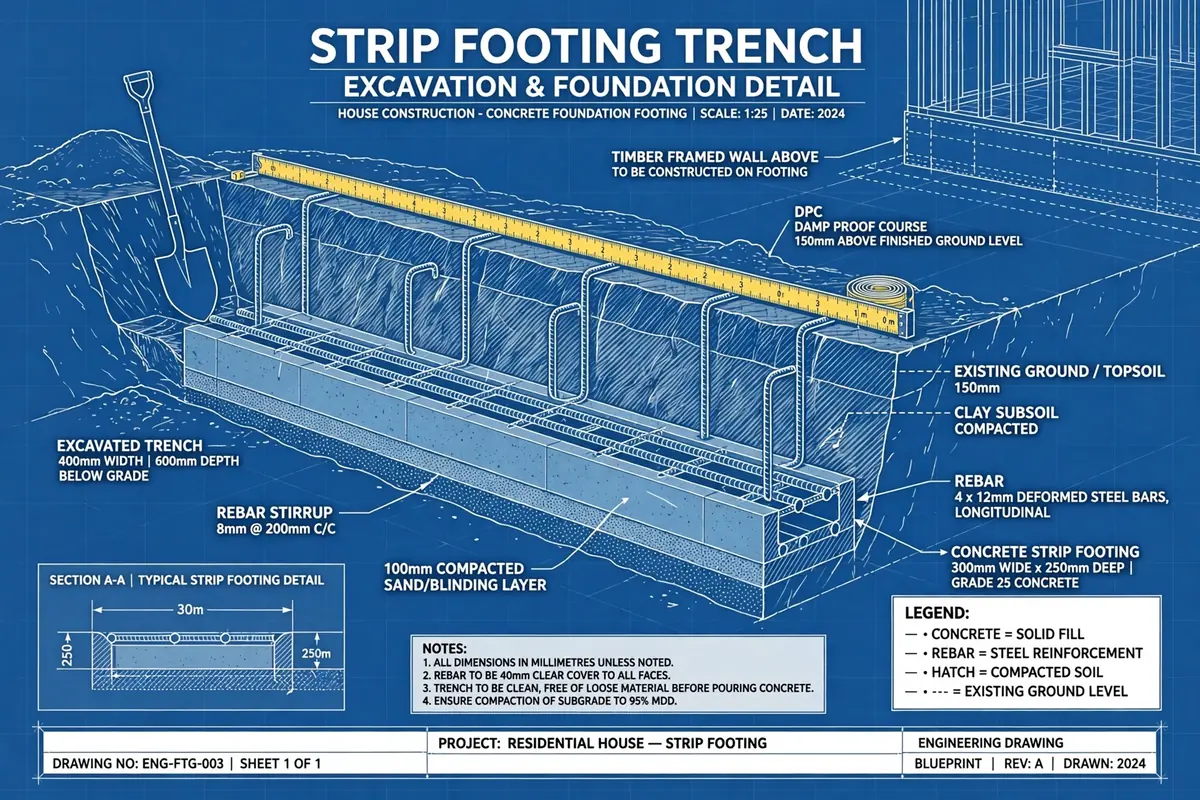
A linear foot of footing is one foot measured along the length of a strip footing — the continuous concrete ribbon that carries the walls of the house down to bearing soil. The price per linear foot is not the price of the concrete alone. A proper per-foot rate bundles everything needed to produce that foot of finished footing in the ground:
- Excavation — digging the trench and hauling the spoil away
- Concrete — ready-mix delivered to site, usually 3,000–4,000 psi for residential footings
- Reinforcement — longitudinal bars, and transverse bars where the design calls for them
- Formwork — where the footing is formed rather than poured directly against the trench walls
- Labour — placing and consolidating the concrete, fixing the steel
- Damp-proofing and backfill — coating the footing and putting the soil back, compacted in layers
When a quote looks suspiciously cheap, it is almost always because one of these items has been left out — most often the excavation or the backfill. Always ask what the rate includes before comparing two numbers.
Typical cost per linear foot in the US
For a standard residential strip footing — 16 to 24 inches wide, 8 to 12 inches deep, two #4 bars, dug 2 to 3 feet down — expect $40 to $75 per linear foot in most US markets in 2026. That range covers the ordinary cases. Prices move toward the top of the range, or beyond it, when any of these apply:
- Deep frost footings. In northern states the footing must sit below the frost line, which can mean a trench 4 feet deep instead of 2. Excavation roughly doubles, and the price can reach $85–$110 per linear foot.
- Wide footings on weak soil. Poor bearing soil forces a wider footing — 30 or 36 inches instead of 16 — and concrete volume grows in direct proportion to the width.
- Heavy reinforcement. A two-storey house or a footing on expansive clay may need three or four bars and stirrups, adding $5–$10 per foot.
- Difficult access. A tight urban lot where a concrete truck cannot get close means pumping or wheelbarrowing, which adds $10–$20 per cubic yard to the concrete alone.
Concrete is the single biggest material cost, so it is worth seeing exactly how it scales. For a 24-inch-wide footing, the concrete alone costs about $7.40 per linear foot at 8 inches deep, $11.10 at 12 inches, and $16.70 at 18 inches — before waste, delivery and placement. Every extra inch of depth is real money, which is why footing depth should follow the design and the frost line, not a guess.
Worked example: a 40 ft × 30 ft single-storey house
Take a simple rectangular house, 40 ft long by 30 ft wide, with a strip footing under all exterior walls plus one interior load-bearing wall. The footing is 24 inches wide and 12 inches deep, with two #4 bars continuous. The trench is 3 ft deep to get below the local frost line.
Step 1 — Total length of footing
Exterior perimeter: 40 + 30 + 40 + 30 = 140 linear feet.
Interior load-bearing wall footing: 30 linear feet.
Total footing length: 140 + 30 = 170 linear feet.
Step 2 — Concrete volume
Cross-section of the footing: 2 ft wide × 1 ft deep = 2 sq ft.
Volume: 170 LF × 2 sq ft = 340 cu ft.
Convert to cubic yards: 340 ÷ 27 = 12.6 cu yd.
Add 10% for waste, spillage and over-excavation: 12.6 × 1.10 = 13.9 cu yd, so order 14 cu yd.
At $150 per cu yd for 3,000 psi ready-mix: 14 × $150 = $2,100, or $12.35 per linear foot.
Step 3 — Reinforcement
Two #4 bars run the full length: 2 × 170 = 340 LF of bar. A #4 bar weighs 0.668 lb per foot, so that is 340 × 0.668 = 227 lb. Add transverse #4 bars at 4 ft centres — 43 bars × 2 ft = 86 LF, or 57 lb — plus ties and laps, giving roughly 284 lb of steel in total.
At $1,200 per ton: 284 lb ÷ 2,000 × $1,200 = $170, about $1.00 per linear foot. Steel is cheap here because a strip footing is lightly reinforced; the cost is dominated by concrete and digging, not by rebar.
Step 4 — Excavation
Trench volume: 2 ft wide × 3 ft deep × 170 LF = 1,020 cu ft = 37.8 cu yd, say 38 cu yd.
At $35 per cu yd for machine excavation and haul-off: 38 × $35 = $1,330, or $7.82 per linear foot.
Step 5 — Formwork, labour, damp-proofing and backfill
- Formwork: two sides, 1 ft high × 170 LF = 340 sq ft of contact area at $3.50 per sq ft = $1,190.
- Labour (fixing steel, placing and consolidating concrete): allow $10 per linear foot = $1,700.
- Damp-proofing the footing faces: allow $3 per linear foot = $510.
- Backfill and compaction in layers: allow $4 per linear foot = $680.
Step 6 — Total and cost per linear foot
Adding it all up:
- Excavation: $1,330
- Concrete: $2,100
- Reinforcement: $170
- Formwork: $1,190
- Labour: $1,700
- Damp-proofing: $510
- Backfill: $680
- Total: $7,680
Cost per linear foot: $7,680 ÷ 170 LF = $45.18 per linear foot. That sits comfortably inside the typical $40–$75 range, which is a good sign — if your own estimate lands far outside that band, something in the takeoff is probably wrong. As a quick cross-check, the concrete alone is 27% of the total; if concrete ever comes to more than about 40% of a footing quote, the other items have probably been under-priced.
What makes the price move
Soil conditions. A geotechnical report that calls for a wider footing or a deeper bearing stratum changes the concrete and excavation volumes directly. Rock excavation can cost three to five times as much per cubic yard as digging in ordinary soil, and it is the most common reason a footing budget blows out.
Footing width. Widening from 16 to 24 inches adds 50% to the concrete volume and to the excavation width. Never widen a footing to "be safe" without checking the bearing pressure — the design width comes from the wall load divided by the allowable soil bearing pressure, and ACI 318 Chapter 13 sets out the design requirements for footings.
Water table and drainage. A high water table means dewatering during excavation, a drainage layer under the footing, and sometimes a waterproof membrane instead of a simple damp-proof coating. Each adds cost per foot and, more importantly, time.
Regional labour and concrete prices. Ready-mix prices vary by $30–$50 per cubic yard between regions, and that alone swings the per-foot price by $2–$4. Always price with a local quote, not a national average.
How to keep the cost honest without cutting corners
- Dig only as deep as the design requires. Going 6 inches deeper "just in case" on a 170 LF footing adds about 85 cu ft of concrete and excavation — roughly $800 on this example — for no structural benefit.
- Pour against the trench where the soil stands up. In firm soil, a footing cast directly against the trench walls needs no formwork at all, saving about $7 per linear foot.
- Order concrete accurately. The 10% waste allowance in the example is realistic for a strip footing; ordering 20% extra "to be safe" is just paying for concrete that goes back in the truck.
- Do not delete the reinforcement. Two #4 bars cost about $1 per linear foot. Skipping them saves almost nothing and removes the footing's ability to span a soft spot in the soil.
- Compact the backfill properly. Poorly compacted backfill settles, cracks the slab edge and lets water sit against the wall. The $4 per foot in the example is cheap insurance.
Frequently asked questions
How much does a house foundation cost per linear foot?
For a standard residential strip footing in the US, $40–$75 per linear foot is typical in 2026, including excavation, concrete, reinforcement, formwork, labour and backfill. Deeper frost footings or difficult soil can push the price to $85–$110 per linear foot.
What is included in the per-linear-foot price?
A complete rate should include excavation and haul-off, concrete, reinforcement, formwork where needed, labour, damp-proofing and backfill. If a quote covers concrete only, expect the finished cost to be roughly double the quoted figure.
How do I calculate the total footing length for my house?
Add the perimeter of the building to the length of every interior load-bearing wall that sits on its own footing. For a 40 ft × 30 ft house with one interior bearing wall, that is 140 + 30 = 170 linear feet.
Does a wider footing cost much more?
Yes, in direct proportion. Widening a footing from 16 to 24 inches increases the concrete volume and the trench width by 50%, adding roughly $5–$8 per linear foot to the finished price at current concrete rates.
A per-linear-foot rate is only useful if you know what is inside it. Price the footing the way the example above does — length first, then concrete, steel, excavation and the rest, line by line — and the number you get will be one you can defend, compare and build to. If you want to check your own numbers, the concrete volume and rebar weight calculators on CivilMath will run the same arithmetic in seconds.
Calculations and engineering guides are for planning and educational reference. Verify final designs against applicable codes with a licensed Professional Engineer.