Roofing Cost per Square Foot: Asphalt Shingles vs Metal
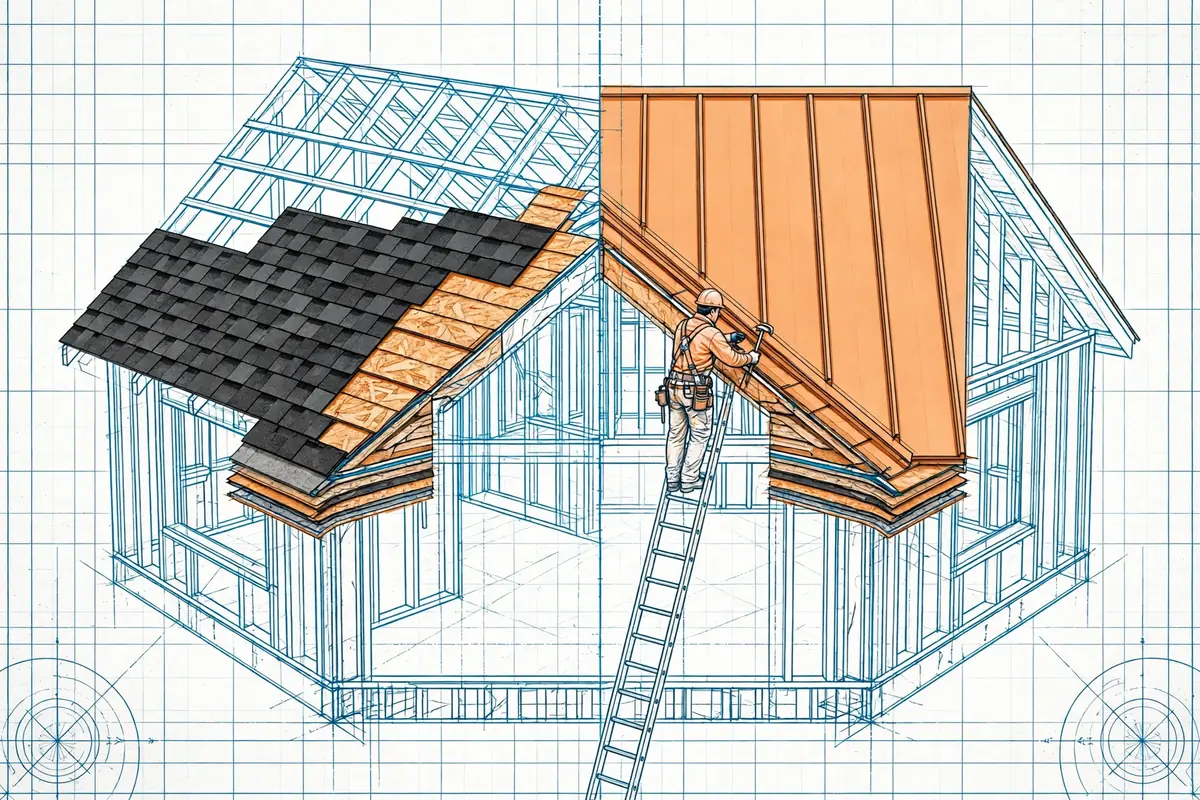
Roofing costs $4.50-$12.50 per sq ft installed. Compare asphalt shingles vs standing-seam metal, with a full worked example for a 1,800 sq ft roof.
If you are pricing a new roof, the first number every contractor will quote you is a cost per square foot. It sounds simple, but that single figure hides a lot: the slope of your roof, whether the old roof comes off, the underlayment, the flashing, and the fact that roofers measure in "squares", not square feet. Get any one of those wrong and a quote that looked cheap turns into a bill you did not expect.
This article breaks down what roofing actually costs per square foot in the United States in 2026, compares asphalt shingles with standing-seam metal honestly, and works through a complete example for a 1,800 sq ft roof so you can check any quote line by line. Prices here are installed costs — materials plus labour — for a typical single-family home with straightforward access. A steep, cut-up roof in a high-cost city will run higher; a simple low-slope ranch in a low-cost market will run lower.
What a "square foot" of roofing actually means
Before the numbers, you need the measurement. Roofing is priced on roof area, not floor area, and roof area is always bigger than the footprint of the house.
First, roofers measure in squares. One square is 100 sq ft of roof surface. A 1,800 sq ft roof is 18 squares. Bundles of shingles are sold by the square too — three bundles of architectural shingles make one square — so this unit is how the whole trade thinks.
Second, a sloped roof has more surface than the flat plan it covers. You convert plan area to roof area with a pitch factor:
- 4/12 pitch: multiply plan area by 1.054
- 6/12 pitch: multiply plan area by 1.118
- 8/12 pitch: multiply plan area by 1.202
- 12/12 pitch: multiply plan area by 1.414
So a 1,500 sq ft footprint under a 6/12 gable roof is about 1,677 sq ft of roof surface before you add overhangs, ridges, valleys and waste. Add 10% waste for cutting and mistakes on a simple roof, 15% on a roof with lots of hips and valleys, and you have the quantity you actually buy. Many homeowners who price a roof from their floor area underestimate the material by 20% or more, which is exactly how a "cheap" quote blows out mid-job.
Roofing cost per square foot: the ranges
Installed costs, including materials, labour, underlayment and standard flashing, for a straightforward residential re-roof:
- Three-tab asphalt shingles: $4.50–$5.50 per sq ft ($450–$550 per square). The budget option. Lighter, thinner, and a shorter life — typically 15–20 years.
- Architectural (dimensional) asphalt shingles: $5.50–$7.50 per sq ft ($550–$750 per square). The most common choice in the US. Heavier mat, better wind rating, 25–30 year life.
- Standing-seam metal: $10.00–$14.00 per sq ft ($1,000–$1,400 per square). Concealed fasteners, clean lines, 40–70 year life.
- Exposed-fastener metal (corrugated / ribbed panels): $6.50–$9.00 per sq ft ($650–$900 per square). Cheaper than standing seam, but the exposed screws need re-seating every 10–15 years.
Those figures assume the deck is sound and the old roof is already off or the price includes a standard single-layer tear-off. Tear-off of an existing roof typically adds $1.00–$1.50 per sq ft, and a second layer underneath adds another $0.50–$1.00 per sq ft. Disposal fees run $50–$100 per square on top in many markets, though contractors often bundle them into the tear-off line.
For reference in metric terms, $6.00 per sq ft is roughly $65 per m², and $12.00 per sq ft is roughly $129 per m². The US trade works in squares and square feet, so keep the conversion in mind only when comparing with overseas pricing guides.
Worked example: a 1,800 sq ft roof
Take a typical two-storey house with a 1,800 sq ft roof surface — that is 18 squares before waste. The roof is a simple gable at 6/12 pitch, one layer of old shingles to remove, sound plywood deck, and normal access. Here is how the two main options compare.
Step 1 — Material quantity with waste
Roof area is 1,800 sq ft, or 18 squares. Add 10% waste for a simple gable:
18 squares × 1.10 = 19.8 squares, so order 20 squares. Ordering the full 20 squares is standard practice — the leftover bundles cover the ridge cap and any miscuts, and a couple of spare bundles are worth keeping for future repairs.
Step 2 — Architectural asphalt shingles
Installed rate of $550 per square, which covers shingles, synthetic underlayment, ice-and-water shield at the eaves, drip edge, ridge cap and labour:
20 squares × $550 = $11,000.
That works out to $11,000 ÷ 1,800 sq ft = $6.11 per sq ft of roof. Add tear-off and disposal of the old layer at $1.25 per sq ft: 1,800 × $1.25 = $2,250, bringing the all-in total to $13,250. If the deck needs a few sheets of plywood replaced, budget $75–$100 per sheet installed.
Step 3 — Standing-seam metal
Installed rate of $1,100 per square for 24-gauge steel panels with concealed clips, which covers panels, underlayment, trim, snow guards where required, and the more specialised labour:
20 squares × $1,100 = $22,000, or $12.22 per sq ft of roof.
Tear-off is the same $2,250, so the all-in total is $24,250. Metal is roughly double the upfront cost of architectural shingles on this roof — and that gap is the whole decision, because the two roofs do not last the same length of time.
Step 4 — Cost per year of service
This is the comparison most quotes never show you. Divide the installed cost by the realistic service life:
- Architectural shingles: $11,000 ÷ 25 years = $440 per year
- Standing-seam metal: $22,000 ÷ 50 years = $440 per year
On this example the two come out dead even per year of service. Over a 50-year horizon the shingle roof needs a second installation at around year 25 — another $11,000 in today's dollars, plus another tear-off — while the metal roof is still in service. That is why metal wins on lifetime cost whenever you plan to stay in the house, and why shingles win when the budget is tight now or you expect to sell within 10–15 years. The honest answer depends on how long you will own the roof, not on which material is "better" in the abstract.
What pushes the price up (or down)
The per-square-foot ranges above assume a simple roof. These factors move a real quote away from the average:
- Pitch: anything above 8/12 is steep-slope work. Expect 15–25% more for labour, plus staging and safety equipment.
- Complexity: every valley, dormer, skylight and chimney is a flashing detail that costs $200–$500 each in labour and materials. A roof with four dormers is a different job from a plain gable at the same area.
- Deck condition: rotten or delaminated plywood only shows up once the old roof is off. A contingency of $500–$1,000 in the quote for deck repair is normal and reasonable.
- Underlayment upgrade: synthetic underlayment is standard now, but a full ice-and-water shield or a high-temperature underlayment under metal adds $0.50–$1.00 per sq ft.
- Region and season: labour rates in the Northeast and West Coast run 20–40% above the national average, and roofing prices typically rise 5–10% in the spring as demand picks up.
- Access: a roof the crew can reach with a truck and a dumpster is cheaper than one that needs materials carried up a long driveway or craned over a garage.
When you compare quotes, check that each one includes the same items: tear-off, disposal, underlayment type, flashing, ridge cap or ridge vent, and deck repair allowance. A quote that is 20% cheaper than the others usually leaves one of those out rather than finding a genuine saving.
Which one should you choose?
Choose architectural shingles if the budget matters most, the roof is complex with many penetrations (shingles handle fiddly details more cheaply), or you plan to sell within 15 years. They are also the easiest to repair — any roofer in any town stocks matching shingles.
Choose standing-seam metal if you plan to stay 20+ years, the house is in a snow, hail or wildfire zone, or you want the lowest lifetime cost. Metal sheds snow, resists wind uplift to 140 mph when properly clipped, and reflects solar heat, which can trim summer cooling bills by 10–25% in hot climates. The trade-off is noise in heavy rain without proper underlayment, and a smaller pool of installers — a badly installed metal roof is worse than a mediocre shingle roof, so check the crew's metal experience specifically.
Exposed-fastener metal sits in between: a good value for sheds, garages and simple rural roofs, but the screw maintenance and shorter life make it a weaker pick for a primary home.
Frequently asked questions
How much does a new roof cost for a 2,000 sq ft house?
A 2,000 sq ft house usually has 2,200–2,600 sq ft of roof surface once pitch and overhangs are counted. At $5.50–$7.50 per sq ft for architectural shingles, expect $12,000–$19,500 installed; standing-seam metal runs $22,000–$36,000. Always get the roof area measured — pricing from floor area is a common estimating error.
Is metal roofing worth double the price of shingles?
Over a 50-year horizon, usually yes — the per-year cost is similar, and you avoid a second tear-off and re-roof. Over a 10-year horizon, no — you will not recover the premium when you sell. The break-even point is roughly 20–25 years of ownership.
Can metal roofing go over existing shingles?
Sometimes, if the local code allows a second layer and the deck is sound. It saves the $1.00–$1.50 per sq ft tear-off, but it hides deck problems and adds weight, and many manufacturers will not honour the full warranty over an old roof. A tear-off is the safer choice.
How long does each roof last?
Three-tab shingles: 15–20 years. Architectural shingles: 25–30 years. Exposed-fastener metal: 25–40 years. Standing-seam metal: 40–70 years. These are realistic service lives, not the headline warranty figures — a "lifetime warranty" on shingles is usually prorated after 10 years.
Do I need a permit for a re-roof?
In most US jurisdictions, yes — a re-roof permit typically costs $150–$500 and triggers an inspection of the underlayment and flashing. Your contractor should pull it; a contractor who suggests skipping the permit is cutting a corner you will pay for later.
Bottom line
For a typical home, budget $5.50–$7.50 per sq ft installed for architectural shingles and $10–$14 per sq ft for standing-seam metal, plus $1.00–$1.50 per sq ft if the old roof comes off. On our worked example — an 1,800 sq ft roof — that is $11,000 versus $22,000 before tear-off, and $440 per year of service for either one. Measure the roof properly, compare quotes on identical scope, and pick the material that matches how long you will actually own the house. That is the whole decision.
Calculations and engineering guides are for planning and educational reference. Verify final designs against applicable codes with a licensed Professional Engineer.