How Much Does a Septic Tank Installation Cost? Sizing & Price Guide
Septic tank installation costs $5,000–$12,000 for most homes. Learn how tank size, soil and system type drive the price, with a full worked example.
If your house sits beyond the reach of the municipal sewer, a septic system is not optional — it is the whole wastewater treatment plant, buried in your back garden. And like any piece of infrastructure, its price depends far more on what is under the ground than on the tank itself. A straightforward install on good soil can come in under $5,000. The same house on heavy clay, a high water table or a steep slope can easily cost three times that.
This guide breaks down what a septic tank installation actually costs in the United States, how the tank and drain field are sized, and where the money goes — with a full worked example for a typical three-bedroom house, so you can check a contractor's quote line by line.
How much does a septic tank installation cost?
For a conventional gravity-fed system serving a three- or four-bedroom home, most homeowners pay $5,000 to $12,000 installed. A simple tank replacement on an existing drain field can be as low as $3,000 to $5,000, while engineered systems — mound systems, aerobic treatment units or sand filters — commonly run $10,000 to $25,000.
The spread is wide because the price is really three prices added together: the tank, the drain field, and the site work. On easy sites the tank is the biggest single item. On difficult sites the excavation, imported fill and engineered design dwarf it.
- Tank only (supply and set): $1,000–$2,500, depending on material and size
- Conventional system, complete: $5,000–$12,000
- Chamber or gravel-less system: $6,000–$14,000
- Mound system: $10,000–$20,000
- Aerobic treatment unit (ATU): $10,000–$20,000, plus $150–$300 per year in maintenance
- Sand filter system: $12,000–$25,000
These are 2026 US price ranges for a typical single-family home. Local labour rates, permit fees and soil conditions move them in either direction, which is why a site evaluation always comes before a firm price.
How septic tank size is calculated
Tank size is not chosen from the number of people living in the house. It is sized from the number of bedrooms, because bedrooms are a fixed proxy for the maximum occupancy a house can support. The design flow used across most US state codes is 150 gallons per day (gpd) per bedroom, roughly 570 litres.
Two rules then govern the tank volume:
- Retention rule: the tank must hold at least 1.5 times the daily design flow, so wastewater stays in the tank for a full day or more while solids settle and grease floats.
- Code minimum: most jurisdictions set a minimum tank of 1,000 gallons (about 3,800 litres) for any home up to three bedrooms, and add roughly 250 gallons per extra bedroom.
For a three-bedroom house the design flow is 3 × 150 = 450 gpd. The retention rule alone would give 1.5 × 450 = 675 gallons, but the 1,000-gallon code minimum governs, so a 1,000-gallon tank is installed. That margin is deliberate — it gives the system room for guests, laundry days and a future bedroom.
Tank size by number of bedrooms
- 2 bedrooms: 300 gpd design flow → 1,000-gallon tank (code minimum)
- 3 bedrooms: 450 gpd design flow → 1,000-gallon tank
- 4 bedrooms: 600 gpd design flow → 1,250-gallon tank
- 5 bedrooms: 750 gpd design flow → 1,500-gallon tank
- 6 bedrooms: 900 gpd design flow → 1,750-gallon tank
Note that a garbage disposal, a home office with extra fixtures, or a hot tub can push the design flow up a step. Always tell the designer about them before the permit drawings are made — upsizing a tank on paper is cheap; upsizing it after the hole is dug is not.
Sizing the drain field: where the real cost hides
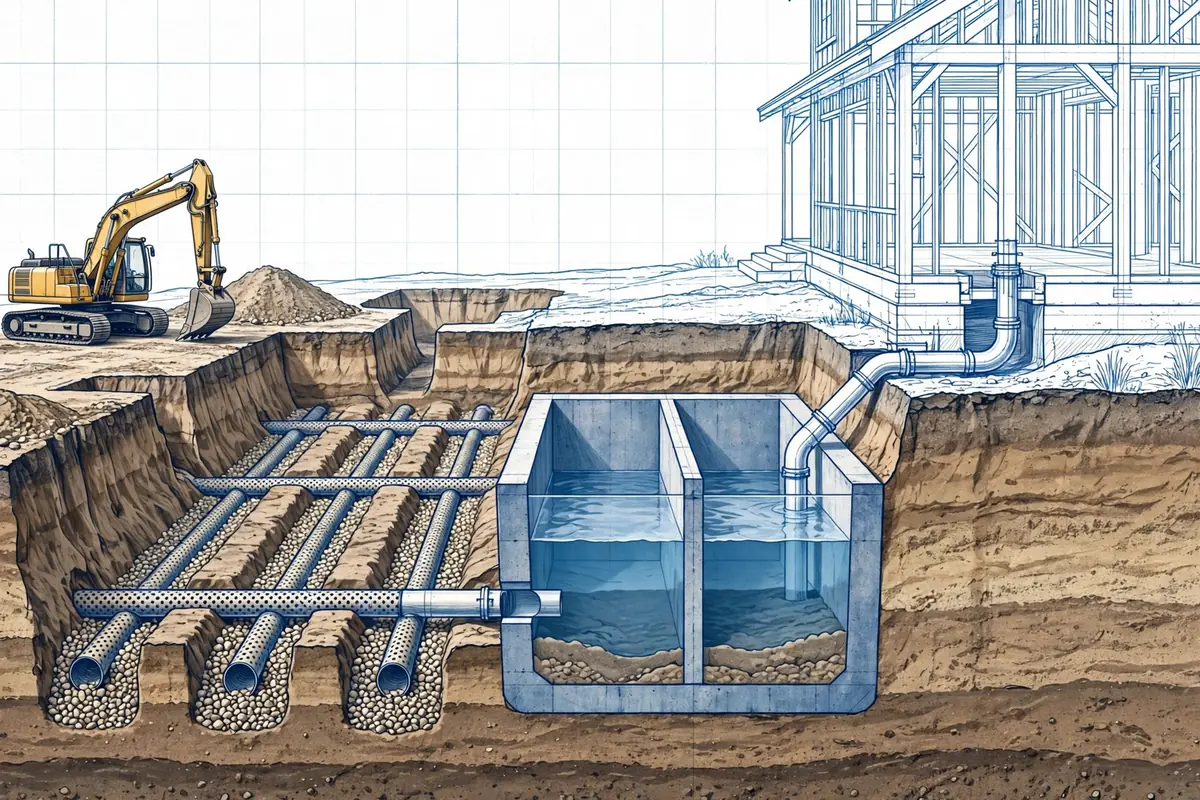
The tank only separates solids. The drain field — the network of perforated pipes in gravel trenches — does the actual treatment, as soil bacteria break down the effluent. Its size comes from a percolation test, and the result often surprises homeowners.
The calculation is simple:
Required absorption area (ft²) = Design flow (gpd) ÷ Soil loading rate (gpd/ft²)
The loading rate depends on how fast water moves through the soil. Fast-draining sand accepts more effluent per square foot; slow clay accepts far less, so the field must be much bigger:
- Sand, perc rate 5 min/inch: about 1.2 gpd/ft²
- Sandy loam, perc rate 15 min/inch: about 0.8 gpd/ft²
- Loam, perc rate 30 min/inch: about 0.6 gpd/ft²
- Clay loam, perc rate 45 min/inch: about 0.45 gpd/ft²
- Heavy clay, perc rate 60 min/inch: about 0.3 gpd/ft²
Take the same three-bedroom house at 450 gpd. On loam at 0.6 gpd/ft², the field needs 450 ÷ 0.6 = 750 ft² of trench bottom area. With 3 ft wide trenches, that is 750 ÷ 3 = 250 linear feet of trench — three trenches of about 85 ft each. On heavy clay at 0.3 gpd/ft² the same house needs 1,500 ft², double the excavation, double the gravel and double the pipe. That single soil result can add $2,000 to $4,000 to the bill, which is why no reputable contractor prices a system before the perc test.
What drives the price up or down
Soil and site conditions
Soil is the biggest cost lever. Sandy, well-drained soil means a small field and a gravity system. Clay, rock, a high water table or a shallow layer of bedrock means a larger field, imported sand, a pump chamber or a fully engineered mound system. A perc test ($300–$1,000) and a site evaluation are the cheapest money in the whole job — they decide which system you actually need.
System type
A gravity system is the cheapest because wastewater flows downhill from tank to field with no moving parts. If the field sits higher than the house, a pump chamber and effluent pump add $1,500–$3,000. Where the soil cannot treat effluent at all, a mound or aerobic unit is required, and the price jumps into five figures.
Tank material
Precast concrete is the workhorse: heavy, durable, and usually the cheapest at $1,200–$2,000 for a 1,000-gallon tank, but it needs a crane truck to set. Polyethylene tanks ($1,000–$1,500) are light enough to carry by hand into tight sites but can float if the water table rises before backfilling. Fibreglass ($1,500–$2,500) sits between the two — light, strong and watertight, but the most expensive.
Access and distance
A long driveway for the excavator, a tank that must be craned over a fence, or a field 200 ft from the house all add labour and pipe. Trenching costs roughly $10–$20 per linear foot, so every extra 50 ft of pipe run adds $500–$1,000. Trees, existing services and retaining walls add more.
Permits and design
Every jurisdiction requires a permit, and most require a design by a licensed designer or engineer. Budget $250–$1,000 for the permit and $500–$2,000 for design, more for engineered systems. Skipping the permit is a false economy — an unpermitted system can block a house sale and, in many areas, draws a fine larger than the permit fee.
Worked example: three-bedroom house, total cost $9,000
Here is a complete, realistic quote for a three-bedroom house on loamy soil with a perc rate of 30 minutes per inch. It is the kind of breakdown you should expect from a contractor — if any of these lines are missing, ask where they went.
Step 1 — Design flow: 3 bedrooms × 150 gpd = 450 gpd.
Step 2 — Tank: 1.5 × 450 = 675 gallons by the retention rule, but the code minimum is 1,000 gallons. Install a 1,000-gallon precast concrete tank.
Step 3 — Drain field: loading rate at 30 min/inch is 0.6 gpd/ft². Required area = 450 ÷ 0.6 = 750 ft². Three trenches, 3 ft wide × 85 ft long, give 3 × 3 × 85 = 765 ft² — just over the requirement, which is what you want.
Step 4 — Cost build-up:
- Perc test and site evaluation: $700
- System design and permit: $900
- 1,000-gallon concrete tank, delivered and set: $1,800
- Excavation and backfill (tank hole plus 255 ft of trench): $2,200
- Drain field materials — pipe, gravel, geotextile fabric: $1,400
- Installation labour: $1,600
- Inspection and final grading: $400
Total: $9,000, or about $20 per gallon of daily design flow. On the same house with heavy clay soil, the field would double to 1,500 ft², adding roughly $2,500 in excavation and materials and pushing the total past $11,500 — the same tank, the same house, a very different bill.
Running costs after installation
A septic system is cheap to run but not free. Budget $300–$600 every three to five years to pump the tank — a family of four with a 1,000-gallon tank should plan on every three years, a couple on every five. An annual inspection ($100–$250) catches a failing baffle or a rising sludge level before it becomes a $5,000 drain field replacement. Aerobic systems add $150–$300 a year in electricity and service contracts.
The expensive mistake is treating the drain field as spare ground. Never drive over it, never pave it, and never plant trees within 20 ft — roots and compaction are the two most common causes of premature field failure, and a replacement field costs as much as the original installation.
Septic vs connecting to the sewer
If a sewer main runs past your property, connection is worth pricing: the connection fee alone can run $5,000–$20,000, plus trenching and a monthly sewer bill forever. A septic system costs more up front than a cheap connection, but for many rural homes the sewer main is half a mile away, and at $50–$100 per foot of main extension the septic system wins by a wide margin. Get both quotes before deciding.
Frequently asked questions
How long does a septic tank installation take?
A conventional system usually takes three to five working days on site once the permit is in hand — a day for excavation, a day to set the tank and lay the field, and a day or two for backfill, inspection and grading. The permit itself can take two to eight weeks, so start the paperwork early.
How long does a septic system last?
A concrete tank can last 40 years or more. The drain field is the limiting factor: 20–30 years with regular pumping and sensible use, far less if it is overloaded, driven over or starved of maintenance.
Can I install a septic tank myself?
You can do the digging in some jurisdictions, but the design, the perc test and the final inspection must be done by licensed professionals almost everywhere, and most codes require a licensed installer. DIY also risks voiding the warranty on the tank and the system approval.
What size septic tank do I need for a four-bedroom house?
A four-bedroom house has a design flow of 600 gpd (4 × 150 gpd) and needs a 1,250-gallon tank under most codes — the 1,000-gallon minimum plus 250 gallons for the fourth bedroom.
Does a bigger tank mean a smaller drain field?
No. The drain field is sized from the daily flow and the soil loading rate, not the tank volume. A bigger tank gives longer retention and more sludge storage, but the field stays the same size.
The short version: budget $5,000–$12,000 for a conventional system, get the perc test done before anyone quotes you a price, and read the quote line by line against the worked example above. The tank is the easy part — it is the soil under your garden that sets the final number.
Calculations and engineering guides are for planning and educational reference. Verify final designs against applicable codes with a licensed Professional Engineer.