Concrete Driveway Cost per Square Foot: Full Worked Example
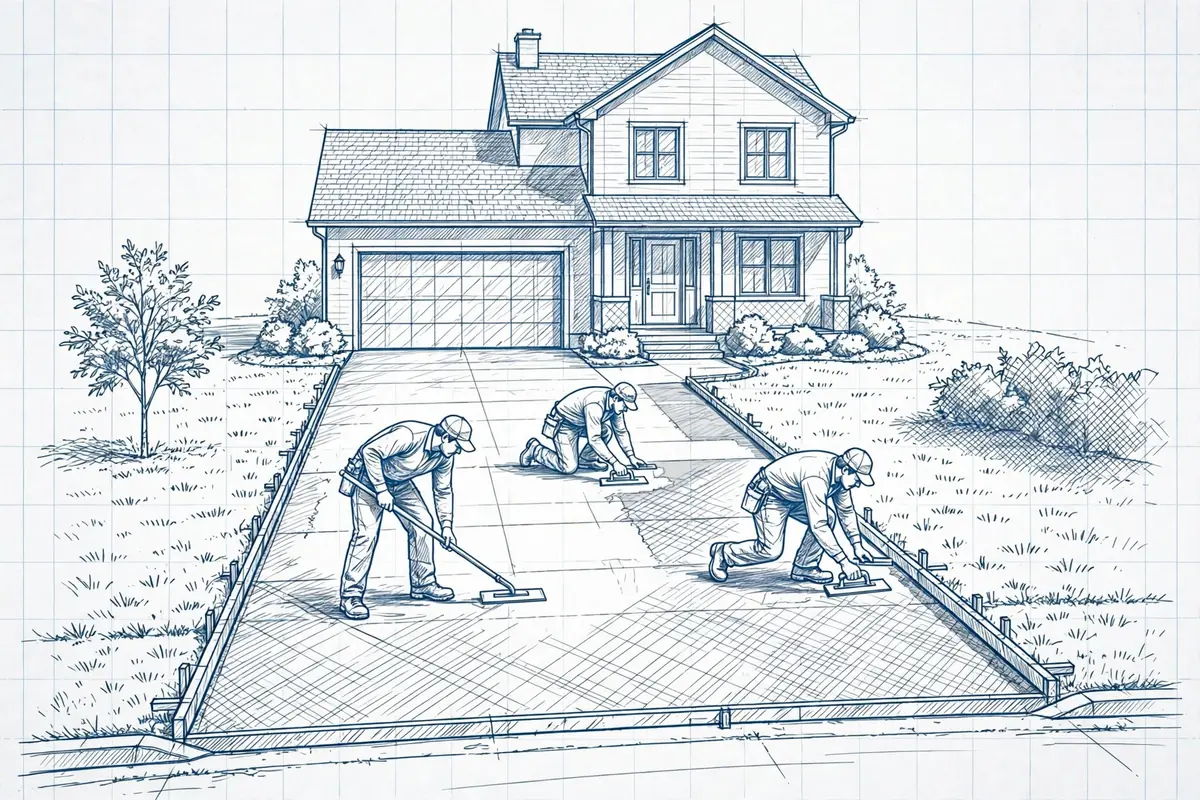
A concrete driveway costs $6–$12 per square foot installed in 2026. Full cost breakdown plus a worked example for a 600 sq ft driveway.
A concrete driveway is one of those jobs where the quote can vary by thousands of dollars between contractors, and the reason is rarely dishonesty — it is that "per square foot" means different things to different people. One contractor quotes material only, another includes excavation and base work, and a third bundles in the finish and the control joints. Until you break the price into its parts, you cannot compare two quotes at all.
This article does that breakdown the way a site engineer would: the cost of the concrete itself, the base and formwork, the steel, and the labour to place and finish it — then a fully worked example for a 600 sq ft driveway so you can see exactly where every dollar goes.
How much does a concrete driveway cost per square foot in 2026?
For a standard 4 in. thick concrete driveway in the United States in 2026, expect to pay $6 to $12 per square foot installed. A typical mid-range figure for a plain broom-finish driveway on a prepared site is $8 per square foot.
That range covers the full job — excavation, base, formwork, reinforcement, concrete, placing and finishing. The concrete itself is only about a quarter of the total. The rest is preparation and labour, which is exactly where cheap quotes cut corners and expensive ones earn their money.
What makes up the price per square foot?
Here is the cost of each part of the job, per square foot of driveway, for a standard 4 in. slab with a broom finish:
- Concrete material: about $1.75–$2.25 per sq ft. At $145 per cubic yard delivered, one cubic yard covers 81 sq ft at 4 in. thick, so $145 ÷ 81 = $1.79 per sq ft.
- Excavation and base: about $1.00–$1.75 per sq ft. This is stripping the topsoil, grading, and placing and compacting 4 in. of crushed stone base. Poor ground that needs deeper excavation costs more.
- Formwork: about $0.60–$1.00 per sq ft. Timber edge forms, stakes and bracing, measured against the driveway area.
- Reinforcement: about $0.70–$1.00 per sq ft. Welded wire mesh or #4 rebar on a 18 in. grid, plus chairs to hold it at mid-depth. ACI 318 requires reinforcement to control cracking, not to carry the load — the base does that — but a driveway without steel cracks sooner.
- Placing and finishing labour: about $2.50–$3.50 per sq ft. Screeding, floating, edging, broom finishing and applying curing compound. This is the biggest single line item after the concrete.
- Control joints and curing: about $0.30–$0.50 per sq ft. Saw-cut or tooled joints every 8–12 ft, plus curing compound or wet curing.
Add the mid-range figures together and you land at roughly $7.50–$8.50 per square foot — which matches the market range above.
How thickness changes the price
Driveways are usually 4 in. thick for cars and light vehicles. If heavy vehicles will use it — a delivery truck, an RV, a loaded skip — go to 5 in. or 6 in. Each extra inch of thickness adds roughly $0.45 per square foot in concrete alone, plus a little extra base and labour:
- 4 in. slab: 1 yd³ covers 81 sq ft — about $8 per sq ft installed
- 5 in. slab: 1 yd³ covers 65 sq ft — about $9 per sq ft installed
- 6 in. slab: 1 yd³ covers 54 sq ft — about $10 per sq ft installed
The rule is simple: divide 27 by the thickness in feet to get the coverage of one cubic yard. At 6 in. (0.5 ft), 27 ÷ 0.5 = 54 sq ft per yard.
Finish options and what they add
A plain broom finish is the standard and is included in the prices above. Decorative finishes cost more, and the premium is charged per square foot on top of the base price:
- Broom finish (standard): included — good grip, low maintenance
- Exposed aggregate: add $2–$4 per sq ft
- Stamped or patterned concrete: add $3–$6 per sq ft
- Integral colour: add $1–$2 per sq ft
- Sealer (recommended every 2–3 years): add $0.50–$1.00 per sq ft
A stamped finish looks impressive on day one, but it needs resealing to stay that way, and a poor stamping job is far harder to fix than a plain broom finish. For most homeowners the broom finish is the sensible default.
Worked example: a 600 sq ft driveway
Take a typical two-car driveway, 20 ft wide and 30 ft long, 4 in. thick with a broom finish. First, the concrete quantity:
Area = 20 ft × 30 ft = 600 sq ft
Volume = 600 sq ft × (4 ÷ 12) ft = 200 ft³ = 200 ÷ 27 = 7.4 yd³
Allow for wastage and uneven subgrade — order 8 yd³. Here is the full build-up at 2026 prices:
- Concrete, 4,000 psi, delivered: 8 yd³ × $145/yd³ = $1,160
- Excavation, grading and 4 in. compacted gravel base: 600 sq ft × $1.25 = $750
- Formwork (edge forms, stakes, bracing): 600 sq ft × $0.80 = $480
- Reinforcement (welded wire mesh, chairs): 600 sq ft × $0.85 = $510
- Placing and finishing labour: 600 sq ft × $2.75 = $1,650
- Control joints and curing compound: 600 sq ft × $0.40 = $240
Total = $1,160 + $750 + $480 + $510 + $1,650 + $240 = $4,790
That works out to $7.98 per square foot ($4,790 ÷ 600 sq ft). The concrete itself is $1.93 per square foot; everything else — base, forms, steel and labour — is $6.05. If a quote comes in at $4 per square foot, ask what has been left out. It is almost always the base preparation or the reinforcement.
Two extras to budget separately if they apply: removing an old driveway adds roughly $1–$2 per square foot for demolition and haulage, and a concrete pump adds $400–$800 if the truck cannot reach the pour.
What pushes the price above $12 per square foot?
- Decorative finishes: stamped or exposed aggregate can take a driveway to $12–$18 per sq ft.
- Difficult access: steep sites, narrow gates or long carries add labour and sometimes a pump.
- Poor ground: soft clay or fill that needs deeper excavation and a thicker base.
- Small jobs: a 200 sq ft apron carries the same mobilisation and minimum-load costs as a bigger pour, so the per-foot price climbs. Short-load fees on the concrete alone can add $60–$120.
- Hot or cold weather: retarders, accelerators and extra curing protection each add cost.
How to keep the cost down
- Keep it simple: a rectangular driveway with a broom finish is the cheapest shape and finish. Curves and decorative work cost more per foot.
- Do not skip the base: a proper compacted gravel base is about $1.25 per sq ft and is what stops the slab cracking. Saving it costs far more in repairs.
- Pour in one go: one truckload beats two small loads, and avoids a second short-load fee.
- Match the thickness to the traffic: 4 in. is enough for cars. Pay for 6 in. only if heavy vehicles will use it.
- Get three itemised quotes: ask each contractor to break out concrete, base, reinforcement and labour separately. The cheapest headline number is rarely the cheapest complete job.
- Allow 28 days before heavy use: concrete reaches its design strength at 28 days per ACI 318. Light foot traffic is fine after 24–48 hours, cars after about 7 days.
Frequently asked questions
How much does a concrete driveway cost per square foot?
Between $6 and $12 per square foot installed in 2026 for a standard 4 in. slab with a broom finish, with $8 per square foot a reasonable planning figure. Decorative finishes run $12–$18 per square foot.
How many cubic yards of concrete do I need for my driveway?
Multiply length × width × thickness in feet, then divide by 27. A 20 ft × 30 ft driveway at 4 in. thick needs 7.4 yd³ — order 8 yd³ to allow for wastage.
Is 4 inches thick enough for a driveway?
Yes, for cars and light vehicles on a properly compacted base. Use 5–6 in. if heavy vehicles, RVs or delivery trucks will regularly use it.
How long does a concrete driveway last?
25–30 years or more with a proper base, control joints, and resealing every 2–3 years. The most common cause of early failure is a poor base, not weak concrete.
Can I pour a driveway in sections to save money?
You can, but each section carries its own mobilisation and minimum-load costs, so the per-foot price goes up. A single pour is usually cheaper overall and gives a more uniform finish.
Calculations and engineering guides are for planning and educational reference. Verify final designs against applicable codes with a licensed Professional Engineer.