Retaining Wall Cost per Linear Foot: Gravity vs Cantilever
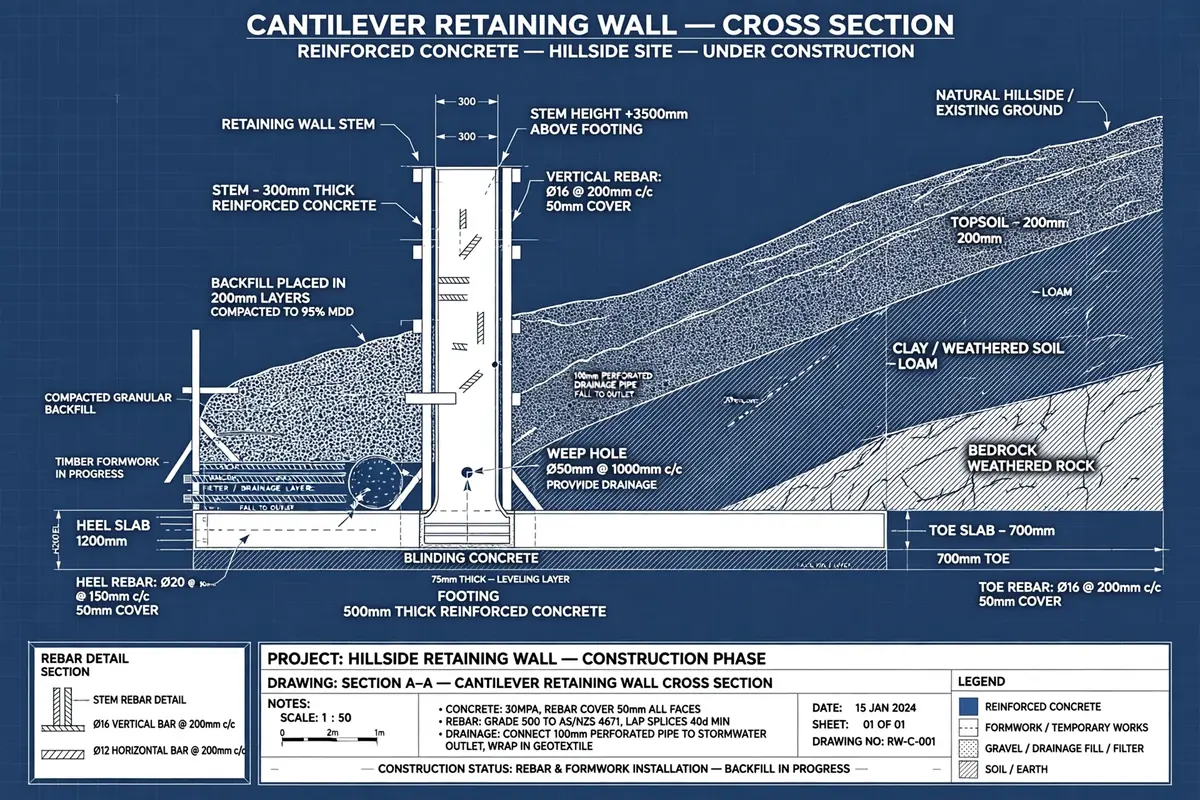
Retaining wall cost per linear foot ranges from $25 for a small gravity wall to $150+ for a tall cantilever wall. See the full breakdown, worked example and FAQ.
If you have ever priced a retaining wall, you will know the first question a client asks is always the same: how much per linear foot? The honest answer is that it depends — mostly on how tall the wall is and which type you build. A short gravity wall and a tall cantilever wall are different structures, and their costs behave very differently as height goes up.
This article breaks down retaining wall cost per linear foot for the two most common types — gravity and cantilever — explains what drives the price, and works through a full numerical example so you can build your own estimate.
Gravity vs cantilever: the two wall types at a glance
A gravity retaining wall holds back soil with its own weight. It is usually mass concrete, stone masonry or segmental block, with a wide base and no steel reinforcement doing the structural work. It is simple to build, needs no formwork for the reinforcement cage, and works well up to about 4 ft (1.2 m) of retained height.
A cantilever retaining wall is a reinforced concrete L- or T-shape: a vertical stem tied to a horizontal base slab. The weight of the soil sitting on the heel of the base slab is what keeps the wall standing, so the wall itself can be much thinner. Cantilever walls are the standard choice from about 4 ft up to 20 ft (6 m) and beyond, and they are designed to ACI 318.
The key cost difference is how material grows with height. A gravity wall's concrete volume grows roughly with the square of its height — double the height and you need about four times the concrete. A cantilever wall's volume grows more slowly, which is why it wins on cost once the wall gets tall.
Retaining wall cost per linear foot by type and height
The figures below are installed costs in US dollars per linear foot, covering materials, labour, excavation and drainage for a straightforward site with good access. Prices vary a lot by region, soil and finish, so treat them as a budgeting range, not a quote.
- Gravity wall (mass concrete or block), 3 ft high: $25–$45 per linear foot
- Gravity wall, 4 ft high: $60–$90 per linear foot
- Cantilever wall, 4 ft high: $90–$140 per linear foot
- Cantilever wall, 6 ft high: $130–$210 per linear foot
- Cantilever wall, 8 ft high: $180–$280 per linear foot
- Cantilever wall, 10 ft high and above: $250–$400+ per linear foot
Notice the crossover. At 3–4 ft a gravity wall is the cheaper option. By 6 ft the cantilever wall is usually cheaper, and by 8 ft there is no contest — a gravity wall that tall would need a base so wide it eats the site and the concrete budget.
Segmental block walls (dry-stacked interlocking blocks with geogrid) sit in the middle: roughly $40–$85 per linear foot for a 4 ft wall, and they are a popular choice for garden and landscape walls where a poured concrete finish is not needed.
What drives the cost per linear foot
Height matters more than length
Length is simple — cost scales linearly with length. Height is not. Earth pressure on a wall grows with the square of the retained height, so the stem gets thicker, the base gets wider, the steel gets heavier and the excavation gets deeper. A 6 ft wall costs far more than twice a 3 ft wall. If a client asks you to raise a wall by a foot, check the price again — it will not be a small change.
Soil type and surcharge
Soft clay, loose fill or a high water table all push the design — and the price — up. A wall carrying a driveway, a building or a road surcharge above it needs a heavier section than a garden wall holding back a lawn. Poor bearing soil may also need the footing widened or the ground improved before you start.
Drainage
Every retaining wall needs drainage: a perforated pipe at the base, gravel backfill and weep holes or outlets. Water trapped behind a wall adds hydrostatic pressure the wall was never designed for, and it is the most common cause of retaining wall failure. Budget roughly $5–$10 per linear foot for drainage and never leave it out to save money.
Excavation, access and permits
A tight site with no room for a machine, a steep slope, or rock in the excavation can add 20–50% to the job. Most US jurisdictions also require a building permit for walls over 4 ft, and an engineered design above that height — allow $200–$1,000 for the permit and a separate fee for the engineer's drawings.
Worked example: 50 ft cantilever wall, 5 ft high
Let us price a reinforced concrete cantilever wall, 50 linear ft long, retaining 5 ft of soil, on a flat site with good access. The wall is designed to ACI 318 with 4,000 psi concrete and Grade 60 reinforcement.
Step 1 — Concrete volume. The stem is 5 ft tall with an average thickness of 9 in (0.75 ft): 5 × 0.75 = 3.75 ft³ per linear foot. The base slab is 6 ft wide and 1 ft thick: 6 × 1 = 6 ft³ per linear foot. Total 9.75 ft³ per linear foot, or 0.361 yd³ per linear foot. For 50 ft that is 18.1 yd³; add 10% wastage and order 20 yd³.
Step 2 — Concrete cost. 20 yd³ × $170 per yd³ delivered and placed = $3,400.
Step 3 — Reinforcement. Allow 55 lb of steel per yd³ of concrete: 55 × 20 = 1,100 lb. At $1.10 per lb supplied, cut, bent and fixed, that is $1,210. ACI 318 minimum reinforcement and 3 in. cover against earth govern the bar sizes and spacing — get these from the design, not from a rule of thumb.
Step 4 — Formwork. The stem needs formwork on both faces: 5 ft × 2 faces × 50 ft = 500 ft². At $3.50 per ft², that is $1,750.
Step 5 — Excavation. A trench roughly 6 ft wide and 2 ft deep gives 12 ft³ per linear foot, or about 22 yd³ total. At $30 per yd³, that is $660.
Step 6 — Drainage, backfill and labour. Perforated drain pipe and gravel at $7 per linear foot = $350. Backfill and compaction = $600. Crew labour for forming, steel fixing and pouring = $2,500.
Total: $3,400 + $1,210 + $1,750 + $660 + $350 + $600 + $2,500 = $10,470, or about $209 per linear foot.
That sits at the top of the 6 ft range because the example includes full formwork, drainage and a realistic labour allowance. On an easy site with a reusable formwork system the same wall can come in nearer $150 per linear foot. The method is what matters: break the wall into concrete, steel, formwork, excavation, drainage and labour, and price each line separately.
Quick check: the same height as a gravity wall
For comparison, a 4 ft mass concrete gravity wall with a 2 ft base (half the height, the usual rule of thumb) and a 1 ft top width has a cross-sectional area of (1 + 2) ÷ 2 × 4 = 6 ft², or 6 ft³ per linear foot — 0.22 yd³ per linear foot. At $170 per yd³ that is $38 of concrete, plus roughly $10 for excavation, $7 for drainage and $30 for labour: about $85 per linear foot.
Now raise that gravity wall to 8 ft. The base grows to 4 ft and the section becomes (1 + 4) ÷ 2 × 8 = 20 ft² — more than three times the concrete for twice the height. That is the square-of-height effect in action, and it is exactly why tall walls are almost always cantilever.
How to estimate a retaining wall job in five steps
- Measure the length and the maximum retained height — price by the tallest section, not the average, because the tall end drives the design.
- Pick the wall type by height: gravity or segmental block up to 4 ft, cantilever above 4 ft.
- Price each component separately — concrete, steel, formwork, excavation, drainage, backfill and labour — instead of guessing a single per-foot rate.
- Add permits and engineering where the wall is over 4 ft, and a 10% contingency for ground conditions you cannot see yet.
- Sanity-check the result against the ranges in this article. If your number is far outside them, find out why before you submit it.
Frequently asked questions
How much does a retaining wall cost per linear foot?
For a straightforward site, budget $25–$90 per linear foot for a gravity or segmental block wall up to 4 ft high, and $90–$280 per linear foot for a reinforced concrete cantilever wall from 4 ft to 8 ft high. Taller walls, poor soil, surcharges and difficult access push the price higher.
Is a gravity wall or a cantilever wall cheaper?
Below about 4 ft, a gravity wall is cheaper because it uses no reinforcement and little formwork. Above 4 ft, a cantilever wall is cheaper because its concrete volume grows much more slowly with height. The crossover is usually around 4–5 ft of retained height.
Do I need a permit for a retaining wall?
In most US jurisdictions, walls over 4 ft need a building permit and an engineered design. Check with your local building department before you start — a wall built without a permit can be ordered removed.
What is the cheapest retaining wall per linear foot?
A short timber or segmental block gravity wall is usually the cheapest option, from around $25 per linear foot for a low garden wall. Timber is the cheapest material but has the shortest life, typically 10–20 years, while concrete and block last 50 years or more.
Does drainage really add to the cost?
Drainage adds roughly $5–$10 per linear foot, which is a small fraction of the total. Skipping it is the most expensive mistake you can make with a retaining wall — trapped water is the leading cause of wall failure.
A retaining wall is one of those jobs where the per-linear-foot price only makes sense once you know the height and the type. Price it by components, respect the height-squared rule, and never skip the drainage. Do that, and your estimate will hold up when the real quotes come in.
Calculations and engineering guides are for planning and educational reference. Verify final designs against applicable codes with a licensed Professional Engineer.