Concrete Sidewalk Cost per Square Foot: Full Breakdown
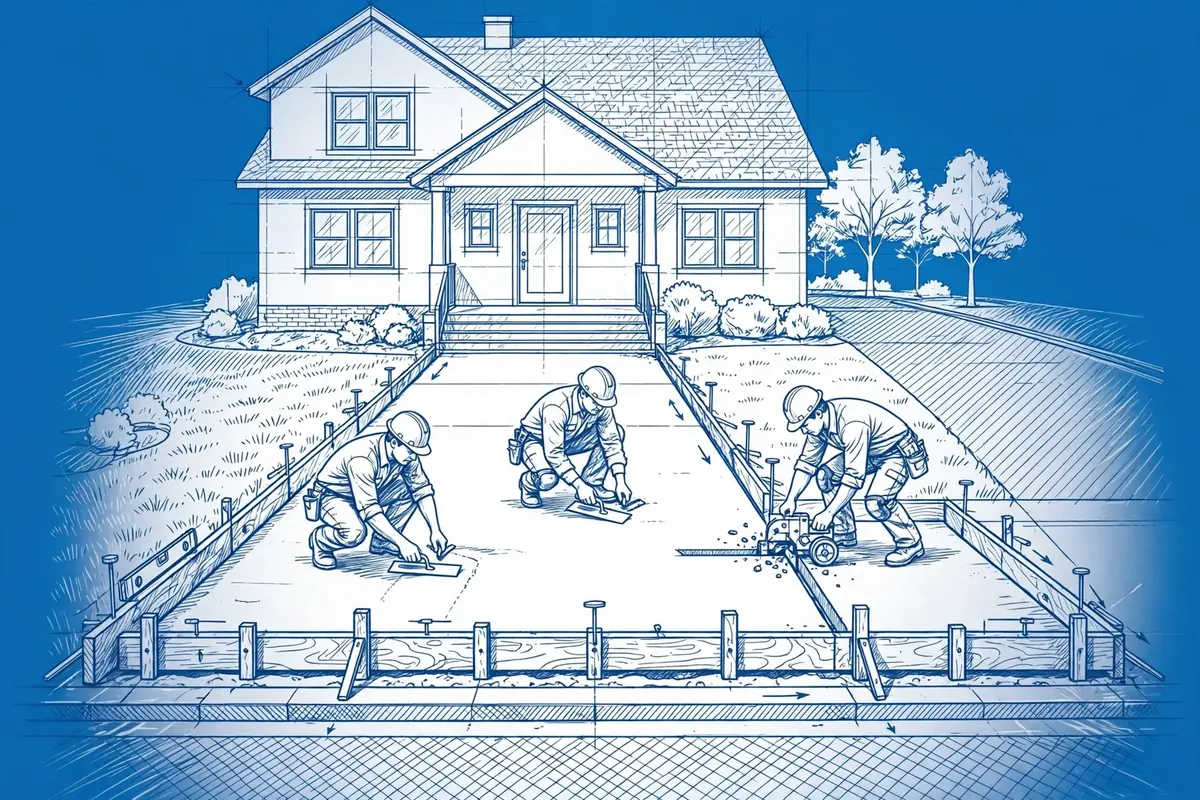
A new concrete sidewalk costs $8–$15 per sq ft installed. We break down concrete, base, labour and finish costs with a full worked example.
If you have ever priced a sidewalk, you will know the quotes rarely agree. One contractor says $8 a square foot, another says $15, and a third will not give you a per-foot number at all. All three can be right, because a sidewalk is not one line item — it is concrete, base, formwork, labour, demolition and permits stacked together, and each of those moves with your site. In this guide we break the price down piece by piece, then price a real 300 sq ft sidewalk from start to finish so you can check any quote against it.
How much does a concrete sidewalk cost per square foot?
For a standard 4-inch residential sidewalk on prepared ground, expect $8 to $15 per square foot installed in most US markets in 2026. A straightforward new build on flat, accessible ground lands at the low end, around $8 to $10. A replacement job — tearing out an old cracked walk, hauling it away and pouring fresh — lands at the high end, around $11 to $15. Premium finishes such as stamped or coloured concrete push the figure higher still, to $15 to $20 per square foot.
Those figures assume a normal 4-inch slab. Where a sidewalk crosses a driveway and carries vehicle traffic, it should be thickened to 6 inches, and that adds roughly $1 to $1.50 per square foot to the concrete alone. Prices also vary by region: concrete is noticeably dearer in the Northeast and on the West Coast than in the Midwest and South, and remote sites pay more for delivery.
Cost breakdown: what you are actually paying for
Here is how the installed price splits up, per square foot, for a 4-inch sidewalk:
- Concrete material: $1.75–$2.50 per sq ft. One cubic yard of concrete covers about 81 sq ft at 4 inches thick, so at $150–$200 per cubic yard the material works out to roughly $2 per square foot.
- Base gravel: $0.50–$0.75 per sq ft. A 4-inch layer of compacted crushed stone or gravel under the slab.
- Forms, mesh and joints: $0.50–$1.00 per sq ft. Timber formwork, welded wire mesh or rebar, expansion joint filler and curing compound.
- Labour (place and finish): $3.00–$5.00 per sq ft. Setting forms, pouring, screeding, floating, broom-finishing and cutting control joints. This is the biggest single line.
- Demolition and haul-off: $3.00–$5.00 per sq ft, only if an old sidewalk is being replaced.
- Permits: typically $75–$150 for the job, or about $0.25–$0.50 per sq ft on a standard walk. Many towns require a permit for sidewalk work, especially where it meets the street.
Notice that labour is roughly half the total. That is why the cheapest quote is not always the best deal — a crew that rushes the finish or skips the base will cost you far more in repairs than the few dollars a square foot you saved.
Worked example: pricing a 5 ft × 60 ft sidewalk
Let us price a typical job: a 5-foot-wide walk running 60 feet from the driveway to the front door. That is 300 sq ft, 4 inches thick, on a flat site with easy truck access and no old concrete to remove.
Step 1 — concrete volume
Volume = length × width × thickness = 60 ft × 5 ft × (4/12) ft = 100 ft³. Converting to cubic yards: 100 ÷ 27 = 3.70 yd³. Add about 8% for waste, spillage and uneven subgrade, and you order 4.0 yd³. At $165 per cubic yard, concrete costs $660, or $2.20 per square foot.
One warning: ready-mix suppliers charge a short-load fee — often $50 to $100 — for orders under about 3 cubic yards. Our 4-yard order avoids it, but a small 100 sq ft repair would not, so short jobs carry a higher cost per square foot.
Step 2 — base gravel
A 4-inch compacted gravel base over the same area is also 100 ft³, or 3.70 yd³. At $42 per cubic yard delivered, that is $155, or $0.52 per square foot.
Step 3 — forms, mesh and consumables
Timber formwork for 130 linear feet of edge, welded wire mesh, expansion joint filler where the walk meets the driveway and steps, and curing compound: allow $190, or $0.63 per square foot.
Step 4 — labour
At $4.50 per square foot for a two-man crew — set forms, place and screed the concrete, float and broom-finish, cut control joints and strip the forms — labour is $1,350.
Step 5 — permit
Allow $120 for the municipal permit.
Total
Add it up: $660 + $155 + $190 + $1,350 + $120 = $2,475. Divide by 300 sq ft and the installed cost is $8.25 per square foot. If this were a replacement job, demolition and haul-off at $3.50 per square foot would add $1,050, taking the total to $3,525, or $11.75 per square foot. Both figures sit comfortably inside the $8–$15 range, which is how you know the range is honest.
What pushes the price up (or down)
Thickness. A 6-inch slab where vehicles cross uses 50% more concrete. One cubic yard covers only 54 sq ft at 6 inches, so the concrete alone rises from about $2.00 to about $3.05 per square foot.
Access. If the ready-mix truck cannot reach the pour and the crew has to wheelbarrow concrete 100 feet, expect a surcharge — or a pump truck at $500 to $800 a day.
Finish. A plain broom finish is included in the standard price. Exposed aggregate adds $1–$2 per square foot, integral colour $1–$2, and stamped concrete $2–$4, because the crew needs more time and more material.
Ground conditions. Soft or wet subgrade needs extra excavation and a thicker base. Tree roots, buried services and steep slopes all add labour.
Job size. The fixed costs — truck delivery, formwork, mobilising the crew — are spread over fewer square feet on a small job. A 100 sq ft walk can easily cost $15–$18 per square foot, while a 1,000 sq ft run can come in under $8.
Getting the slab itself right
Price means nothing if the walk cracks in its first winter, so a few technical points are worth checking in any quote. Exterior flatwork in freeze-thaw climates should use air-entrained concrete with a compressive strength of about 4,000 psi, as set out in ACI 318 Table 19.3.2.1 for exposure classes F1 to F3. A slump of around 4 inches gives a workable mix without excess water, which is the usual cause of a weak, dusty surface.
Control joints should be cut at a spacing of 24 to 30 times the slab thickness in inches — so every 8 to 10 feet for a 4-inch slab — and to a depth of one quarter of the thickness, about 1 inch. The surface should fall away from the house at about 1/4 inch per foot (2%) so water drains off instead of ponding. Cure the slab for at least 7 days, keeping it damp or covered, per ACI 308; do not let anyone walk on it for 24 hours or drive on it for 7 days.
How to check a contractor's quote
When a quote arrives, ask for it broken down into concrete, base, labour, demolition and permits, then compare each line against the ranges above. A quote that is far below $8 per square foot usually means the base has been skipped, the concrete is a weaker mix, or the thickness is less than specified — all of which you will pay for later. And always confirm the thickness, strength and finish in writing before the pour; a 4-inch slab and a 6-inch slab look identical from above on the day, but they do not perform the same.
Frequently asked questions
How much does a 100 sq ft concrete sidewalk cost?
Expect $1,200 to $1,800, or $12–$18 per square foot. Small jobs carry a higher rate because delivery, formwork and crew mobilisation are fixed costs spread over a small area, and a short-load fee often applies to the concrete.
Is a 4-inch sidewalk thick enough?
Yes for foot traffic, which is what most residential sidewalks carry. Go to 6 inches where vehicles cross, such as the section over a driveway, and reinforce with mesh or rebar there.
How long does a concrete sidewalk last?
A properly built sidewalk — good base, 4,000 psi air-entrained concrete, control joints every 8 to 10 feet and proper curing — should last 25 to 30 years. Poor drainage and de-icing salts are the two things that shorten its life most.
Can I pour a sidewalk myself to save money?
Yes, and you can save roughly $3–$5 per square foot on labour. But concrete waits for no one: a 300 sq ft pour is about 4 cubic yards, and once it is in the forms you have an hour or two to screed, float and finish it. For anything bigger than a short path, hire a crew — or at least two experienced helpers.
Calculations and engineering guides are for planning and educational reference. Verify final designs against applicable codes with a licensed Professional Engineer.