Plastering Cost per Square Foot: Interior vs Exterior Guide
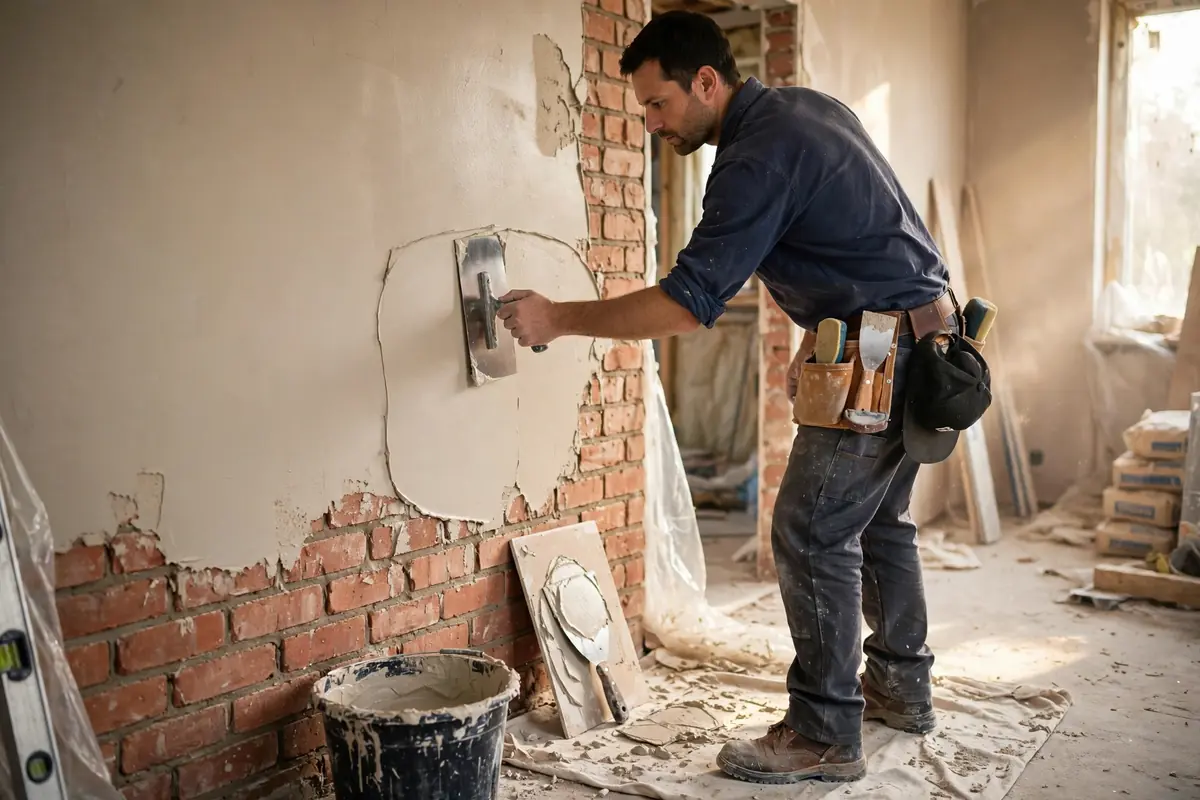
Plastering costs – per square foot installed. Compare interior vs exterior rates, material and labour splits, and two full worked examples.
Ask three plasterers for a price and you will get three different numbers — and all three can be honest. Plastering is one of those trades where the headline rate per square foot hides a lot: how thick the coat is, how many coats, what state the wall is in, and whether the work is inside or outside. Once you understand what sits behind the rate, you can read any quote in about thirty seconds and know whether it is fair.
This guide gives you the going rates for interior and exterior plastering in the United States, breaks each one into material and labour, and then works through two full examples — a bedroom inside and a house wall outside — so you can price your own job the same way a site engineer would.
Plastering cost per square foot at a glance
For a straightforward job on sound walls, carried out by a professional crew, expect these installed rates (material plus labour):
- Interior plastering: $2.00–$5.00 per sq ft (typical $3.50, or about $37.70/m²)
- Exterior plastering (stucco): $4.00–$7.00 per sq ft (typical $6.00, or about $64.60/m²)
- Skim coat over existing plaster: $1.50–$3.00 per sq ft
- Patch and repair work: $3.00–$6.00 per sq ft, often with a $150–$300 minimum call-out
The exterior rate runs roughly 70% higher than the interior rate. That is not a markup — it is a different job. Exterior work is a three-coat system over lath or masonry, it is weather-dependent, it needs scaffolding or staging, and the finish has to survive rain, sun and freeze-thaw cycles. Interior work is usually one or two coats on a dry, sheltered wall.
What drives the price
Before you compare quotes, check that they are pricing the same thing. Five factors move the rate more than anything else:
- Number of coats. A single skim coat is cheap; a full three-coat stucco system (scratch, brown and finish coats, per ASTM C926) is three passes with curing time between each.
- Thickness. Interior gypsum plaster is typically finished at 10–12 mm (about ½ in.). Exterior cement plaster runs 15–20 mm (⅝–¾ in.) in total. Every extra millimetre is more material and more trowel time.
- Condition of the wall. Sound brick or block takes plaster well. A wall that needs old plaster hacked off, cracks stitched, or a bonding agent applied can add $1–$2 per sq ft before any plaster goes on.
- Access. Ground-floor work is cheap. Second-storey exterior work needs scaffolding, and scaffolding hire alone can add $1–$2 per sq ft to a small job.
- Finish. A smooth trowelled finish is standard. A textured, dashed or patterned finish takes longer and costs more, and any decorative cornice or moulding is priced separately by the linear foot.
Interior plastering cost breakdown
Inside the house, the work is usually gypsum plaster over plasterboard or a cement-sand plaster over masonry. The split between material and labour looks like this:
- Materials: $0.50–$0.90 per sq ft — plaster, water, bonding agent, corner beads and mesh tape.
- Labour: $1.50–$4.00 per sq ft — mixing, application, ruling flat, trowelling and clean-up.
- Typical total: $3.50 per sq ft installed.
Labour is the dominant cost — roughly 80% of the total — which is why a skilled plasterer who works fast and leaves a flat finish is worth paying for. A bad plastering job is not cheap to fix: the only remedy is usually to hack it off and start again.
One thing worth knowing: gypsum plaster goes on in one or two coats and is ready for paint in a few days. Cement-sand plaster inside needs a full 7-day cure before painting, per IS 1661 practice, and it shrinks more as it dries, so hairline cracks are more common. If the quote does not say which material it is, ask.
Exterior plastering (stucco) cost breakdown
Outside, the standard is a three-coat Portland cement stucco system over metal lath or directly onto masonry, applied to ASTM C926. The coats have separate jobs: the scratch coat keys into the lath, the brown coat builds the thickness and is ruled flat, and the finish coat gives the colour and texture.
- Materials: $1.25–$2.00 per sq ft — cement, sand, lime, lath, accessories, and finish coat.
- Labour: $3.00–$5.00 per sq ft — three separate applications, each with its own curing interval.
- Typical total: $6.00 per sq ft installed.
The curing intervals are the hidden cost driver. The scratch coat needs 48 hours before the brown coat, and the brown coat needs 7 days before the finish coat. A crew cannot finish an exterior wall in one visit, so you are paying for three mobilisations. A contractor who promises a three-coat job in two days is either skipping a coat or ignoring the cure — either way, expect cracking within a year.
Worked example 1: plastering a bedroom (interior)
Take a bedroom 12 ft × 10 ft with 8 ft ceilings, one door and one window. Work out the area first, then the money.
Step 1 — wall area. Perimeter = 2 × (12 + 10) = 44 ft. Gross wall area = 44 × 8 = 352 sq ft.
Step 2 — deduct openings. Door = 3 × 7 = 21 sq ft. Window = 5 × 3 = 15 sq ft. Total deduction = 36 sq ft. Net wall area = 352 − 36 = 316 sq ft.
Step 3 — add the ceiling. Ceiling = 12 × 10 = 120 sq ft. Total plastering area = 316 + 120 = 436 sq ft, say 440 sq ft to allow for reveals and waste.
Step 4 — apply the rate. At the typical $3.50 per sq ft: 440 × $3.50 = $1,540.
Step 5 — split material and labour. Materials at $0.60 per sq ft: 440 × $0.60 = $264. Labour at $2.90 per sq ft: 440 × $2.90 = $1,276. Check: $264 + $1,276 = $1,540. It ties.
Step 6 — allow contingency. Add 10% for patching, extra corner beads and thickness variations: $1,540 × 1.10 = $1,694. That is your budget figure for the room — about $155 per square foot of floor area, which is a useful cross-check on any quote.
Worked example 2: stucco on a house wall (exterior)
Now the outside. Suppose a single-storey house has 1,500 sq ft of external wall to stucco, measured net of window and door openings.
Step 1 — apply the rate. At the typical $6.00 per sq ft: 1,500 × $6.00 = $9,000.
Step 2 — split material and labour. Materials at $1.75 per sq ft: 1,500 × $1.75 = $2,625. Labour at $4.25 per sq ft: 1,500 × $4.25 = $6,375. Check: $2,625 + $6,375 = $9,000.
Step 3 — add access. If the upper half of the wall needs scaffolding, allow roughly $1.50 per sq ft over half the area: 750 × $1.50 = $1,125. Budget total: $9,000 + $1,125 = $10,125.
Step 4 — check the material quantity. A common cross-check is the cement plaster quantity for a 1,000 sq ft patch of wall at 12 mm thick in a 1:4 cement-sand mix. Area = 1,000 sq ft = 92.9 m². Wet mortar volume = 92.9 × 0.012 = 1.115 m³. Dry volume, allowing for voids, = 1.33 × 1.115 = 1.48 m³. Cement = 1.48 ÷ 5 = 0.297 m³ × 1,440 kg/m³ = 427 kg, or 9 bags of 50 kg. Sand = 1.48 × 4 ÷ 5 = 1.19 m³, about 42 ft³. If your supplier's delivery is far from these numbers, something is off in the mix or the measurement.
How to estimate your own job
The method is the same every time:
- Measure the area. Perimeter × height for walls, length × width for ceilings. Deduct doors and windows over 10 sq ft, and add back a small allowance for reveals.
- Pick the right rate. Use $3.50 per sq ft for interior work and $6.00 per sq ft for exterior stucco as your planning figures, then adjust up for poor wall condition, high access, or a premium finish.
- Add contingency. 10% for interior work on sound walls, 15% for exterior work or any job involving repairs.
- Get the quote in writing, split. Ask for material and labour shown separately, the number of coats, the mix ratio, and the curing periods. A quote that shows its working is almost always the honest one.
Ways to keep the cost down
- Prepare the wall yourself. Hacking off loose plaster, cleaning the surface and removing fixtures is unskilled work — doing it yourself can save $0.50–$1.00 per sq ft.
- Bundle the work. A plasterer already on site for one room charges far less per square foot for the second room than for a separate visit.
- Choose a standard finish. A smooth trowelled finish is the cheapest; textured and patterned finishes add labour on every square foot.
- Time it right. Exterior stucco needs dry weather above 40°F (4°C) — work done in the wrong season either costs more in protection or fails early.
- Do not skip the cure. Rushing the coats is the classic false economy: the rework costs more than the week you saved.
Frequently asked questions
How much does it cost to plaster a 12 × 12 room?
A 12 ft × 12 ft room with 8 ft ceilings has about 384 sq ft of wall plus 144 sq ft of ceiling, or roughly 490 sq ft after deducting the door and window. At the typical interior rate of $3.50 per sq ft, expect $1,700–$1,900 including contingency.
Is plastering cheaper than drywall?
Usually not. Drywall installation runs about $1.50–$3.00 per sq ft, which undercuts plaster. Plaster wins on durability, sound insulation and fire resistance, and on solid masonry walls it is often the only sensible option. Where a plasterboard wall already exists, a skim coat at $1.50–$3.00 per sq ft is the cheapest way to a plaster finish.
Why is exterior plastering so much more expensive?
Three reasons: three coats instead of one or two, weatherproof materials including metal lath and a cement-rich mix, and scaffolding. The three curing intervals also mean three separate site visits, which is why exterior labour runs about 45% higher per square foot than interior labour.
How long does plaster take to dry before painting?
Gypsum plaster is usually paint-ready in 3–5 days. Cement plaster needs at least 7 days of curing, and painting before it is fully dry traps moisture and causes peeling. In both cases, wait until the plaster is uniformly pale with no dark damp patches before applying primer.
Can I plaster over old plaster?
Yes, if the old plaster is sound and well bonded — a skim coat of 2–3 mm is the standard approach and costs $1.50–$3.00 per sq ft. If the old plaster sounds hollow when tapped, it has debonded and must be hacked off first, which adds $1–$2 per sq ft to the job.
Calculations and engineering guides are for planning and educational reference. Verify final designs against applicable codes with a licensed Professional Engineer.