How Much Does a Concrete Patio Cost? Full Breakdown
A concrete patio costs –5 per sq ft installed in 2026. See the slab, base and finish breakdown with a full worked example for a 12 × 16 ft patio.
If you are pricing up a backyard patio, the quote you get from a contractor can feel like a black box. One company says $8 a square foot, another says $18, and both claim to be giving you a fair price. The difference is almost never the concrete itself. It is the thickness of the slab, the quality of the base underneath it, the finish on top, and how much of the job is labour. Once you can break those pieces apart, you can read any quote and spot the one that is cutting corners.
This guide walks through a concrete patio the way an estimator would: square foot by square foot, layer by layer. All prices are typical US 2026 installed prices, and every number below is worked out on a real example — a 12 ft × 16 ft patio, 192 sq ft — so you can scale the maths to your own yard.
What a Concrete Patio Costs in 2026
For a plain broom-finished patio, expect $6 to $12 per square foot installed. A 192 sq ft patio therefore lands somewhere between $1,150 and $2,300. Add colour, stamping or an exposed-aggregate finish and the range moves to $12 to $25 per square foot, or $2,300 to $4,800 for the same patio. A small patio under 100 sq ft usually costs more per square foot, because the contractor still has to bring a truck, a crew and the same set-up time; a large patio over 500 sq ft usually costs less per square foot, because the fixed costs are spread further.
Three things drive the price more than anything else. The first is the slab thickness — 4 inches is standard for a patio that only carries foot traffic and furniture, and going to 5 or 6 inches adds roughly $1 to $2 per square foot. The second is the base: a properly compacted 4-inch gravel base is not optional, and skipping it is the single most common reason a patio cracks in its first winter. The third is the finish. A broom finish is cheap and grippy; stamping, staining and sealing are where the price climbs, and where the patio starts to look like stone or tile.
The Four Cost Layers, Explained
Every patio quote is built from the same four layers. Understanding them is the fastest way to compare two contractors fairly.
1. Site preparation and excavation
Before any concrete arrives, the ground has to be stripped of topsoil and grass, dug down to the right level, and graded so water runs away from the house. For a patio on flat, easy ground this runs about $1 to $3 per square foot. It climbs when the crew has to remove an old patio, haul spoil away, or work around tree roots, buried pipes or a tight access gate that a wheelbarrow cannot fit through. If the site slopes steeply, expect a retaining edge or a small step, which is priced separately.
2. The gravel base and compaction
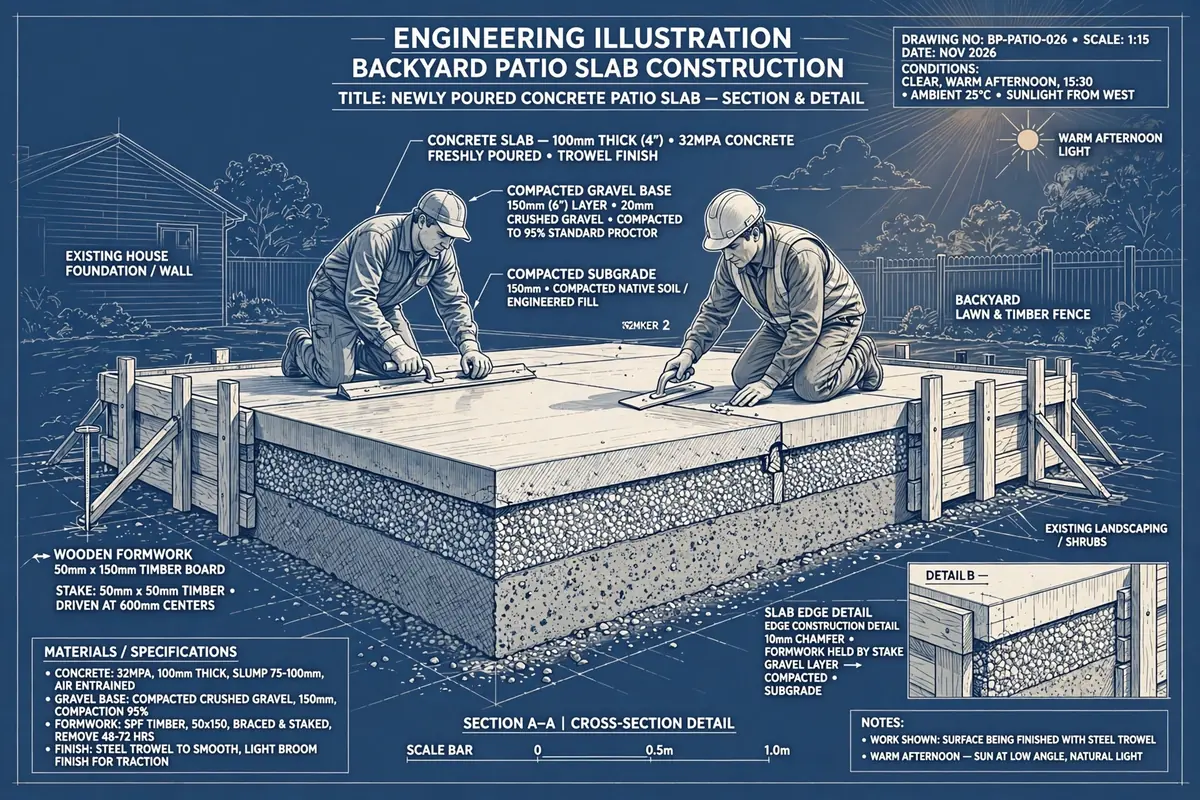
Concrete is strong in compression and weak in tension, so it needs a firm, uniform bed to sit on. ACI 318 and good site practice both point the same way: a minimum 4-inch layer of compacted crushed stone or gravel, laid on undisturbed or properly compacted soil. The material itself is cheap — $30 to $50 per cubic yard delivered — but the labour of spreading and compacting it in layers adds up to roughly $1 to $2 per square foot. A contractor who proposes pouring straight onto topsoil, or onto a thin scatter of sand, is saving a few hundred dollars and handing you a cracked patio within a year or two.
3. The concrete slab itself
The concrete is the biggest material cost. Ready-mix concrete in the US currently runs about $140 to $180 per cubic yard delivered, depending on region, strength and delivery distance. A residential patio is normally specified at 3,000 to 4,000 psi (around 20 to 28 MPa) with a 4-inch slump, and air-entrained mix is worth specifying in freeze-thaw climates — it costs a little more and protects the surface from scaling. Add reinforcement: welded wire mesh or, better, #3 or #4 rebar on a grid, plus a plastic vapour barrier if the patio doubles as an outdoor living floor. The slab layer, material and placing labour together, typically accounts for $3 to $5 per square foot of the total.
4. Finishing, edging and sealing
The finish is what you actually see and walk on. A broom finish — the crew drags a stiff broom across the fresh surface — is included in most base prices and gives good slip resistance. A smooth trowel finish is cheaper to do but slippery when wet, so it is rarely the right choice outdoors. Stamped concrete, where patterns and colour are pressed into the surface, adds $4 to $8 per square foot. Exposed aggregate adds $2 to $4. A penetrating sealer, applied once the concrete has cured, costs $0.50 to $1 per square foot and is money well spent: it keeps water, stains and freeze-thaw damage out of the surface, and it should be reapplied every two to three years.
Worked Example: A 12 ft × 16 ft Patio
Here is the full calculation for a standard patio — 12 ft wide, 16 ft long, 4-inch slab, 4-inch gravel base, broom finish, no stamping. Work through it once and you can price any size of patio yourself.
Step 1 — Area. 12 ft × 16 ft = 192 sq ft.
Step 2 — Concrete volume. A 4-inch slab is 4/12 = 0.333 ft thick. Volume = 192 × 0.333 = 64 cu ft. There are 27 cu ft in a cubic yard, so 64 / 27 = 2.37 cu yd. Add 10% for wastage, spillage and uneven subgrade: 2.37 × 1.10 = 2.61 cu yd. Order 2.75 cu yd — ready-mix is sold in quarter-yard increments, and running short mid-pour is far worse than having a wheelbarrow left over.
Step 3 — Concrete cost. At $160 per cubic yard delivered, 2.75 × $160 = $440. Most suppliers charge a short-load fee of $50 to $100 on orders under about 3 cu yd, so allow $60 for that: $500 in total for the concrete on the truck.
Step 4 — Gravel base. The base is the same 192 sq ft, 4 inches thick, so it is the same 2.37 cu yd before wastage. Allow 2.75 cu yd at $40 per cubic yard = $110.
Step 5 — Reinforcement and sundries. A roll of welded wire mesh covers about 150 sq ft and costs around $60; allow two rolls with overlap, plus chairs to hold the mesh up off the base, plus a sheet of 6-mil polythene if you want a vapour barrier — call it $150.
Step 6 — Labour. A three-person crew can form, pour, screed and broom-finish a patio this size in about a day. At typical rates, allow $800 to $1,200 for excavation, forming, placing and finishing labour, including the compactor hire for the base.
Total: $500 + $110 + $150 + $1,000 ≈ $1,760, or about $9.20 per square foot. That sits comfortably in the middle of the $6 to $12 range for a plain broom-finished patio — and now you can see exactly where every dollar went. Swap the broom finish for stamping and the total rises to roughly $2,900; drop the gravel base and you save about $250 and a lot of the patio's life.
Where Quotes Go Wrong
The most common trap is a quote that looks cheap because the base is missing. If one contractor is $2 per square foot cheaper than the rest, read the fine print: a 2-inch slab, no gravel, no mesh and no sealer will all show up as "savings" on the day, and as cracks, settlement and surface scaling within two winters. Another trap is the slab poured hard against the house with no slope. A patio needs a fall of about 1/4 inch per foot away from the building — on a 12 ft patio that is 3 inches of fall from the house to the edge — or rainwater will sit against the wall and find its way in.
Control joints matter too. A 12 ft × 16 ft slab should be sawn or tooled into roughly 6 ft × 8 ft panels, with joints cut to a quarter of the slab depth, within 24 hours of the pour. Joints do not prevent cracking; they decide where the cracking happens, in a straight line you chose rather than a random wander across the middle of the patio. And ask about curing: the slab should be kept damp or covered for at least 7 days. A contractor who walks off the site the moment the broom finish is done is leaving strength on the table — concrete that dries out in the first week never reaches its specified strength.
Ways to Save Money Without Cutting Corners
- Keep the shape simple. Rectangles and squares are the cheapest to form. Curves and angles add formwork time and waste.
- Pour in the off-season. Late autumn and winter quotes are often 10–15% lower in regions where contractors have spare capacity.
- Do the excavation yourself if you have the time and a wheelbarrow — it is the easiest part of the job to take on, and it can save $200 to $400 on a patio this size.
- Choose broom finish over stamping if budget is tight. You can always add a stain or an overlay later; you cannot cheaply fix a bad base.
- Share the truck. If a neighbour is pouring a driveway or a path in the same week, a combined order can split the delivery and short-load fees.
Frequently Asked Questions
How thick should a concrete patio be?
Four inches is the standard for foot traffic, garden furniture and a barbecue. Go to 5 or 6 inches if the patio will carry a hot tub, a heavy outdoor kitchen or occasional vehicle traffic, and use #4 rebar rather than mesh for those loads.
Do I need a gravel base under a concrete patio?
Yes. A 4-inch compacted gravel base spreads the load, drains water away from the slab and stops the concrete from moving with seasonal soil changes. Pouring directly onto topsoil is the most common cause of early cracking.
How long before I can walk on a new patio?
Light foot traffic after 24 to 48 hours, furniture after about 7 days, and full strength at 28 days. Keep it damp or covered for the first week, and do not seal it until it has cured for at least 28 days.
How much does a 10 × 10 ft patio cost?
At $6 to $12 per square foot, a 100 sq ft patio costs roughly $600 to $1,200 for a plain finish, though small jobs attract a minimum charge — most contractors will not mobilise for less than $800 to $1,000 in total.
Is stamped concrete worth the extra cost?
If the patio is a main outdoor living space, yes — stamped concrete costs $4 to $8 more per square foot but can look like flagstone or slate at a fraction of the price of real stone. Budget for resealing every two to three years to keep the colour and pattern looking sharp.
A concrete patio is one of the best-value outdoor projects a homeowner can commission, but only if the money goes into the parts you cannot see. Price the slab, the base and the finish separately, insist on a 4-inch slab on a 4-inch compacted base, and you will have a patio that is still flat and crack-free a decade from now.
Calculations and engineering guides are for planning and educational reference. Verify final designs against applicable codes with a licensed Professional Engineer.