Site Grading & Earthwork Cost Per Cubic Yard: What Estimators Miss
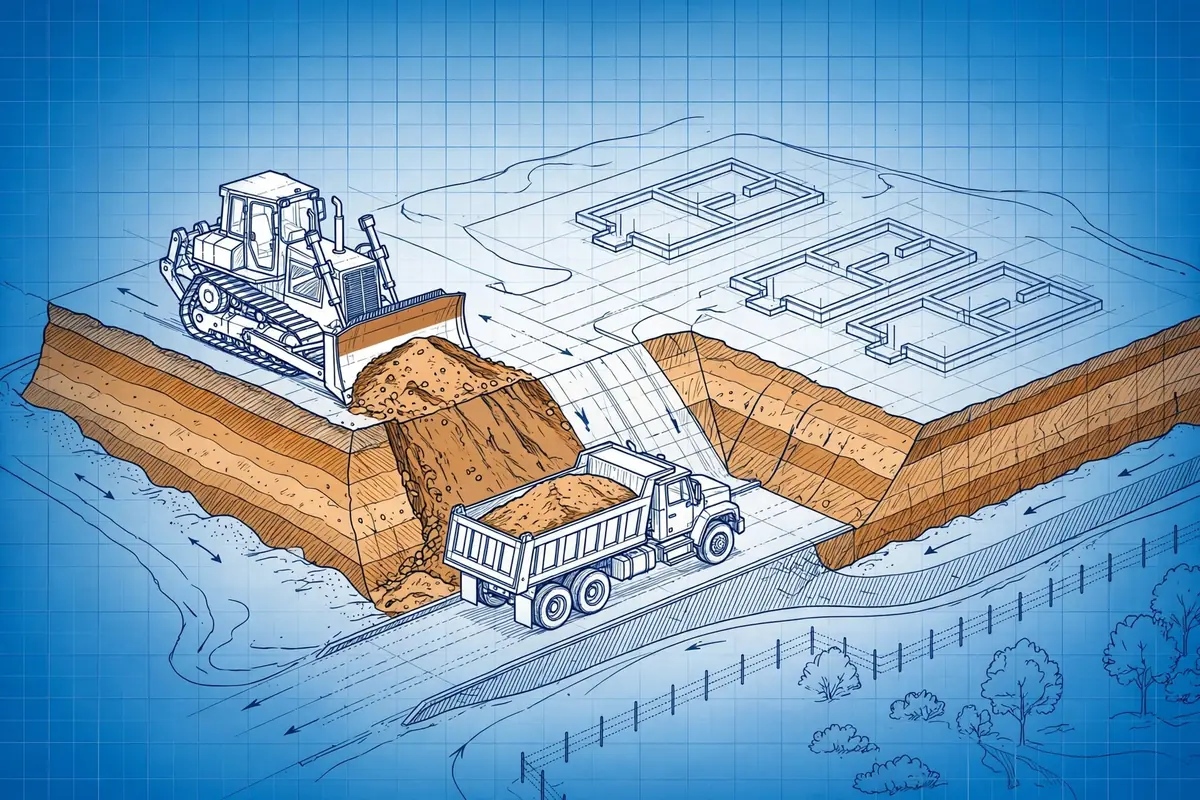
Site grading costs far more than the excavation rate suggests. A worked 120x80 ft pad example shows the all-in cost per cubic yard — and what estimators miss.
If you have ever priced a grading job by multiplying the cut volume by a single excavation rate, you already know how the story ends: the bid looks competitive, the work starts, and somewhere around the third week the budget is gone. Earthwork is the line item where the cheapest-looking number on the estimate is almost never the number that shows up on the final invoice. The gap is not a rounding error. It is haulage, swell, imported fill, testing and half a dozen small items that never made it onto the takeoff sheet in the first place.
This article walks through what site grading and earthwork actually cost per cubic yard, why the unit rate you hear quoted on the phone means very little on its own, and how to build an estimate that survives contact with the site. All figures are in US customary units and reflect typical 2026 pricing for residential and light commercial work in the United States.
What "per cubic yard" actually means
The first trap in earthwork pricing is that a cubic yard is not one thing. The same soil measures differently depending on when you measure it, and every one of those measurements has its own price attached.
- Bank cubic yards (BCY): soil in its natural, undisturbed state in the ground. This is how cut volumes are measured from survey cross-sections, usually by the average end area method.
- Loose cubic yards (LCY): soil after excavation, when it has swelled. A truck carries loose yards, and haulage is priced on them.
- Compacted cubic yards (CCY): soil after placement and compaction in a fill. A cubic yard of compacted fill takes more loose material than a cubic yard of bank cut gives you.
Mixing these up is the single most common estimating mistake in grading. An estimator who prices 700 bank yards of cut as 700 truck yards has already underpriced the haul by a quarter, because that soil will swell the moment the bucket breaks it loose.
Swell and shrinkage: the numbers that change everything
When undisturbed soil is excavated it occupies more volume. When it is placed and compacted it occupies less than the loose volume, and usually slightly less than the bank volume too. The two factors to carry on every estimate are:
- Swell factor: sand and gravel 10–15%, common earth 20–30%, clay 30–40%, blasted rock 40–60%.
- Shrinkage factor: compacted fill typically settles to 85–90% of its loose volume, and a cubic yard of bank material commonly yields only about 0.9 compacted yards once placed and rolled.
Take a straightforward case. You cut 700 BCY of common earth with a 25% swell factor. That is 875 LCY leaving the site in trucks. If you then need 700 CCY of fill elsewhere on the lot, you cannot just push the cut material across — you will be roughly 75 CCY short even before compaction losses, and that shortfall has to be imported at delivered-fill prices.
Typical unit rates for grading and earthwork
These are the line items a complete estimate needs, with the ranges you will most often see quoted for residential-scale work. The spread is wide because soil, haul distance and access change everything.
Excavation
Stripping and bulk excavation in ordinary soil runs about $3 to $8 per BCY, including loading.
Haulage and disposal
Hauling is usually priced per loose yard or per truckload, and it is distance-driven: $4 to $9 per LCY, or roughly $75 to $150 per 14-CY truckload for a local round trip. Dump fees add another $5 to $25 per load where they apply. A 20-mile haul can easily double the per-yard cost of a 5-mile haul.
Imported fill
Structural fill delivered to site runs about $15 to $30 per LCY, depending on material quality and distance. Placing and compacting it adds roughly $2 to $4 per CCY, including moisture conditioning and rolling in 8- to 12-inch lifts as required for proper compaction under ASTM D1557 (Modified Proctor) density targets.
Fine grading and compaction testing
Fine grading to tolerance — the final pass with a grader or skid steer, typically to within half an inch of design grade — runs about $0.35 to $0.75 per square foot. Compaction testing runs about $100 to $200 per density test, and a residential pad usually needs at least one test per lift per 500 to 1,000 square feet of fill area, plus a Proctor test for each soil type.
Worked example: grading a 120 ft × 80 ft house pad
Here is a complete estimate for a real, ordinary job: a level building pad for a single house on a gently sloping lot. The pad is 120 ft long by 80 ft wide, and the survey shows an average cut of 2 ft across the pad. The low corner needs 300 CCY of fill to bring it up to grade. Topsoil is 6 in. deep and must be stripped and stockpiled for respreading. Trucks carry 14 CY, and the contractor's rates are mid-range.
Step 1: Cut volume in bank yards
Pad area = 120 ft × 80 ft = 9,600 ft².
Cut volume = 9,600 ft² × 2 ft = 19,200 ft³. Divide by 27 ft³ per cubic yard: 19,200 ÷ 27 = 711 BCY.
Step 2: Topsoil strip
Topsoil volume = 9,600 ft² × 0.5 ft = 4,800 ft³ = 178 CY. This is stockpiled on site and respread later, so it costs handling time but no haulage. Many estimates forget it entirely, then pay for it as a change order.
Step 3: Haul volume after swell
The soil is common earth with a 25% swell factor. Loose volume = 711 BCY × 1.25 = 889 LCY. At 14 CY per truck that is 889 ÷ 14 = 63.5, so 64 truckloads leaving the site.
Step 4: Imported fill
The low corner needs 300 CCY of compacted fill. Because fill shrinks in compaction, order about 15% extra loose: 300 × 1.15 = 345 LCY of imported material.
Step 5: The full estimate
- Excavation: 711 BCY × $4.50 = $3,200
- Haul and disposal: 889 LCY × $6.00 = $5,334
- Imported fill, delivered: 345 LCY × $18.00 = $6,210
- Place and compact fill: 300 CCY × $2.50 = $750
- Fine grading: 9,600 ft² × $0.45 = $4,320
- Compaction testing: 6 tests × $150 = $900
- Subtotal: $20,714
- Contingency (10%): $2,071
- Total: $22,785
Now look at the number that matters. The excavation alone cost $4.50 per bank yard. But the all-in cost of moving the earth — total cost divided by the 1,011 cubic yards actually cut and placed — is $22.54 per cubic yard. That five-to-one gap is the whole lesson of this article. The excavation rate is the smallest line on the estimate, and it is the only one most people ever quote.
What estimators miss
Here are the items that most often turn a tidy earthwork estimate into a loss, in the order I see them bite on real jobs.
1. Swell and shrinkage, priced as if they did not exist
Covered above, and worth repeating because it is the biggest single error. Always convert bank yards to loose yards before pricing haulage, and compacted yards to loose yards before ordering fill.
2. Topsoil handling
Stripping, stockpiling, protecting and respreading topsoil is real work, and on a residential lot it is often 150 to 200 CY that appears nowhere in the cut volume.
3. Haul distance and dump fees
Haulage is not a fixed rate. A disposal site 5 miles away and one 25 miles away can differ by $4 or more per loose yard, and some receiving sites charge a tipping fee per load. Confirm the disposal site and the route before the estimate goes out.
4. Unsuitable material and rock
Organic topsoil, soft clay and buried debris cannot be used as structural fill, and rock cannot be excavated at soil rates.
5. Dewatering and wet-weather working
A high water table or a wet season turns a dry excavation into pumping, sumps and stabilised haul roads. Dewatering is rarely in the base rate, and a week of rain can add a line item nobody budgeted for.
6. Access, mobilisation and traffic management
Getting a dozer, an excavator and a fleet of trucks onto a tight residential lot costs money: low-loader transport, temporary access tracks, wheel washing, and sometimes a traffic management plan. On small jobs mobilisation can be 10 to 15% of the total.
7. Over-excavation and rework
Soft spots found during proof rolling, footing trenches dug too deep, grade stakes knocked over by a truck — every site has some of it. The 10% contingency in the worked example is not padding; it is the allowance for the things you cannot see from the survey.
8. Testing and certification
Compaction testing, Proctor tests and the engineer's sign-off are usually a separate cost, and they are not optional where fill supports a structure. Six density tests at $150 each added $900 to our example — small against the total, but exactly the kind of item that gets forgotten until the invoice arrives.
9. Erosion control and site restoration
Silt fence, stabilised entrances, temporary seeding and final respreading of topsoil are often permit conditions. They are cheap compared with a stop-work order or a fine, and they should be line items, not afterthoughts.
How to build an estimate that holds up
Start from the survey, not from a rate. Take cross-sections at regular intervals and compute bank volumes by the average end area method, then convert to loose and compacted volumes before you price a single line. Walk the site, dig test pits, confirm the disposal site and the haul route, and check where the water sits after rain.
Then build the estimate line by line: excavation, haulage, imported fill, placement and compaction, fine grading, testing, topsoil handling, mobilisation, erosion control, and a contingency of 10 to 15% on earthwork — it is the most variable trade on the job, and it earns the largest contingency. Present the per-cubic-yard figure as an all-in number, not as the excavation rate, so the client compares like with like.
Frequently asked questions
How much does site grading cost per cubic yard?
Excavation alone typically runs $3 to $8 per bank cubic yard, but the all-in cost — excavation, haulage, imported fill, compaction, fine grading and testing — commonly lands between $15 and $30 per cubic yard of earth moved, and higher where haul distances are long or rock is present.
What is the difference between bank, loose and compacted cubic yards?
A bank yard is soil in its natural state in the ground. A loose yard is the same soil after excavation, swollen by 10 to 60% depending on soil type. A compacted yard is soil placed and rolled to its design density, and it takes more loose material than the bank volume suggests.
How do I calculate earthwork volume for a building pad?
Multiply the pad area by the average cut depth, then divide by 27 to convert cubic feet to cubic yards. For a 120 ft × 80 ft pad cut 2 ft deep, that is 19,200 ft³, or 711 bank cubic yards. For irregular ground, use cross-sections and the average end area method.
Why is haulage often more expensive than excavation?
Because haulage is priced on swollen loose volume, it is distance-driven, and it includes truck time, fuel, driver cost and dump fees. In our worked example haulage cost $5,334 against $3,200 for the excavation itself — and that was a short haul.
How much contingency should I allow for earthwork?
Allow 10 to 15% on residential grading and more on sites with unknown ground conditions. Earthwork is the trade most exposed to what lies below the surface, and it is the worst place on the estimate to carry a thin contingency.
Calculations and engineering guides are for planning and educational reference. Verify final designs against applicable codes with a licensed Professional Engineer.