How Much Does Concrete Cost Per Cubic Yard? Full Breakdown
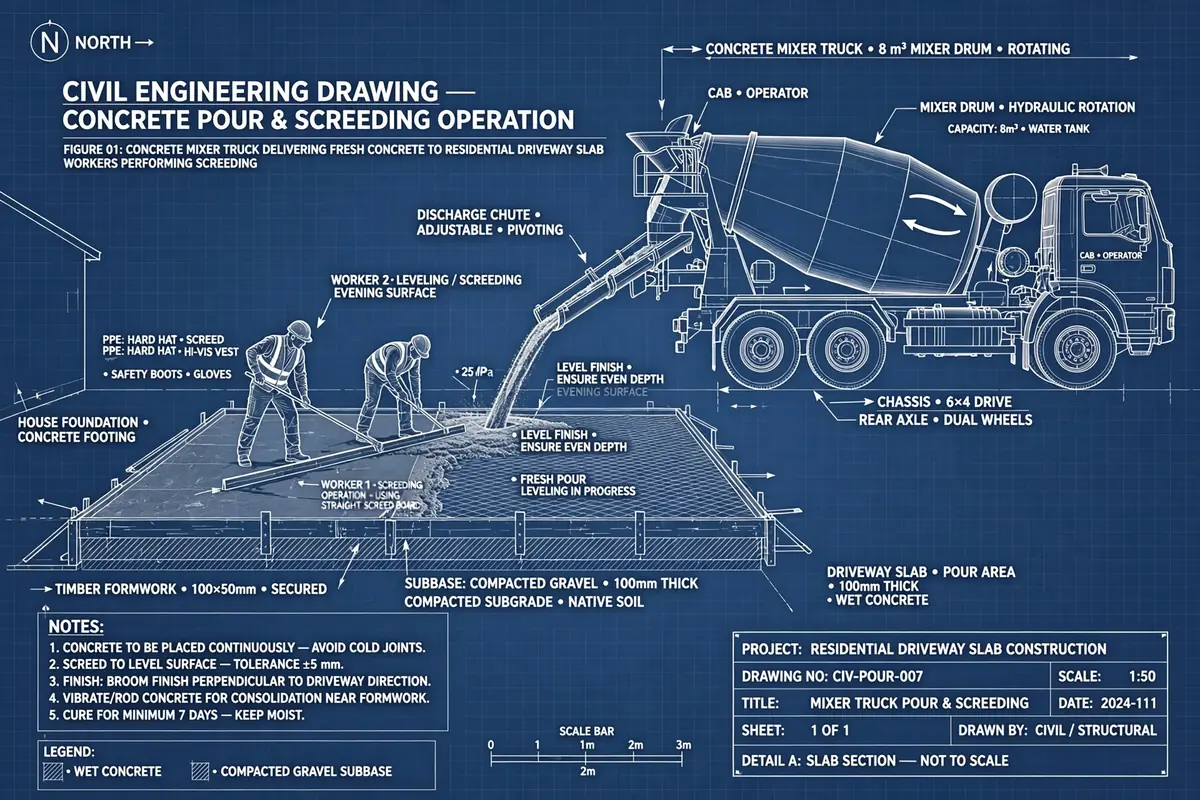
Concrete costs $125–$200 per cubic yard installed in most US markets. Here's the material, delivery and placement breakdown, with a worked example.
If you have ever phoned a ready-mix plant for a price and been quoted a number that seemed to come out of thin air, you are not alone. Concrete is sold by the cubic yard, but the price on the ticket is only one part of what the job actually costs. The material, the delivery, the placing and finishing, and a handful of extras that catch first-timers out all land on the same invoice — or on separate ones, which is worse, because then nobody sees the true per-yard cost.
This article breaks the price down the way an estimator does it: material first, then delivery, then labour, then the extras. All prices are typical US market ranges for 2026. They move with region, season and the price of cement, so treat them as planning figures and always confirm a written quote before you order. If you are working in metric, 1 cubic yard equals 0.765 cubic metres, and 1 cubic metre equals 1.308 cubic yards.
How much does concrete cost per cubic yard?
As a planning range, expect $125 to $200 per cubic yard installed for ordinary residential work in most US markets — a 4-inch slab, driveway or patio with a standard 3,000 to 4,000 psi mix. The material alone typically runs $125 to $180 per cubic yard, and placing and finishing adds roughly $40 to $70 per cubic yard on top. At the low end of the range you are looking at a straightforward rural pour with a basic mix; at the high end you are in a major metro area, ordering a high-strength or air-entrained mix, with a pump and a tight site.
Here is the same range split into its three main parts:
- Material (ready-mix delivered): $125–$180 per cubic yard
- Delivery surcharges: $0–$150 per load, depending on distance and load size
- Placing and finishing labour: $40–$70 per cubic yard
- Reinforcement (mesh or rebar): $0.40–$0.60 per square foot of slab, if specified
Everything below explains where each number comes from, and what pushes it up or down.
Material cost: what the ready-mix plant charges
The biggest single component is the concrete itself, batched at the plant to ASTM C94 and delivered in a mixer truck. The price moves mainly with strength and with the admixtures in the mix:
- 3,000 psi (standard residential): $125–$150 per cubic yard
- 4,000 psi (driveways, garage floors, freeze-thaw exposure): $140–$170 per cubic yard
- 5,000 psi (heavy-duty or structural work): $160–$190 per cubic yard
Each step up in strength costs roughly $10–$20 per yard, because it needs more cement per yard. ACI 318 ties strength to durability through its exposure classes, so do not order the cheapest mix for a driveway in a freeze-thaw climate: the few dollars saved per yard are nothing against a surface that scales off in two winters. For exterior slabs in cold regions, air entrainment is effectively mandatory, and it adds about $5–$10 per yard. Other common admixtures: a water reducer or plasticiser, $5–$10 per yard; a set accelerator for cold weather, $8–$15 per yard; synthetic fibre reinforcement, $8–$12 per yard.
One more thing to check on the quote: whether the price is for a full load. Most plants run 9 to 10 cubic yard trucks, and many quote a lower per-yard rate only above a minimum order, typically 5 to 6 yards. Below that you pay a short-load fee.
Delivery charges: distance, minimums and waiting time
Delivery is usually included in the per-yard price within the plant's normal radius, often about 20 miles. Outside that, expect $5–$10 per mile per load. The charges that surprise people are these:
- Short-load fee: $50–$150 flat, or $20–$40 per yard under the minimum, when you order less than the plant's minimum, usually 5 yards. A 2-yard order can easily cost $200 per yard once this is applied.
- Waiting time: the first 30 to 60 minutes at site is normally free; after that, $1–$2 per minute. A slow crew or a site that is not ready when the truck arrives is the most common cause.
- Weekend or after-hours delivery: $50–$150 per load on many plants' rate cards.
- Fuel surcharge: some plants add a flat $10–$25 per load when diesel prices spike.
The practical lesson is simple: have the formwork, reinforcement and access ready before the truck leaves the plant, and order enough to clear the minimum load. Ordering a second small top-up load later in the day is the most expensive concrete you will ever buy.
Placing and finishing labour
Placing — getting the concrete out of the truck, spread, screeded and floated — and finishing — trowelling, edging and brooming the surface — are priced by the crew, but it is useful to think of them per yard. For ordinary flatwork, allow $40–$70 per cubic yard, or roughly $3–$6 per square foot for a 4-inch slab. The rate rises when the work is fiddly: steps, narrow strips, hand finishing around drains, or a site where the truck cannot get close and everything has to be wheelbarrowed.
If the truck cannot reach the pour, you need a pump. A line pump or boom pump typically costs $500–$1,000 per visit, plus a per-yard pumping charge. On a small residential job that can add $50–$100 per yard, which is why access is worth sorting out before you price the job. A pump is still cheaper than a crew barrowing concrete all day, and the concrete stays workable — every extra 15 minutes in a barrow costs you slump and finish quality.
Worked example: a 20 ft by 24 ft driveway slab
Let us price a real job end to end: a driveway slab 20 ft wide, 24 ft long and 4 in thick, in 4,000 psi air-entrained concrete, with welded wire mesh reinforcement.
Step 1 — Volume
Volume = length × width × thickness. Convert the 4 in thickness to feet first: 4 ÷ 12 = 0.333 ft.
Volume = 20 × 24 × 0.333 = 160 ft³.
Convert to cubic yards by dividing by 27: 160 ÷ 27 = 5.93 yd³.
Step 2 — Order quantity with waste
Allow 10% for waste, spillage and uneven subgrade: 5.93 × 1.10 = 6.52 yd³. Order 6.5 yd³. This also clears the plant's 5-yard minimum, so there is no short-load fee.
Step 3 — Material cost
At $145 per yard for 4,000 psi air-entrained concrete: 6.5 × $145 = $942.50. Delivery within the normal radius is included, and the site is ready, so there is no waiting-time charge.
Step 4 — Placing and finishing
At $55 per yard: 6.5 × $55 = $357.50.
Step 5 — Reinforcement
Welded wire mesh at $0.50 per square foot over 480 ft²: 480 × $0.50 = $240.00.
Step 6 — Total and cost per yard
Total = $942.50 + $357.50 + $240.00 = $1,540.00.
Cost per cubic yard installed = $1,540.00 ÷ 6.5 = $237 per yd³ with reinforcement, or $1,300 ÷ 6.5 = $200 per yd³ without it. That sits at the upper-middle of the planning range, which is exactly where a 4,000 psi air-entrained driveway in a metro market should land. If the same slab used 3,000 psi concrete at $130 per yard and no mesh, the total would be $845 + $357.50 = $1,202.50, or about $185 per yard — cheaper, but the wrong mix for a driveway that will see freeze-thaw and vehicle loads.
What pushes the price up (and down)
A few factors move the per-yard cost more than anything else:
- Region: metro areas run 20–40% above rural prices, driven by cement haulage, labour rates and plant overhead.
- Strength and exposure class: each 1,000 psi step and each admixture adds $5–$20 per yard. ACI 318 exposure classes for freeze-thaw, sulphate and chloride exposure decide the minimum strength, not the budget.
- Slump: a high-slump or self-consolidating mix costs more and needs a plasticiser, not extra water. Never let anyone add water on site to make the concrete flow — it raises the water-cement ratio and cuts strength, and ACI 318 is clear that the as-delivered mix is the design mix.
- Load size: anything under the plant minimum attracts a short-load fee; anything over one truckload means a second delivery charge.
- Season: cold-weather concreting adds accelerator and protection costs; hot weather adds retarder and earlier start times. Both are cheaper than repairing a failed pour.
- Access: a pump adds $500–$1,000 per visit, but barrowing a full load across a site costs more in labour and lost slump.
Common estimating mistakes
The errors I see most often on site are all avoidable. First, forgetting the waste allowance — order exactly the calculated volume and you will run short, and a top-up load costs more per yard than the whole first load. Second, pricing the material only and forgetting placing and finishing, which is a third of the installed cost. Third, ordering a low-strength mix to save $10 a yard, then paying for repairs. And fourth, not checking the ticket: the batch ticket (ASTM C94) shows the mix design, the water added at the plant and the time of batching. Check the slump with a slump cone (ASTM C143) before the truck discharges, and reject a load that is outside the specified slump range — it is far cheaper than a slab that fails.
Quick-reference cost table
- Material only, 3,000 psi: $125–$150/yd³
- Material only, 4,000 psi: $140–$170/yd³
- Material only, 5,000 psi: $160–$190/yd³
- Placing and finishing: $40–$70/yd³
- Installed total, typical residential: $125–$200/yd³
- Short-load fee: $50–$150 per load
- Pump hire: $500–$1,000 per visit
Frequently asked questions
How many cubic yards of concrete do I need?
Multiply length × width × thickness in feet, then divide by 27. A 20 ft × 24 ft slab at 4 in thick needs 5.93 yd³; add 10% waste and order 6.5 yd³.
Is concrete cheaper by the bag or by the truck?
Bagged concrete from a hardware store costs roughly $150–$250 per cubic yard equivalent once you count the bags, and that is before your labour to mix it. Ready-mix is cheaper per yard on any job over about 1 cubic yard, and the quality is far more consistent because it is batched to ASTM C94.
Why did my quote change between the phone call and the invoice?
Usually waiting time, a short-load fee, or an admixture that was not in the verbal quote. Ask for the price in writing with the mix design, the slump, the minimum load and the waiting-time terms stated.
Can I reduce the cost by ordering a lower-strength mix?
Only if the lower strength still meets the ACI 318 exposure requirements for the job. For a driveway or exterior slab in a freeze-thaw climate, 4,000 psi air-entrained concrete is the sensible minimum, and the saving from dropping to 3,000 psi is usually under $100 on a whole driveway.
How much does a concrete truck hold?
A standard mixer truck carries 9 to 10 cubic yards. Smaller jobs still pay the short-load fee if they fall below the plant's minimum, usually 5 to 6 yards, so it often pays to combine small pours into one order.
The honest answer to "how much does concrete cost per cubic yard" is that it depends on the mix, the distance, the access and the finish — but with the breakdown above you can build the price yourself instead of taking a single number on trust. Price the material, the delivery, the placing and the reinforcement separately, add 10% waste to the volume, and check the batch ticket when the truck arrives. Do that, and the per-yard cost stops being a surprise.
Calculations and engineering guides are for planning and educational reference. Verify final designs against applicable codes with a licensed Professional Engineer.