Coarse Aggregate Tests: Crushing, Impact & Abrasion Explained
How crushing, impact and abrasion tests judge coarse aggregate strength — limits per IS 2386, procedures and a worked example for site engineers.
Concrete is only as good as the stone inside it. Cement paste binds everything together, but coarse aggregate makes up roughly 60 to 75 percent of the volume of a normal concrete mix, and it carries much of the load. If the stone is weak, it will crush under load, break under impact, or wear away under traffic long before the cement paste fails. That is why three laboratory tests — the crushing value, the impact value and the Los Angeles abrasion value — are still the first checks on any new aggregate source, and why a site engineer should know what each number actually means rather than just filing the test certificate.
This article explains all three tests in plain language: what each one measures, how it is done, what limits are normally applied, and how to read the result. Procedures follow IS 2386 Part IV and BS 812, with ASTM equivalents noted. Check the project specification first: the limits here are commonly specified values, not a substitute for the contract documents.
Why three different strength tests?
Aggregate fails in different ways, and each test reproduces a different kind of loading: a stone that survives a slow squeeze may still shatter under a wheel impact, and one that survives both may still wear down under thousands of tyre passes.
- Crushing value measures resistance to a gradually applied compressive load, similar to the sustained load in a column or a pavement slab.
- Impact value measures resistance to sudden blows, similar to wheel impact, handling, and compaction.
- Abrasion value measures resistance to wear, grinding and attrition, similar to traffic on a road surface or material moving in a mixer.
That is the key point for reading results: a low value is good in all three tests. Each result is expressed as a percentage of material broken down or lost, so a smaller percentage means stronger, tougher stone.
Sampling first: the step everyone rushes
None of these tests means anything if the sample does not represent the stockpile. Take material from several points in the pile, not just the easy edge where fines have separated. Combine the increments, reduce by quartering, wash off dust, and oven-dry before testing. A sample taken only from the top of a segregated heap will flatter a poor source. Record the source, size, and date on the test sheet — a result without a source is just a number.
1. Aggregate crushing value (ACV)
The crushing test, in IS 2386 Part IV and BS 812-110, answers a simple question: how much of the stone breaks into fines when it is squeezed hard in a steel cylinder?
How the test is done
The test uses aggregate passing a 12.5 mm sieve and retained on a 10 mm sieve. The dried sample is placed in a cylindrical steel mould in three layers, each layer tamped 25 times with a standard tamping rod. A plunger is placed on top, and a compression machine applies load gradually until it reaches 40 tonnes (400 kN) in about 10 minutes. The crushed material is then removed and sieved on a 2.36 mm sieve. Everything passing that sieve counts as crushed fines.
The aggregate crushing value is calculated as:
ACV = (mass passing the 2.36 mm sieve / total mass of the sample) × 100
Worked example: crushing value
Suppose a dried sample weighing 3,000 g is tested. After loading and sieving, the mass passing the 2.36 mm sieve is 720 g.
ACV = (720 / 3,000) × 100 = 24%
A result of 24% means just under a quarter of the stone broke down under the test load. That passes the commonly specified limit of 30% for wearing surfaces, and it is comfortably inside the 45% limit often applied to general concrete work. If the same source had returned 38%, it would still be acceptable for ordinary concrete in many specifications but would be rejected for a wearing course — the same number, a different verdict, which is why the intended use matters.
What the limits mean
As a general guide, an ACV below 30% is specified for concrete in wearing surfaces and heavy-duty pavements, while values up to 45% are commonly accepted for other concrete. Very strong aggregates such as good granite or basalt often return values in the teens or low twenties. Weak, weathered or porous stone can exceed 45%, and at that point the aggregate, not the cement, will govern the strength and durability of the concrete.
2. Aggregate impact value (AIV)
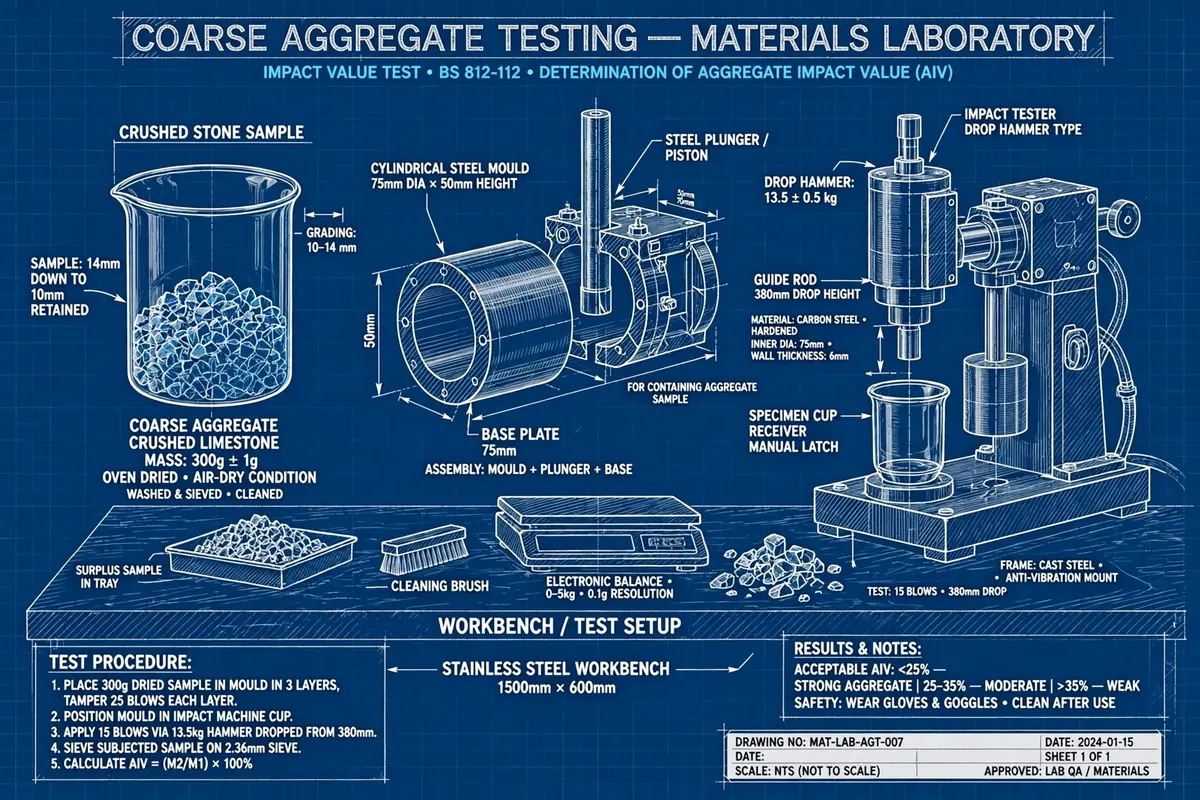
The impact test, in IS 2386 Part IV and BS 812-112, measures toughness: how the stone behaves when it is hit, not squeezed. This matters wherever aggregate is dropped, compacted, or subjected to moving wheel loads.
How the test is done
The sample, again passing 12.5 mm and retained on 10 mm, is placed in a cylindrical cup in the impact machine. A hammer weighing about 13.5 to 14 kg is dropped from a height of 380 mm onto the sample, 15 times. The sample is then sieved on a 2.36 mm sieve, and the fines passing through are weighed.
The aggregate impact value is calculated as:
AIV = (mass passing the 2.36 mm sieve / total mass of the sample) × 100
Worked example: impact value
Suppose a dried sample weighing 350 g is given 15 blows. After sieving, the mass passing the 2.36 mm sieve is 56 g.
AIV = (56 / 350) × 100 = 16%
A result of 16% falls in the “strong” band described below. The aggregate has absorbed repeated blows without breaking down excessively, which is exactly what you want in a road base, a pavement, or any concrete that will see impact or vibration in service.
What the limits mean
The usual interpretation, following BS 812 guidance, is: below 10% exceptionally strong, 10 to 20% strong, 20 to 30% satisfactory for road surfacing, and above 30% weak for heavy traffic. For wearing courses, many specifications cap the impact value at 30%, and some demanding specifications require 20% or less. Note the difference from the crushing test: the same stone can give a good crushing value and a poor impact value if it is hard but brittle, which is precisely why both tests are run.
3. Los Angeles abrasion value (LAA)
The Los Angeles abrasion test, in IS 2386 Part IV and ASTM C131 (with ASTM C535 for larger sizes), measures wear resistance. A sample is tumbled in a rotating steel drum with steel balls, so the stone is abraded, ground and knocked against itself — a harsh but realistic simulation of traffic wear and handling.
How the test is done
A graded sample, typically 5,000 g for the common gradings, is placed in the drum with a specified number of steel spheres, depending on the grading. The drum is rotated at 30 to 33 revolutions per minute for 500 revolutions. The material is then removed and sieved on a 1.70 mm sieve. The material retained on that sieve is weighed, and the loss is the difference from the original mass.
The Los Angeles abrasion value is calculated as:
LAA = ((original mass − mass retained on the 1.70 mm sieve) / original mass) × 100
Worked example: abrasion value
Suppose the original sample weighs 5,000 g. After 500 revolutions and sieving, the mass retained on the 1.70 mm sieve is 3,650 g.
Loss = 5,000 − 3,650 = 1,350 g
LAA = (1,350 / 5,000) × 100 = 27%
A result of 27% passes the commonly specified limit of 30% for wearing surfaces and is well inside the 40% limit often applied to other pavement layers. If the result had been 48%, the stone would wear and polish too quickly for a road surface, even if its crushing and impact values looked acceptable.
What the limits mean
As a guide, an abrasion loss of up to 30% is commonly specified for wearing courses, up to 40% for base courses and other pavements, and up to 50% for general concrete aggregate in some specifications. Hard, dense igneous rock usually performs best; soft limestone, weathered gravel and shale tend to lose more material. A high abrasion value also warns of dust generation during handling and mixing, which can increase water demand and weaken the mix.
Reading the three results together
No single test tells the whole story, and the most useful judgement comes from reading all three side by side. Strong, durable aggregate should be low on all three. A pattern in the results often points to the problem: high crushing with low impact suggests the stone is weak under sustained load; low crushing with high impact suggests brittleness; good crushing and impact with high abrasion suggests a stone that is strong in bulk but wears at the surface. When results disagree, do not average them away — investigate the source, check for weathering or deleterious material, and if in doubt, retest a fresh, properly sampled batch before accepting the delivery.
Also confirm grading and the flakiness and elongation indices alongside these tests: flat or elongated particles break more easily and need more paste. Strength tests prove the stone is tough; they do not by themselves prove it is clean or well graded.
Common mistakes on site
- Testing the wrong size fraction. Crushing and impact tests are defined for the 10 to 12.5 mm fraction. Testing ungraded crusher-run material gives a number that cannot be compared with the specification.
- Skipping drying. Moisture changes the behaviour of the sample and the mass measurements. Oven-dry the sample as the method requires.
- Applying the wrong limit. A value that passes for general concrete may fail for a wearing course. Always match the limit to the intended use.
- Accepting one test in isolation. A supplier quoting only a crushing value is not giving you the full picture. Ask for all three values, plus grading.
- Forgetting the source. Test results belong to a quarry, a stockpile and a date. A certificate for one delivery does not cover the next load from a different bench.
Practical checklist before accepting aggregate
- Sample from several points in the stockpile and record the source and date.
- Confirm the test methods on the certificate: IS 2386 Part IV, BS 812, or the ASTM equivalent.
- Check crushing value against the limit for the intended use (commonly 30% for wearing surfaces, 45% for general concrete).
- Check impact value (commonly 30% maximum for wearing courses, lower where specified).
- Check Los Angeles abrasion (commonly 30% for wearing surfaces, 40% for other pavements).
- Confirm grading, cleanliness and, where required, soundness before the first truck is tipped.
Frequently asked questions
Which test matters most for ordinary building concrete?
For ordinary structural concrete, the crushing value is usually the first check, because the aggregate must carry compressive load without breaking down. Impact and abrasion matter more for pavements, roads and surfaces exposed to traffic or wear, but there is no harm in having all three on file.
Can a high crushing value be compensated by more cement?
No. Extra cement improves the paste, but it cannot make weak stone strong. The aggregate will still crush, and the concrete will still lose strength and durability. Reject or blend the source rather than trying to paste over the problem.
How often should aggregate be tested?
Test each new source before first use, and retest whenever the quarry bench, stockpile, or appearance of the material changes. On large jobs, test at the specification frequency — one test at the start of a year-long project is not enough.
Do these tests apply to recycled aggregate?
The same methods can be used, but recycled concrete aggregate usually returns higher crushing, impact and abrasion values than natural stone because of the attached mortar. Judge it against the limits in the specification for recycled material, which are often relaxed, and confirm the application is suitable.
Check the stone before you trust the concrete: three percentages on a certificate can save months of argument about a pavement that ruts or a structure that never reaches its design strength.
Calculations and engineering guides are for planning and educational reference. Verify final designs against applicable codes with a licensed Professional Engineer.