Bulking of Sand: Field Test and Correction Explained
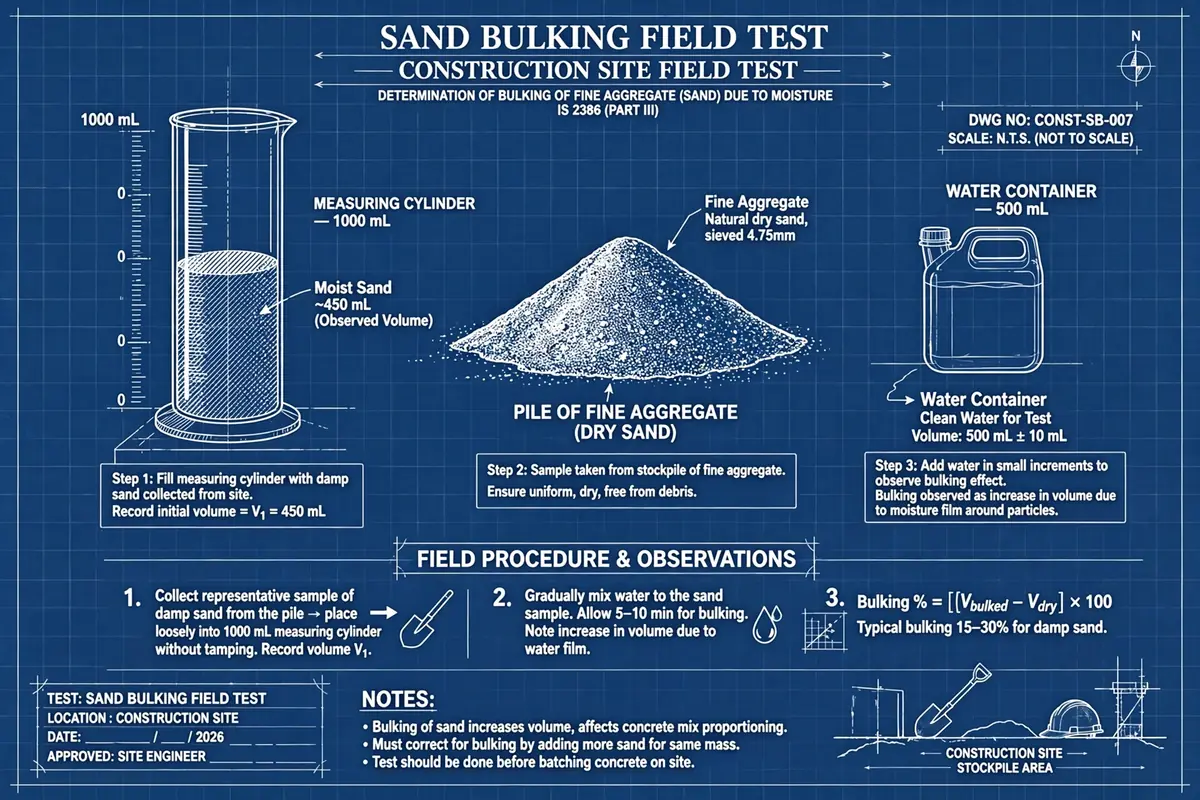
Learn the bulking of sand field test step by step, with a worked example and the volume correction formula so volume-batched concrete stays on mix.
Order a truck of sand, tip it on site, and measure it in a gauge box — and you may find you are getting less sand than you think. Not because the supplier shorted you, but because damp sand takes up more space than the same sand when it is dry. This is bulking of sand, and if you batch concrete by volume without correcting for it, your mix ends up sand-starved, harsh to work with, and weaker than the design intended.
This article explains what bulking is, why it happens, how to measure it with a simple field test that needs nothing more than a container and water, and how to correct your batching quantities. The method follows IS 2386 (Part III), the Indian standard for testing aggregates, and the principles apply equally under ACI 318 and Eurocode 2 practice, where volume batching is corrected the same way.
What Is Bulking of Sand?
Bulking is the increase in the volume of fine aggregate caused by moisture. When sand is damp, a thin film of water forms around each grain. Surface tension in that film pushes neighbouring grains slightly apart, opening up air voids between them. The sand grains themselves have not changed — the same mass now occupies a larger volume.
The effect is surprisingly large. Fine sand at about 5–6% moisture content can bulk by 25–30%, meaning a gauge box that should hold a given mass of dry sand holds roughly a quarter less when the sand is damp. Coarse sand bulks less, typically around 15%, because its larger grains have less surface area per unit volume for water films to act on. Very fine sand bulks the most.
Two things about the bulking curve are worth knowing:
- Bulking peaks at moderate moisture. As moisture rises from dry to about 5–6%, bulking climbs to its maximum. Beyond that, the extra water starts filling the voids instead of pushing grains apart, and bulking falls again.
- At full saturation, bulking disappears. Fully submerged sand occupies the same volume as dry sand, because the water films no longer hold the grains apart. This is exactly why the field test works: add water to damp sand and it settles back to its true volume.
Why Bulking Matters on Site
Bulking only matters when you batch by volume — measuring sand in boxes, buckets or wheelbarrows, which is still common on smaller sites and in many parts of the world. If you batch by weight, bulking is irrelevant: a kilogram of damp sand is a kilogram of sand, whatever volume it occupies. That is one reason IS 456 and ACI 318 both prefer weight batching for structural concrete.
But where volume batching is used, ignoring bulking has real consequences:
- Less sand in the mix. A box of bulked sand contains less actual sand than the same box of dry sand. The mix becomes lean on fines, harsh, and hard to compact.
- Wrong water-cement ratio in practice. The missing sand is often compensated on site by adding extra water to improve workability, which raises the water-cement ratio and cuts strength.
- Inconsistent strength. Sand moisture changes through the day — morning dew, afternoon sun, a rain shower — so the same box gives a different sand content each time. Cube test results scatter, and nobody knows why.
Correcting for bulking costs nothing and takes ten minutes. It is one of the highest-value checks a site engineer can run before a pour.
The Field Test: Apparatus and Procedure
You need a straight-sided, transparent container of known cross-section — a graduated measuring cylinder is ideal, but a straight tin or bucket with a marked scale works — plus clean water and a rod for stirring. The test is described in IS 2386 (Part III), and the field version runs as follows:
- Step 1 — Fill loosely. Take a representative sample of the damp sand from the stockpile and pour it loosely into the container without tamping or compacting it. Note the height of the sand surface. Call this height H₁.
- Step 2 — Add water. Pour water into the container until the sand is fully covered, then stir thoroughly with the rod so that all air is released and every grain is wetted.
- Step 3 — Let it settle. Allow the sand to settle completely. The sand now sits at its true, unbulked volume. Note the new height of the sand surface. Call this height H₂.
- Step 4 — Calculate. The percentage bulking is given by the formula below. Because the container has a constant cross-section, heights can be used directly in place of volumes.
Bulking Formula
Bulking (%) = [(H₁ − H₂) / H₂] × 100
Equivalently, using volumes: Bulking (%) = [(V₁ − V₂) / V₂] × 100, where V₁ is the volume of damp sand and V₂ is the volume of the same sand after wetting and settlement. Note the denominator is the settled (dry-equivalent) volume, not the damp volume — a common mistake that understates the correction.
Worked Example: Measuring and Correcting Bulking
Suppose you are about to batch concrete on a small residential site, and the sand in the stockpile is visibly damp after overnight rain. You run the field test in a graduated cylinder:
- Height of damp sand, H₁ = 200 mm
- Height after adding water and settling, H₂ = 160 mm
Bulking = [(200 − 160) / 160] × 100 = (40 / 160) × 100 = 25%
So this sand is bulked by 25%. Now apply the correction to a real batch. Take 1 m³ of M20 nominal-mix concrete (1 : 1.5 : 3). Using the standard dry-volume factor of 1.54, the dry volume of ingredients is 1.54 m³, and the sand share is:
Dry sand required = 1.54 × (1.5 / 5.5) = 0.42 m³
But your gauge boxes hold bulked, damp sand. To get 0.42 m³ of actual sand into the mixer, you must measure out:
Corrected damp sand volume = 0.42 × (1 + 25/100) = 0.42 × 1.25 = 0.525 m³
In practical terms, if you batch with standard 35-litre gauge boxes, dry sand would need 0.42 / 0.035 = 12 boxes, but the damp sand needs 0.525 / 0.035 = 15 boxes. Batching only 12 boxes of damp sand would have starved the mix of 0.105 m³ of sand — a quarter of the fines missing — and the crew would almost certainly have added water to compensate, damaging strength twice over.
How to Correct Batching on Site
Once you know the bulking percentage, the correction is straightforward:
- Corrected volume = Dry volume × (1 + bulking % / 100). Increase the measured volume of sand by the bulking percentage. If bulking is 20%, measure 20% more damp sand than the dry volume the mix design calls for.
- Adjust the water too. Damp sand already carries free water into the mixer. Reduce the added mixing water by the free moisture content of the sand, or the water-cement ratio will drift upward. For structural work, weigh a sample, dry it, and calculate the moisture content properly.
- Re-test when conditions change. Bulking is not a fixed property of a sand stockpile — it changes with rain, sun and depth in the pile. Re-run the test at the start of each concreting day and after rain, and take samples from different parts of the pile.
- Switch to weight batching where you can. Weighing sand removes bulking from the equation entirely. Even a simple platform scale and a corrected batch sheet beat volume boxes on any structural pour.
Common Mistakes to Avoid
- Tamping the sand in the container. The test measures loose volume. Tamping compacts the sand and hides the bulking you are trying to measure.
- Using the wrong denominator. Bulking is (H₁ − H₂) / H₂, not divided by H₁. Dividing by the damp height understates the percentage and under-corrects the batch.
- Testing only the surface of the pile. The top of a stockpile dries fastest and bulks least. Sample from inside the pile where the sand that actually goes into the mixer comes from.
- Assuming one test covers the whole job. A test done in the dry season is meaningless after the first monsoon shower. Bulking follows moisture, and moisture follows weather.
- Correcting volume but forgetting water. Adding the extra damp sand also adds its free water. Correct both, or the mix will still be wetter than designed.
Frequently Asked Questions
Does bulking affect coarse aggregate?
Hardly at all. Bulking is a surface-tension effect on fine particles. Coarse aggregate has far less surface area per unit volume, so the water film effect is negligible and no correction is needed for stone or gravel.
What is the maximum bulking of sand?
Fine sand typically bulks by 25–30% at around 5–6% moisture content. Medium sand bulks around 20%, and coarse sand around 15%. These are guides only — always test the sand on your site rather than assuming a textbook value.
Does bulking happen in manufactured sand?
Yes. Manufactured sand (crushed rock fines) bulks on the same principle, though the percentage depends on its grading and particle shape. Angular crushed fines can bulk slightly differently from rounded river sand, so test the actual material you will batch.
Can I skip the test if I batch by weight?
Yes — weight batching is unaffected by bulking, which is one of its main advantages. You still need to correct the added water for the sand's free moisture content, but the sand quantity itself needs no bulking correction.
The Bottom Line
Bulking of sand is invisible, costs nothing to check, and quietly corrupts volume-batched mixes when it is ignored. A ten-minute field test — fill, wet, settle, calculate — tells you exactly how much extra damp sand to measure, and the correction formula turns that number straight into corrected gauge boxes. Run the test each concreting day, correct both sand volume and mixing water, and your mixes will stay on design while the site next door wonders why its cubes keep failing.
Calculations and engineering guides are for planning and educational reference. Verify final designs against applicable codes with a licensed Professional Engineer.