How Much Does Water Heater Replacement Cost? Tank vs Tankless
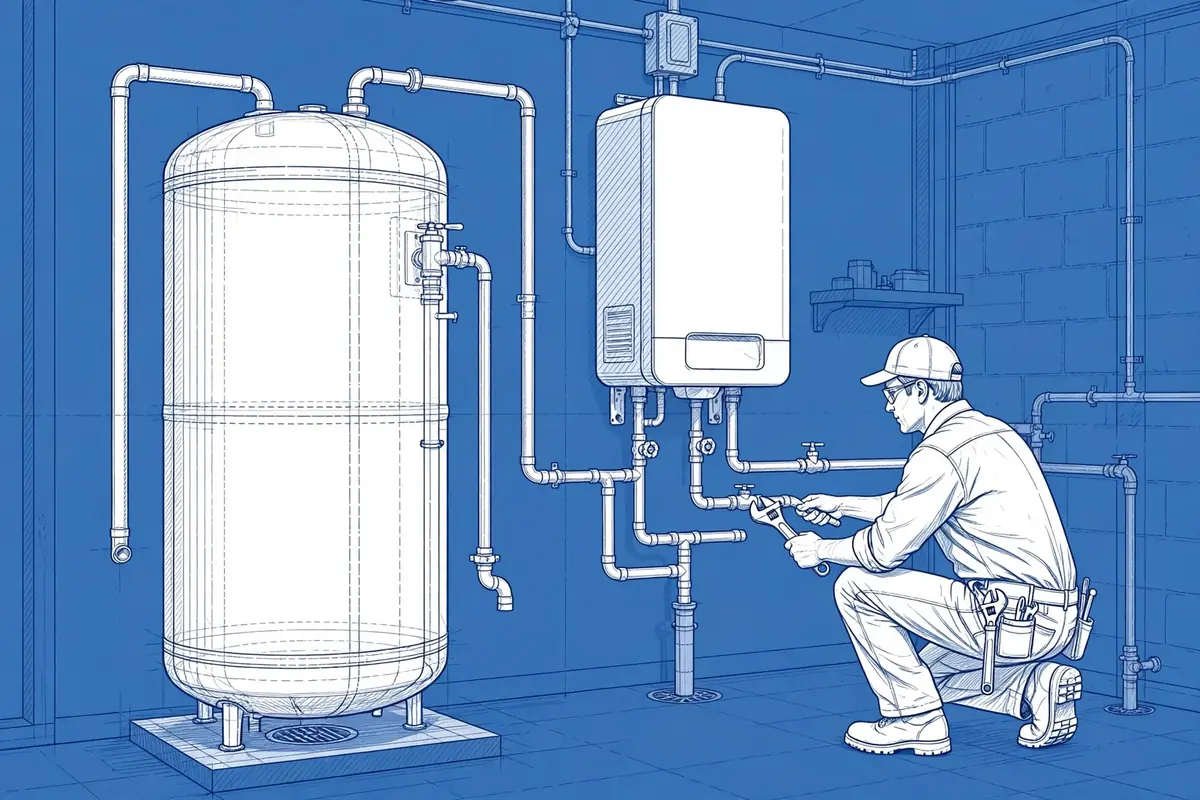
Water heater replacement costs $1,300-$5,500 or more depending on tank vs tankless, size, fuel and install. Here is the full breakdown with a worked example.
A water heater usually announces its retirement at the worst possible moment — a cold shower on a Monday morning, or a puddle spreading across the utility room floor. When that happens you do not have the luxury of shopping around for weeks, so it helps to know the numbers before you need them. Replacing a water heater in the US typically costs $1,300 to $5,500 installed, and the spread comes down to four decisions: tank or tankless, gas or electric, the size you need, and what your house demands in venting, gas piping and permits.
This guide walks through each cost driver with real 2026 prices, shows how to size a heater so you do not pay for capacity you will never use, and ends with a worked example for a four-person household.
What a Water Heater Replacement Costs at a Glance
The table below covers the installed price — unit plus labour, basic fittings and haul-away of the old heater — for a straightforward like-for-like swap in a typical single-family home. Anything that changes the fuel type, the venting or the gas line pushes the price up from here.
- Gas tank, 40–50 gallon: $1,300–$2,500 installed (unit $600–$1,200)
- Electric tank, 40–50 gallon: $1,200–$2,200 installed (unit $500–$1,000)
- Gas tankless (condensing): $2,500–$5,500 installed (unit $1,000–$2,500)
- Electric tankless: $1,500–$3,000 installed (unit $500–$1,500)
- Heat pump hybrid, 50–80 gallon: $2,500–$4,500 installed (unit $1,500–$3,000)
Those are national averages. Labour rates in high-cost metros can add 20–30%, while a small-town plumber swapping an identical electric tank in an accessible garage may come in under $1,200 all-in.
Tank vs Tankless: The Price Gap and What You Get for It
A storage tank heater is a simple machine: an insulated tank, a burner or heating elements, and a thermostat. It keeps 40–80 gallons hot around the clock, so it is always ready — and always burning energy to stay ready. A tankless heater has no stored water at all. It fires only when a tap opens, heating water as it passes through a heat exchanger.
The tankless unit costs roughly twice as much to buy and two to three times as much to install, for three reasons. First, the heat exchanger and controls are more complex. Second, a gas tankless needs a much larger burner — 150,000 to 199,000 BTU/h against 40,000 BTU/h for a tank — which often means upsizing the gas line. Third, it needs dedicated venting, usually PVC or stainless steel run directly outside, plus a condensate drain if it is a condensing model.
What you get in return is a lifespan of 20 years or more against 8–12 years for a tank, endless hot water within its flow rating, and lower running costs — the US Department of Energy puts tankless savings at roughly 24–34% for light users and 8–14% for heavy users. A tankless also frees up floor space, which matters in a tight utility closet.
For a small household with modest use, a tank is usually the better financial choice. For a large household that runs out of hot water, or where the heater occupies valuable space, tankless earns its premium.
Gas vs Electric: Fuel Changes the Whole Job
Sticking with the fuel you already have is almost always cheaper. A gas-to-gas or electric-to-electric swap reuses the existing supply line, venting and electrical circuit. Switching fuels is a different job entirely.
Going from electric to gas means running a new gas line, adding a flue or power vent, and possibly upgrading the gas meter — add $1,000–$2,500 before you buy the heater. Going from gas to electric can mean a new dedicated 240-volt circuit, and a tankless electric unit may need two or three 40-amp breakers plus a panel upgrade if the service is only 100 amps. A panel upgrade alone runs $1,500–$3,000.
On running costs, gas is usually cheaper per unit of heat, and a gas tank recovers in about an hour against two or more for electric. Electric heaters need no venting, are simpler to install, and pair well with a heat pump hybrid, which can cut water-heating energy use roughly in half.
How to Size a Water Heater (So You Don't Overspend)
Oversizing is the quietest way to waste money on this job. A bigger tank costs more, loses more standby heat and takes up more space; an oversized tankless is pure wasted capacity.
Sizing a tank heater
Tank sizing is driven by the first hour rating (FHR) — how many gallons the heater can deliver in its first hour, starting from a full hot tank. As a rule of thumb:
- 1–2 people: 30–40 gallon tank, FHR 45–60 gallons
- 2–3 people: 40–50 gallon tank, FHR 55–75 gallons
- 3–4 people: 50–60 gallon tank, FHR 70–90 gallons
- 5+ people: 75–80 gallon tank, FHR 90–110 gallons
Count the morning peak, not the daily average. Two showers back-to-back plus a dishwasher cycle is the load that matters — a 50-gallon tank with a 70-gallon FHR handles it; a 40-gallon tank with a 50-gallon FHR does not.
Sizing a tankless heater
Tankless sizing is a flow-rate problem, not a volume problem. Add up the flow of every fixture likely to run at the same time, then check the heater can deliver that flow at your required temperature rise.
- Shower: 2.0–2.5 GPM
- Bathroom faucet: 0.5–1.0 GPM
- Kitchen faucet: 1.0–1.5 GPM
- Dishwasher: 1.0–1.5 GPM
- Washing machine: 1.5–2.0 GPM
Temperature rise is the gap between your incoming cold water and the 120 °F setpoint. In a warm climate the inlet might be 65 °F, a rise of 55 °F; in a cold climate it can be 40 °F, a rise of 80 °F. The same unit that delivers 9 GPM at a 55 °F rise may only manage 5 GPM at an 80 °F rise, so always check the manufacturer's rating at your rise, not the headline number.
Hidden Costs That Catch Homeowners Out
The unit price is only part of the invoice. Budget for these extras:
- Permit: $50–$300, required in most jurisdictions; the plumber usually pulls it.
- Old heater disposal: $50–$150, often included but check.
- Expansion tank: $100–$250 installed — required by code where a pressure-reducing valve or backflow preventer is fitted.
- Gas line upsizing for tankless: $500–$1,500, depending on length and access.
- New venting for tankless: $300–$1,000, more if the run is long or must go through masonry.
- Condensate drain: $100–$300 for a condensing gas tankless.
- Water treatment: $150–$600 for a scale filter in hard-water areas — limescale is the main killer of tankless heat exchangers.
- Bringing the installation up to code: $100–$500 for items like a seismic strap, drain pan, or proper combustion air in older homes.
Ask for a written quote that separates the unit, labour, permit and extras. Two quotes for the "same" job can differ by $1,000 simply because one includes the expansion tank and permit and the other does not.
Worked Example: A Four-Person Household Chooses
A family of four in Ohio has a 15-year-old 40-gallon gas tank leaking from the base. Their morning peak is two showers plus the dishwasher, and winter inlet water is 50 °F. They get two quotes.
Option A — like-for-like gas tank. A 50-gallon gas tank, FHR 75 gallons, installed for $1,900 including permit, expansion tank and haul-away. Expected life 10 years. Annual gas cost for water heating: about $280.
Option B — condensing gas tankless. First, size it. Peak simultaneous flow: two showers at 2.5 GPM plus dishwasher at 1.5 GPM = 6.5 GPM. Winter temperature rise: 120 °F − 50 °F = 70 °F. A 199,000 BTU/h condensing unit delivers about 6.8 GPM at a 70 °F rise, so it just covers the peak. Quoted price: $4,200 installed, including gas line upsizing ($800), new PVC venting ($450), condensate drain ($150), permit and haul-away. Expected life 20 years. Annual gas cost: about $190, roughly $90 a year less than the tank.
Ten-year cost comparison:
- Option A: $1,900 + (10 × $280) = $4,700
- Option B: $4,200 + (10 × $190) = $6,100
Over ten years the tank is $1,400 cheaper. But the tank will need replacing around year 10, while the tankless is only halfway through its life. Over twenty years the picture flips: two tanks cost $3,800 in units plus $5,600 in gas, totalling $9,400, against one tankless at $4,200 plus $3,800 in gas, totalling $8,000 — and the family never runs out of hot water in that time. The family chooses the tankless, mainly for the endless hot water and the space it frees up, knowing the payback is long but real.
The lesson: compare total cost of ownership over the heater's life, not the quote on the day. A cheap tank replaced twice is not cheaper than one tankless that lasts twenty years.
When to Replace Instead of Repair
Repair makes sense for a young heater with one failed part — a thermostat, element or thermocouple typically costs $150–$400 to fix. Replace when:
- The tank itself leaks or rusts — the tank cannot be repaired.
- The heater is over 10 years old and the repair is more than about a third of a replacement.
- It needs a second major repair within a year.
- It can no longer keep up with the household, or your energy bills have crept up for no other reason.
If your heater is over 12 years old, start budgeting now rather than waiting for the leak. A planned replacement on a weekday costs hundreds less than an emergency call-out on a Sunday night, and you get to choose the model instead of taking whatever the truck carries.
Ways to Bring the Cost Down
- Keep the same fuel and the same location. Moving a heater or changing fuel is where the bill doubles.
- Get three written quotes with the same scope — unit model, permit, expansion tank, disposal — so you are comparing like with like.
- Check for rebates. Many utilities offer $100–$500 for high-efficiency or heat pump hybrid models, and federal tax credits have applied to qualifying heat pump water heaters — check current programmes before you buy.
- Consider a hybrid heat pump heater if you have a garage or basement with space and warm air — it costs more upfront but can halve the running cost.
Frequently Asked Questions
How long does a water heater replacement take?
A like-for-like tank swap usually takes 2–3 hours. A tankless conversion takes a full day, sometimes two, because of the gas line, venting and condensate work.
Do I need a permit to replace a water heater?
In most US cities and counties, yes — a plumbing permit and sometimes an electrical or gas permit. Your plumber normally handles it, and the inspection protects you if something goes wrong later.
Is a tankless water heater worth it?
For a household of four or more with high hot-water use, usually yes — the 20-year life and endless hot water justify the premium. For one or two people with light use, a good tank is the better financial choice.
Can I replace a water heater myself?
Legally, in many places a homeowner can do it, but gas connections, venting and pressure-relief discharge are safety-critical and code-inspected. A faulty gas joint or a mis-routed temperature-and-pressure relief line can cause an explosion or scalding. Most homeowners are better off hiring a licensed plumber.
How much does it cost to replace a 50-gallon water heater?
Expect $1,200–$2,500 installed for a 50-gallon tank, depending on fuel and location, or $2,500–$5,500 if you switch to a tankless unit at the same time.
What size tankless water heater do I need?
Add the flow rates of the fixtures you run at once, then check the unit's rating at your winter temperature rise — the difference between your cold-water inlet temperature and 120 °F. A four-person household with two simultaneous showers typically needs 6–7 GPM at a 70 °F rise, which means a 199,000 BTU/h gas unit.
Calculations and engineering guides are for planning and educational reference. Verify final designs against applicable codes with a licensed Professional Engineer.