How Much Does Quartz Countertop Cost Per Square Foot?
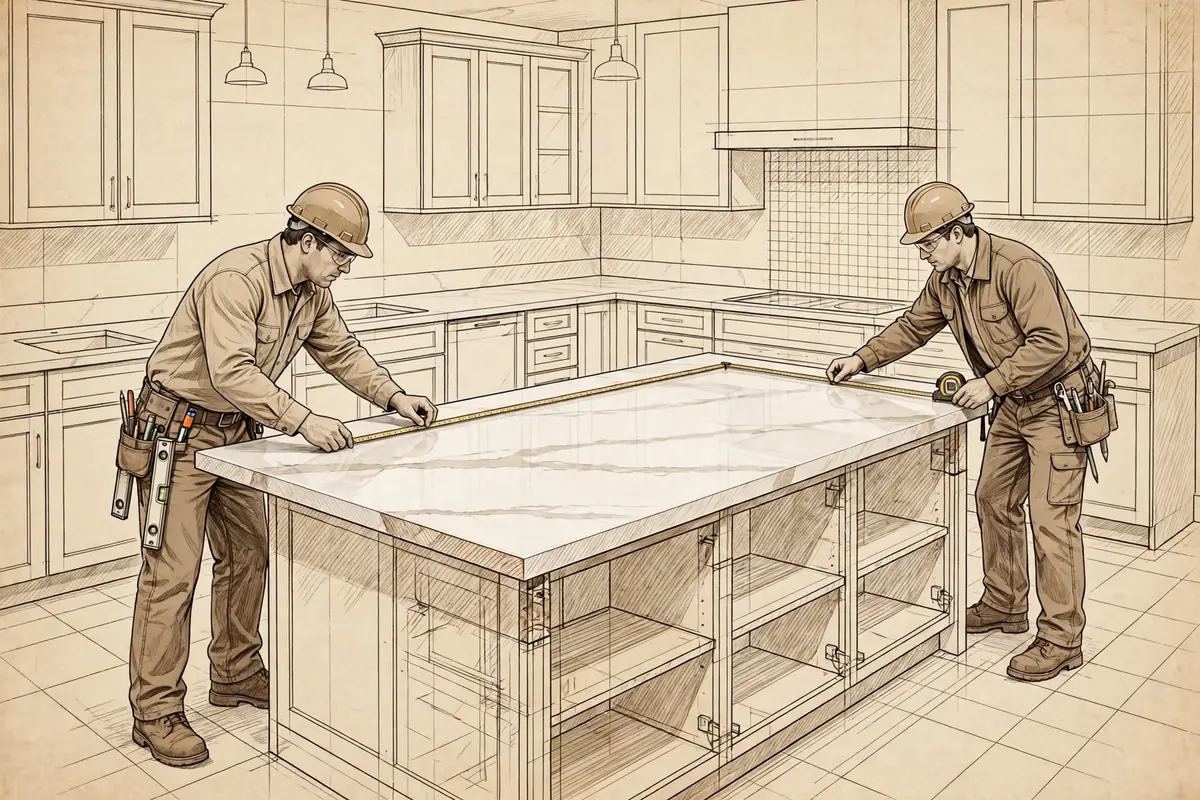
Quartz countertops cost $50–$200 per sq ft installed. See the material, fabrication and install breakdown, plus a worked example for a typical 45 sq ft kitchen.
If you are pricing a kitchen remodel, the countertop is usually the line item that surprises people most. Quartz looks like natural stone, behaves better than most natural stone, and is priced by the square foot — but the headline rate you see in an advert is rarely the number on your final invoice. The slab, the cutting, the edge profile, the sink cutout and the old countertop coming out all get billed separately, and each one moves the total.
This guide breaks quartz countertop cost down the way an estimator would: material, fabrication and installation as separate numbers, then a full worked example for a typical 45 sq ft kitchen so you can see exactly where every dollar goes.
How Much Does Quartz Countertop Cost Per Square Foot?
Installed, quartz countertops in the United States typically cost $50 to $200 per square foot in 2026, with most kitchens landing in the $70 to $100 per square foot mid-range. The spread is wide because "quartz" covers everything from plain builder-grade slabs to book-matched designer patterns that are priced almost like marble.
- Entry level ($50–$70 per sq ft installed): solid colours and simple speckled patterns, 2 cm or 3 cm thick, eased edge. The workhorse choice for rentals and budget remodels.
- Mid-range ($70–$100 per sq ft installed): the bulk of the market. Marble-look veining, name brands such as Cambria, Silestone and Caesarstone, standard edge profiles included.
- Premium ($100–$150 per sq ft installed): bold veining, rare colours, thicker mitred edges, large-format slabs with fewer seams.
- Luxury ($150–$200+ per sq ft installed): exotic patterns, book-matched slabs, waterfall edges and full-height backsplashes.
A useful rule of thumb: for a standard 2 ft deep run of countertop, one linear foot equals roughly two square feet, so a $85 per sq ft rate is about $170 per linear foot. Estimators switch between the two freely, and checking which unit a quote uses is the first thing to do before comparing prices.
What Drives the Price of Quartz?
Five factors decide whether your quote lands at the bottom or the top of that range.
1. Pattern and colour
Plain white, grey and black slabs are the cheapest because they are produced in the largest volumes. Marble-look slabs with heavy veining cost more, and the premium rises again for patterns that need vein-matching across a seam or around a corner. If a slab has to be cut so the veins line up, the fabricator uses more material — and charges for it.
2. Thickness
Quartz is sold in 2 cm (about 3/4 in) and 3 cm (about 1-1/4 in) thicknesses. The 3 cm slab is the standard for kitchens: it sits directly on the cabinets with no plywood substrate, spans a standard overhang without support, and looks more substantial at the edge. The 2 cm slab is cheaper per square foot but usually needs a plywood underlayment, which adds labour and material back in. For most kitchens, 3 cm works out cheaper overall.
3. Brand
Engineered quartz is about 90–93% ground quartz aggregate bound with 7–10% polymer resin, and the big brands all meet the same core standards — most are certified to NSF/ANSI 51 for food contact. What you pay for with a premium brand is a wider pattern range, tighter quality control and a longer warranty, typically 10 years to lifetime for residential use. Lesser-known brands can be 15–25% cheaper for an equivalent look.
4. Edge profile
A simple eased or pencil edge is usually included in the installed rate. Stepped, bullnose and ogee profiles add $5 to $15 per linear foot, and a mitred edge — where two pieces are joined at 45° to fake a 2 in or 3 in thick slab — can add $20 or more per linear foot.
5. Slab size and seams
A standard quartz slab measures roughly 120 in × 56 in, or about 46.7 sq ft. Any single run longer than about 10 ft needs a seam, and L-shaped kitchens and islands almost always need two slabs even when the total area would fit on one. Expect a waste factor of 15–20% on the slab quantity for a typical kitchen layout.
Material vs Fabrication vs Installation: The Real Breakdown
That single "per square foot installed" figure hides three different costs. Here is how a mid-range job typically splits:
- Material (the slab): $25–$75 per sq ft. The slab itself, priced by grade and brand. This is the biggest single chunk, roughly half the total.
- Fabrication: $10–$25 per sq ft. Cutting to template, polishing edges, cutting the sink and tap holes, and finishing. Complex layouts, undermount sinks and tight corners push this up.
- Installation: $10–$20 per sq ft. Delivery, setting the tops, levelling, seaming and sealing the joints. Two installers, suction cups and a lot of care — a 3 cm quartz top weighs about 14 lb per sq ft, so a 45 sq ft kitchen is over 600 lb of stone.
On top of the per-square-foot rate, budget for the extras that appear on nearly every invoice: an undermount sink cutout ($100–$400), tap and soap-dispenser holes ($25–$75 each), edge-profile upgrades, removal and disposal of the old countertop ($100–$500), and a plumber to disconnect and reconnect the sink and taps ($150–$350).
Worked Example: A 45 Sq Ft Kitchen
Take a typical L-shaped kitchen with an island, using mid-range marble-look quartz at $85 per sq ft installed.
Step 1 — Measure the area. Main run: 12 ft long × 2 ft deep = 24 sq ft. Island: 7 ft long × 3 ft deep = 21 sq ft. Total countertop area = 24 + 21 = 45 sq ft.
Step 2 — Split the installed rate. Material at $45 per sq ft: 45 × $45 = $2,025. Fabrication at $20 per sq ft: 45 × $20 = $900. Installation at $15 per sq ft: 45 × $15 = $675. Subtotal: $2,025 + $900 + $675 = $3,600.
Step 3 — Add the extras. Undermount sink cutout $250, plus tap-hole drilling $75. Ogee edge upgrade on the island's 14 linear ft of exposed edge at $10 per linear foot: 14 × $10 = $140. Removal and disposal of the old laminate tops: $300. Extras total: $250 + $75 + $140 + $300 = $765.
Step 4 — Total. $3,600 + $765 = $4,365 for the whole job, or $4,365 ÷ 45 = $97 per sq ft all-in. That is the number to compare against other quotes — not the $85 headline rate, which excluded every extra.
Two practical notes from this example. First, the slab maths: one standard slab covers 46.7 sq ft, so on paper one slab is enough — but the L-shape and the island cut so awkwardly that the fabricator will order two slabs, and the offcuts go to waste. Second, the weight: 45 sq ft at 14 lb per sq ft is about 630 lb, which is why installation is a two-person job and why the cabinets underneath must be level and firmly fixed before templating.
Costs People Forget to Budget For
- Overhang support: a 3 cm quartz top can overhang unsupported by about 10–12 in. A breakfast-bar overhang beyond that needs steel brackets or corbels, at $50–$150 each installed.
- Backsplash: a matching quartz backsplash runs $10–$20 per sq ft, and a full-height slab backsplash behind the cooker can add $800–$2,000.
- Plumbing: the sink and taps must be disconnected before the old top comes out and reconnected after. If the new sink is a different size, the waste and supply lines may need moving too.
- Seams: runs over 10 ft need a joined seam. A good fabricator places it where it is least visible — over the dishwasher or near a corner — but vein-matched seams take longer and cost more.
- Template and measure: most fabricators include laser templating in the price, but some charge $100–$250 for the site visit if you do not proceed with the order.
Quartz vs Granite vs Butcher Block: Cost Compared
Quartz is rarely the cheapest option, but it is usually the cheapest to live with. Granite runs $60–$120 per sq ft installed for comparable quality, and exotic granite can exceed quartz. The difference is maintenance: granite is porous and needs resealing every 1–2 years, while quartz, with its resin binder, never needs sealing. Butcher block is cheaper upfront at $40–$80 per sq ft installed, but it needs regular oiling, scratches and stains easily, and is a poor choice around a sink. Laminate is the budget option at $20–$50 per sq ft, but it has a fraction of the lifespan.
On heat, quartz has one honest weakness: the resin binder can scorch or discolour if a very hot pan sits directly on it, generally above about 150 °C (300 °F). Granite tolerates heat better. In practice this means using a trivet — a small habit that protects a large investment.
How to Keep the Cost Down
- Choose a common pattern. Solid colours and light speckles can be 20–30% cheaper than bold marble-look slabs.
- Keep the edge simple. An eased edge is included; an ogee or mitred edge on a long run adds hundreds of dollars.
- Reduce the slab count. If your layout can be cut from a single slab with minimal waste, ask the fabricator — it is the single biggest saving available.
- Use a remnant for small jobs. A bathroom vanity or laundry top can often be cut from a fabricator's offcut at half price or less.
- Get three itemised quotes. Ask each fabricator to split material, fabrication, installation and extras. Two quotes at the same headline rate can be $1,000 apart once the extras are counted.
Frequently Asked Questions
How much does a typical kitchen quartz countertop cost?
For a mid-range quartz at $70–$100 per sq ft installed, a typical kitchen with 35–55 sq ft of countertop costs $3,500–$7,000 all-in, including sink cutout and removal of the old tops. Our worked example — 45 sq ft with extras — came to $4,365.
Is quartz cheaper than granite?
Often, yes, at the entry and mid-range. Basic quartz starts around $50 per sq ft installed against $60 for granite, and quartz needs no sealing, so the lifetime cost is usually lower. Exotic granite can still undercut premium quartz on the slab alone.
Does quartz need sealing?
No. The resin binder fills the pores, so quartz is non-porous and does not need sealing — one of its main advantages over granite and marble. Clean it with warm water and mild detergent; avoid abrasive pads and harsh solvents.
Can you put hot pans on quartz?
Not directly. The quartz aggregate is heat-resistant, but the resin binder is not, and sustained heat above about 150 °C (300 °F) can scorch or crack the surface. Always use a trivet or heat pad for hot pots and trays.
What thickness should I choose?
For kitchens, 3 cm (1-1/4 in) is the standard: it needs no plywood substrate, supports a normal overhang and looks right at the edge. The 2 cm (3/4 in) slab suits bathrooms, laundry rooms and vertical applications, where it is usually laminated to a built-up edge for appearance.
The bottom line is simple: budget on the all-in number, not the advertised rate. Measure your countertop area, split the quote into material, fabrication and installation, add the sink cutout and the old top's removal, and you will know what the job actually costs before anyone picks up a saw.
Calculations and engineering guides are for planning and educational reference. Verify final designs against applicable codes with a licensed Professional Engineer.