How Much Does Concrete Resurfacing Cost Per Square Foot?
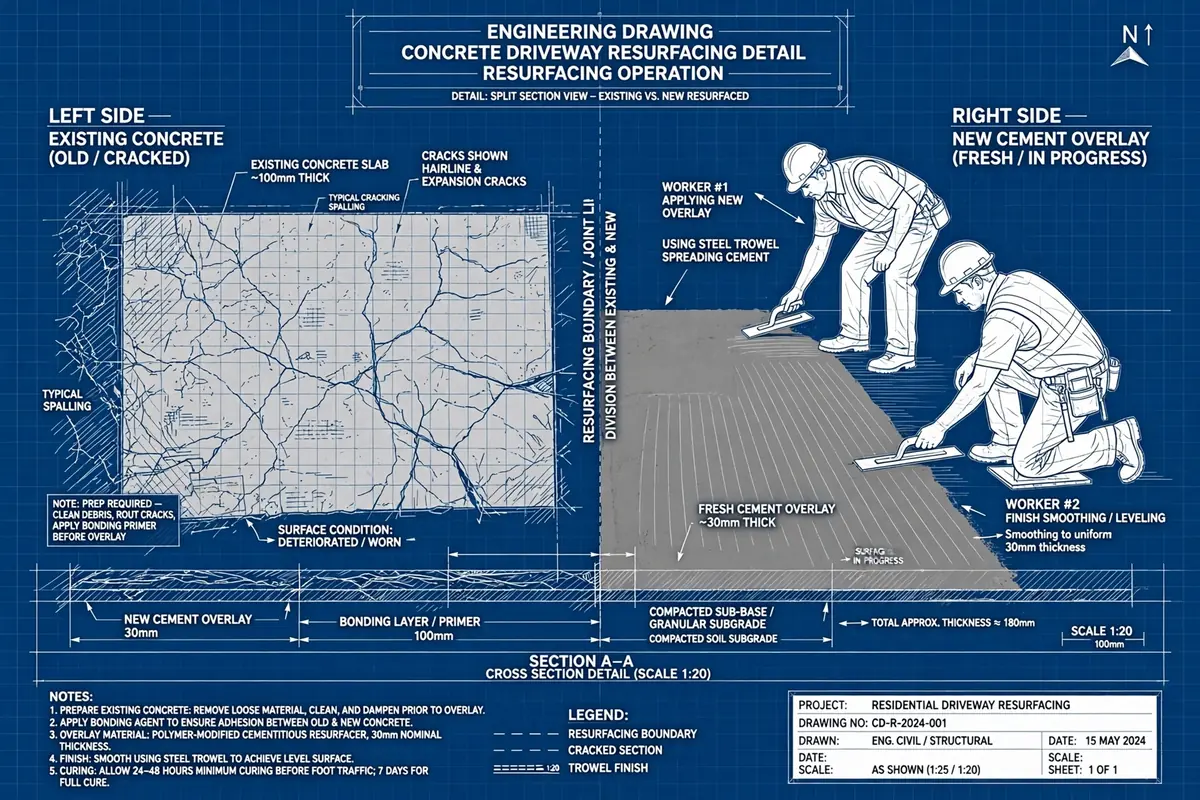
Concrete resurfacing costs – per square foot installed. We compare overlay vs full replacement, break down prep, materials and labour, and work a 600 sq ft driveway example.
When a driveway, patio or garage floor starts to look tired — hairline cracks, surface spalling, stains that no amount of pressure washing will shift — most homeowners face the same question: pay to resurface it, or tear it out and start again? Resurfacing is usually the cheaper answer by a wide margin, but only when the slab underneath is still sound. Get that judgement wrong and the new surface will crack along exactly the same lines within a year.
This guide breaks down what concrete resurfacing actually costs per square foot in the United States, what pushes the price up or down, and how it compares with full replacement. All figures are typical 2026 contractor rates; they vary by region, access and the condition of the existing slab.
How much does concrete resurfacing cost per square foot?
As a rule of thumb, concrete resurfacing costs $3 to $8 per square foot installed by a professional contractor. A basic grey cement-based overlay on a sound, well-prepared slab sits at the bottom of that range. A decorative finish — stamped pattern, exposed aggregate, or a coloured stain — sits at the top, and can run past $8 per square foot on complex work.
For comparison, full removal and replacement typically costs $8 to $15 per square foot, including demolition and haul-off of the old slab. That means resurfacing usually saves 40 to 60 percent against replacement on the same area — which is exactly why it is the first option worth pricing.
- Basic overlay (grey, broom or trowel finish): $3–$5 per sq ft
- Stamped or textured overlay: $5–$8 per sq ft
- Coloured, stained or epoxy-coated overlay: $5–$10 per sq ft
- Full replacement (demolition + new slab): $8–$15 per sq ft
- DIY materials only (resurfacer + primer): $1–$2 per sq ft
Minimum charges apply on small jobs. Most contractors will not mobilise for less than $500 to $1,000, so a 100 sq ft porch repair can work out at $10 or more per square foot even though the unit rate looks low on a big driveway.
What is concrete resurfacing, exactly?
Resurfacing means bonding a thin new layer — typically 1/8 to 1/2 inch (3 to 12 mm) of polymer-modified cement — over the existing slab. The polymer in the mix is what makes it work: it gives the thin layer the flexural strength and bond it needs to stay attached to old concrete instead of curling off.
The work follows a fixed sequence, and skipping any step is how overlays fail:
- Cleaning: pressure washing and degreasing, because an overlay will not bond to oil, paint or loose dust.
- Repair: routing and filling cracks wider than about 1/8 inch, and cutting out any hollow or delaminated patches.
- Priming: a bonding agent or slurry coat brushed onto the damp old surface.
- Overlay: the resurfacer is poured, squeegeed to level, then troweled or broomed to the chosen finish.
- Curing: kept damp and protected from traffic for at least 24 to 48 hours, and from vehicles for 7 days.
ACI 318 does not govern resurfacing directly — it is a structural code — but its durability and cover principles still matter: the existing slab must be structurally sound, with no settlement, no through-slab cracking and no failed subgrade. If the slab is moving, an overlay is a cosmetic fix on a moving base, and it will fail.
What drives the price per square foot?
Condition of the existing slab. This is the biggest variable. A sound slab needing only a wash and prime adds almost nothing. A slab with dozens of cracks, spalled patches and oil stains can add $1 to $2 per square foot in repair and preparation before the overlay even starts.
Overlay thickness. A 1/8-inch skim coat uses roughly half the material of a 1/2-inch self-levelling pour. Thicker overlays are specified where the surface is uneven or where a new fall to a drain has to be created. As a guide, one 40 lb bag of polymer-modified resurfacer covers about 90 sq ft at 1/8 inch, or about 25 sq ft at 1/2 inch.
Finish. A plain broom finish is the cheapest. Stamping a stone or brick pattern adds labour and a release agent; a two-tone stain adds a second visit. Decorative finishes typically add $2 to $4 per square foot over a basic overlay.
Access and area. Large, open driveways are efficient: the crew sets up once and works fast. A small backyard patio reached through a side gate, or a garage that has to be emptied and kept clear for a week, costs more per square foot.
Region. Labour rates in the Northeast and West Coast run 20 to 30 percent above the national average; the South and Midwest sit below it. Material prices follow the same pattern, though less sharply.
Resurfacing vs replacement: a direct comparison
The honest way to choose is to look at the slab, not the price list. Resurfacing wins when the damage is cosmetic — surface wear, light cracking, discolouration, minor spalling. Replacement wins when the damage is structural.
- Resurface when: cracks are hairline to 1/8 inch, the slab is level, there is no settlement or rocking, and the surface is simply worn or ugly.
- Replace when: cracks run right through the slab, sections have settled or heaved by more than about 1/2 inch, the subgrade has failed, or tree roots have lifted panels.
- Resurfacing lasts 8 to 15 years with decent maintenance; a new slab lasts 25 to 40 years.
- Resurfacing takes 1 to 2 days plus a week of curing; replacement takes 3 to 5 days plus 28 days before heavy vehicle traffic.
One warning from site experience: never resurface a slab that is still moving. Fill the cracks, watch them for a season, and if they open again, the ground underneath is the problem — fix the drainage or the subgrade first, or budget for replacement.
Worked example: resurfacing a 600 sq ft driveway
Take a typical two-car driveway, 20 ft by 30 ft — 600 sq ft — with a sound slab, a dozen hairline cracks and a faded, stained surface. The homeowner wants a stamped stone pattern with a light grey stain.
Step 1 — Preparation. Pressure washing, crack routing and filling, and a bonding primer. Allow $600, which is $1.00 per sq ft — fair for a slab in average condition.
Step 2 — Overlay material. A stamped overlay at 3/8 inch thick. At $1.60 per sq ft for polymer-modified resurfacer, colour hardener and release agent, material comes to $960.
Step 3 — Labour and finishing. Pouring, stamping and sealing at $3.40 per sq ft gives $2,040.
Step 4 — Sealer. Two coats of acrylic sealer at $0.50 per sq ft adds $300.
Total: $600 + $960 + $2,040 + $300 = $3,900, or $6.50 per square foot.
Now compare that with full replacement of the same driveway. Demolition and haul-off at $2.00 per sq ft is $1,200. A new 4-inch slab at $8.00 per sq ft is $4,800. Add $400 for a new compacted base where the old one is disturbed, and the total is $6,400 — $10.67 per square foot. The overlay saves about $2,500, or 39 percent, and the driveway is back in use in a week instead of a month.
Run the same maths on a basic grey overlay instead of stamped: preparation $600, material $720, labour $1,800, sealer $300 — $3,420, or $5.70 per square foot. The finish choice alone moves the total by nearly $500 on this size of job.
DIY vs hiring a contractor
A competent DIYer can resurface a small patio for the cost of materials — roughly $1 to $2 per square foot — using bagged resurfacer from a builders' merchant. The catch is the working window: polymer-modified mixes start to set in 20 to 30 minutes, and a stamped finish needs two people working fast. A 600 sq ft driveway is a two-person job at minimum, and a first-timer should not attempt a decorative finish on that scale.
Hire a contractor when the area is over about 300 sq ft, when a stamped or stained finish is wanted, or when the slab needs more than cosmetic repair. Ask for a price broken into preparation, material and labour — if preparation is not listed separately, it has probably been skipped in the quote, and that is where overlays fail.
How long does resurfacing last, and what maintenance does it need?
A properly bonded overlay on a sound slab lasts 8 to 15 years. The sealer is the weak link: re-seal every 2 to 3 years, keep de-icing salts off it in winter, and clean oil spills quickly, since oil softens most acrylic sealers. In freeze-thaw climates, the bond is tested every winter, so preparation quality matters even more — and a thin 1/8-inch skim coat is a poor choice where water can sit and freeze.
Watch for the two early warning signs of a failing overlay: a hollow sound when tapped, which means it has debonded, and cracks that reappear in exactly the same place as the old ones, which means the old crack was never properly routed and filled. Both are fixable locally if caught early.
Frequently asked questions
Can you resurface cracked concrete?
Yes, if the cracks are hairline to 1/8 inch and the slab is not moving. Cracks must be routed and filled first; an overlay laid over an unfilled crack will reflect that crack through within months.
How thick is a concrete overlay?
Most cement-based resurfacers are applied 1/8 to 1/2 inch thick. Self-levelling overlays can go to 1 inch where a new fall is needed. Anything thicker than that is really a topping slab, not a resurfacing job.
Can you resurface a driveway yourself?
Small areas, yes — materials cost $1 to $2 per square foot. Large driveways and decorative finishes are best left to a crew, because the material sets in under 30 minutes and there is no time to learn on the job.
Is resurfacing cheaper than replacing concrete?
Almost always. Resurfacing runs $3 to $8 per square foot against $8 to $15 for full replacement — a saving of roughly 40 to 60 percent — provided the existing slab is structurally sound.
How soon can you drive on resurfaced concrete?
Foot traffic after 24 to 48 hours, light vehicles after 7 days. Full strength develops over 28 days, so keep heavy vehicles off it for the first month.
Calculations and engineering guides are for planning and educational reference. Verify final designs against applicable codes with a licensed Professional Engineer.