How Much Does Epoxy Garage Floor Coating Cost Per Square Foot?
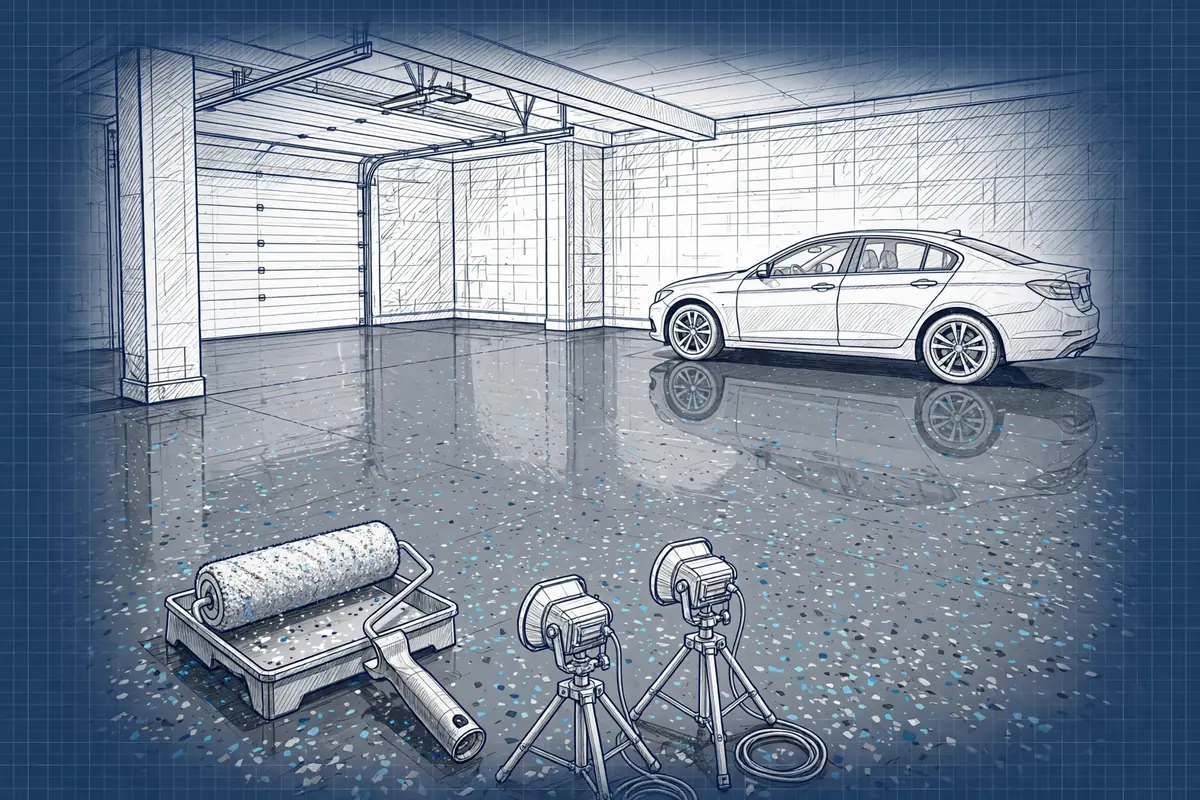
Epoxy garage floor coating costs $3–$12 per sq ft installed. We break down prep, materials, flakes and topcoat with a full worked 2-car garage example.
An epoxy garage floor looks simple from the doorway — a glossy grey slab with a sprinkle of coloured flakes. What most homeowners never see is where the money actually goes. On a typical two-car garage, the coating itself is often the smallest line on the invoice. Surface preparation, crack repair, the flake broadcast and the topcoat can each cost more than the epoxy resin. That is why quotes for the "same job" can range from $3 to $12 per square foot, and why the cheapest quote is so often the one that peels in year two.
How Much Does Epoxy Garage Floor Coating Cost Per Square Foot?
For a professionally installed system, expect $3 to $12 per square foot, all-in. A basic one-coat water-based epoxy sits at the bottom of that range. A full solid-epoxy flake system with a polyaspartic topcoat — the system most reputable contractors recommend — lands in the middle, around $5 to $8 per square foot. A premium metallic or quartz system with moisture mitigation can reach $10 to $12.
DIY kits are cheaper on paper: $0.50 to $3.50 per square foot for materials alone. But that figure leaves out grinder rental, crack filler, and the cost of doing it twice when a water-based kit lifts off an unprepared slab.
- DIY water-based epoxy kit: $0.50–$1.50 per sq ft (materials only)
- DIY solid epoxy kit: $1.50–$3.50 per sq ft (materials only)
- Pro single-coat epoxy: $3–$5 per sq ft installed
- Pro solid epoxy with flake broadcast: $5–$8 per sq ft installed
- Pro metallic, quartz or polyaspartic system: $8–$12 per sq ft installed
What Is Epoxy, and Why Do Prices Vary So Much?
Epoxy is a two-part thermosetting resin: a resin and a hardener that cross-link into a hard, chemical-resistant film once mixed. The percentage of solids in the mix is the single biggest quality difference. Water-based epoxies are roughly 50% solids — half the wet film evaporates away, leaving a thin coat of about 2–3 mils (a mil is one-thousandth of an inch). A 100%-solids epoxy leaves everything on the floor, building 8–10 mils in a single coat, with far better abrasion resistance and service life.
The second cost driver is preparation. Epoxy bonds mechanically to concrete, not chemically. It needs a clean, open, profiled surface — what the industry calls a concrete surface profile of CSP 2–3, roughly the texture of 80-grit sandpaper. Achieving that takes diamond grinding or shot blasting, and it is the step most DIY jobs skip and most cheap contractors rush.
Cost Breakdown: Where Every Dollar Goes
1. Surface preparation: $1.00–$2.00 per sq ft
Preparation is usually 20–30% of the total job cost, and it is the one step you cannot shortcut. A proper prep includes sweeping and degreasing, diamond grinding the whole floor, chasing and filling cracks, and testing for moisture. Grinder rental alone runs $150–$250 per day for a walk-behind machine, and a contractor will typically charge $1.00–$2.00 per square foot for grinding, including dust extraction.
Crack repair is priced separately, usually $1.00–$2.00 per linear foot. A garage with 40 linear feet of hairline cracks adds $40–$80. Any oil staining has to be degreased and often ground out — epoxy will not bond to oil-soaked concrete.
2. Moisture testing and mitigation: $0–$3.00 per sq ft
Moisture vapour rising through the slab is the number one cause of epoxy delamination. Before coating, a contractor should test to ASTM F1869 (calcium chloride test, limit 3 lb per 1,000 sq ft per 24 hours) or ASTM F2170 (in-situ relative humidity probe, limit 75% RH). A slab that fails needs a moisture-mitigation primer, typically a two-part epoxy vapour barrier at $1.00–$3.00 per square foot.
3. Epoxy primer and base coat: $1.50–$3.00 per sq ft
The primer seals the concrete and the base coat builds the film thickness and carries the colour. Material cost depends on the solids content and the coverage rate. Coverage follows a simple rule: one gallon of epoxy covers 1,604 square feet at 1 mil thickness. So at 10 mils, one gallon covers about 160 square feet:
Coverage = 1,604 ÷ film thickness in mils = 1,604 ÷ 10 = 160 sq ft per gallon
A 440 sq ft garage at 10 mils needs 440 ÷ 160 = 2.75 gallons, so you buy 3 gallons. At roughly $60 per gallon for a quality 100%-solids product, that is about $180 in base-coat material — before flakes, topcoat or labour.
4. Decorative flakes: $0.50–$1.50 per sq ft
Vinyl colour flakes do two jobs: they hide dirt and tyre marks, and they add slip resistance. A light "sprinkle" broadcast uses about 1 lb of flakes per 100 sq ft and costs around $0.50 per square foot. A full broadcast — flakes thrown until the wet epoxy is completely covered — uses roughly 1 lb per 25–30 sq ft and runs $1.00–$1.50 per square foot. Full broadcast is the standard for a showroom look and gives the best texture underfoot.
5. Topcoat: $1.00–$2.50 per sq ft
The topcoat is the wear layer. A clear epoxy topcoat is the budget option at $1.00–$1.50 per square foot. A polyaspartic topcoat costs $1.75–$2.50 per square foot but cures in hours instead of days, resists UV yellowing, and stands up better to hot-tyre pickup — where hot tyres soften a cheap topcoat and pull it off the slab.
6. Labour: $1.00–$2.50 per sq ft
Labour covers the crew's time across the two or three days a flake system takes: day one for grinding and prep, day two for primer, base coat and flakes, day three for scraping the loose flakes and rolling the topcoat. Rates vary by region, but $1.00–$2.50 per square foot is typical for an experienced two-person crew.
Worked Example: A 440 Sq Ft Two-Car Garage
Take a standard two-car garage, 20 ft × 22 ft — 440 sq ft — with a mid-range system: diamond-ground prep, solid epoxy base coat, full flake broadcast, and a polyaspartic topcoat.
Step 1 — Area: 20 ft × 22 ft = 440 sq ft.
Step 2 — Surface prep: diamond grinding at $1.50 per sq ft → 440 × $1.50 = $660. Crack repair: 40 linear feet at $1.50 per ft → $60.
Step 3 — Primer and base coat: 3 gallons of 100%-solids epoxy at $60 per gallon → $180 in material, plus application labour rolled into the crew rate below.
Step 4 — Flakes: full broadcast, 15 lb at $8 per lb → $120.
Step 5 — Topcoat: polyaspartic at $1.75 per sq ft → 440 × $1.75 = $770.
Step 6 — Labour: two-person crew, two and a half days, at $1.00 per sq ft → 440 × $1.00 = $440.
Step 7 — Total: $660 + $60 + $180 + $120 + $770 + $440 = $2,230 in direct costs. With overhead, profit and a 5% contingency, the quoted price lands around $3,300, or $7.50 per square foot.
That $7.50 figure sits squarely in the $5–$8 band for a professional flake system, which is exactly where it should be. If a quote for the same scope comes in at $4 per square foot, something has been left out — usually the grinding, the moisture test, or the topcoat.
A DIY kit for the same 440 sq ft garage runs roughly $700–$1,200 in materials plus $200–$300 for a grinder rental, degreaser and crack filler — about $1,000–$1,500 all-in. That saves around $1,800 against the professional quote, but it comes with three risks a first-timer should weigh honestly. First, coverage: a kit that promises 500 sq ft per coat usually assumes a smooth, sealed slab and a 3-mil film. On a ground, open slab the epoxy soaks in and the real coverage is closer to 300 sq ft, so you run short mid-coat. Second, timing: once the two parts are mixed, the pot life is 30–45 minutes at 70°F. A two-person team can roll 440 sq ft in that window; one person working alone usually cannot. Third, warranty: a professional system typically carries a 5- to 15-year warranty against peeling and delamination. A DIY kit carries none.
What Makes the Price Go Up (or Down)
- Slab condition: a new, clean slab needs only grinding. An old slab with oil stains, spalling or previous coatings can add $1–$2 per sq ft in prep.
- Moisture: a failed ASTM F2170 test adds a vapour-barrier primer at $1–$3 per sq ft.
- System thickness: each extra coat of epoxy adds roughly $1–$1.50 per sq ft in material and labour.
- Decorative options: metallic pigments add $2–$4 per sq ft; quartz aggregate adds $1.50–$3 per sq ft.
- Region and season: labour rates in major metros run 20–30% higher than the national average, and epoxy should not be applied below 50°F or above 85°F.
- Garage size: a one-car garage (about 240 sq ft) costs more per square foot than a three-car garage (about 660 sq ft), because fixed costs like grinder delivery and crew mobilisation are spread over fewer square feet.
Curing Times: When Can You Park on It?
Cure times assume a slab and air temperature around 70°F (21°C). At 50°F, cure times roughly double.
- Foot traffic: 24 hours after the topcoat
- Light vehicle traffic: 72 hours
- Full cure and heavy use: 7 days
- Polyaspartic topcoat: foot traffic in 4–6 hours, vehicles in 24 hours
Do not rush this. Parking a car on a floor that has only cured for 48 hours is the fastest way to get hot-tyre pickup, and there is no cheap fix — the damaged area has to be ground back and recoated.
How Long Does an Epoxy Garage Floor Last?
A professionally installed 100%-solids system with a polyaspartic topcoat should last 10–15 years in a residential garage. A water-based DIY kit typically lasts 2–5 years before it starts showing wear in the tyre tracks. ACI 302.1R, the guide for concrete floor construction, stresses that the coating is only as good as the surface it bonds to — and that applies to epoxy just as much as to the concrete itself.
Frequently Asked Questions
How much does epoxy garage floor coating cost for a 2-car garage?
A two-car garage of about 440 sq ft costs $1,300–$3,500 professionally installed. A basic single-coat job is at the low end; a solid-epoxy flake system with a polyaspartic topcoat is around $3,000–$3,500. DIY materials for the same garage run $700–$1,500.
Is epoxy flooring worth it for a garage?
Yes, for most owners. It protects the concrete from oil, road salt and freeze-thaw damage, makes the floor far easier to clean, and adds a finished look that buyers notice. The payback is in slab protection — a coated slab does not spall and dust the way a bare one does.
Can you epoxy over a painted or sealed garage floor?
Not without removing the old coating first. Epoxy bonds to bare concrete, not to paint or sealer. The old coating has to be ground or shot-blasted off, which adds $0.50–$1.50 per square foot to the prep cost.
Why is my epoxy floor peeling?
Usually moisture vapour from the slab, oil contamination, or inadequate surface profiling. Moisture is the most common: if the slab was never tested to ASTM F1869 or F2170, vapour pressure lifts the coating from below.
How much does it cost to epoxy a 3-car garage?
A three-car garage of about 660 sq ft costs $2,000–$5,300 professionally installed at $3–$8 per square foot. The per-square-foot rate is lower than a two-car garage because fixed costs are spread over more area.
The Bottom Line
Epoxy garage floor coating costs $3–$12 per square foot installed, with the sweet spot for most homeowners being a solid-epoxy flake system with a polyaspartic topcoat at $5–$8 per square foot. For a standard two-car garage that works out to roughly $3,300. On any quote, check the preparation line and the topcoat line — if either is missing or suspiciously cheap, the floor will show it within two years.
Calculations and engineering guides are for planning and educational reference. Verify final designs against applicable codes with a licensed Professional Engineer.