How Much Does Stucco Installation Cost Per Square Foot?
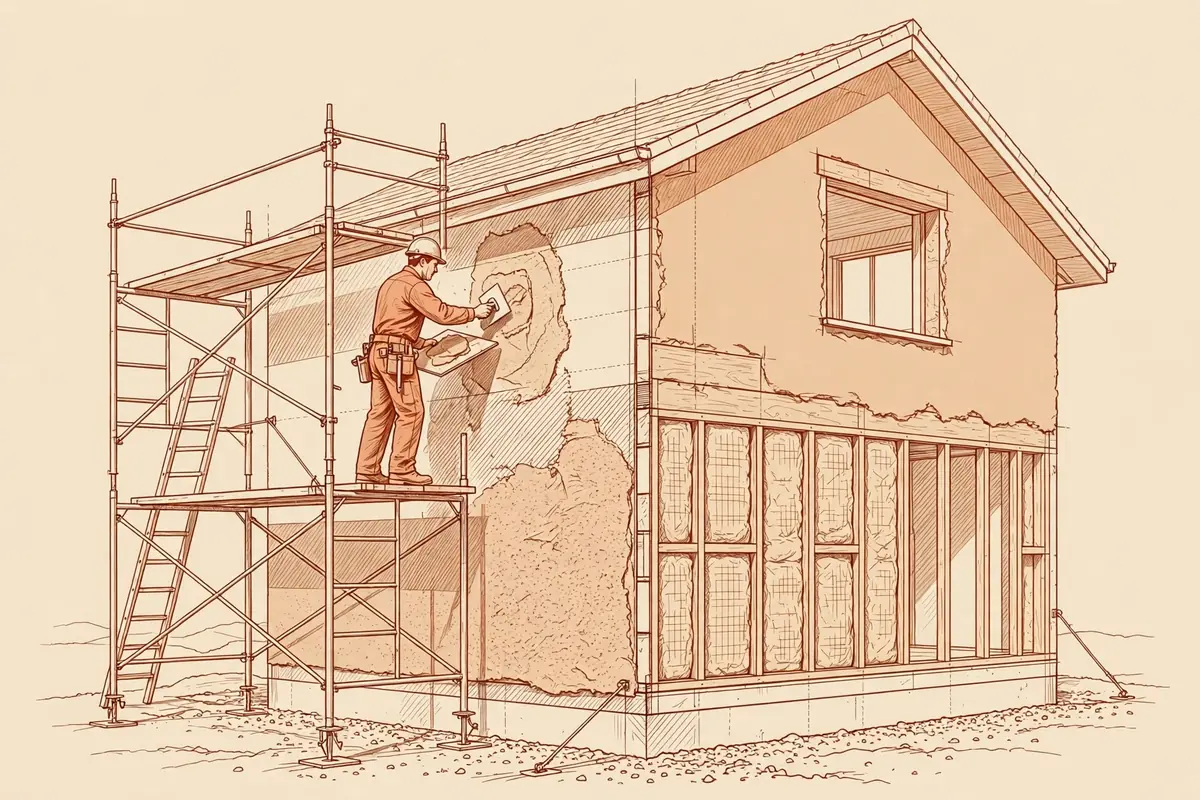
Stucco installation costs $7–$15 per sq ft in 2026. Compare traditional vs synthetic stucco, prep and finish costs, with a full worked example.
Stucco is one of the oldest exterior finishes in the book, and it is still one of the most durable — a properly installed three-coat stucco wall can last 50 years or more with little more than a wash and a repaint. The catch is that stucco is labour-heavy work done in layers, so the price depends as much on the crew and the preparation as on the material itself. In 2026, expect to pay $7 to $15 per square foot installed for stucco on a typical house, with most straightforward jobs landing between $9 and $12 per square foot.
This guide breaks down what sits behind that range: the difference between traditional cement stucco and synthetic (EIFS) systems, what preparation and finish work really cost, and a full worked example for a 1,800 sq ft wall area so you can check a contractor's quote line by line.
Stucco installation cost at a glance
Prices below are installed costs per square foot of wall area, including material and labour, for a typical single-family house in the US in 2026. Regional labour rates move these numbers by 10–20% either way.
- Traditional three-coat stucco (new construction): $8–$13 per sq ft
- Synthetic stucco / EIFS: $7–$12 per sq ft
- One-coat stucco system: $7–$10 per sq ft
- Re-stucco over existing stucco: $8–$12 per sq ft
- Stucco repair (patching and blending): $10–$18 per sq ft, because small areas carry the same setup cost
- Stucco finish coat only (recoat): $3–$6 per sq ft
As a rule of thumb, labour makes up 45–55% of the total, materials 30–35%, and preparation, scaffolding and clean-up the rest. Any quote that is far below $7 per sq ft for a full system should raise questions — it usually means a coat has been skipped or the preparation has been cut short.
Traditional stucco vs synthetic stucco (EIFS)
The two systems look similar from the street but are built very differently, and the choice affects both price and performance.
Traditional cement stucco
Traditional stucco is Portland cement, sand, lime and water, applied in three coats over metal lath to a total thickness of about 7/8 in. (22 mm), as set out in ASTM C926. The scratch coat keys into the lath, the brown coat levels the wall, and the finish coat gives the colour and texture. It is hard, breathable and fire-resistant, and it suits dry and mixed climates well. The downside is time: each coat needs to cure before the next goes on, so a full job takes a week or more, and that is where the labour cost sits.
Synthetic stucco (EIFS)
EIFS — Exterior Insulation and Finish System — is a foam board glued or mechanically fixed to the wall, covered with a fibreglass mesh embedded in a polymer base coat and a synthetic acrylic finish. It is lighter, faster to install and adds real insulation value (typically R-4 to R-5 per inch of foam), which is why it often comes in slightly cheaper per square foot. The trade-off is that EIFS is less forgiving of trapped moisture: it needs careful detailing at windows, doors and roof junctions, and any water that gets behind the foam has nowhere to go. Modern drainable EIFS systems solve much of this, but they cost $1–$2 per sq ft more than the older barrier type.
For a house you plan to keep for decades, traditional stucco is the safer long-term bet in most climates. For a quick, well-insulated finish on a tight budget, EIFS is hard to beat — provided the installer is experienced with the system.
What drives the price per square foot?
Preparation of the substrate
Stucco is only as good as what it sticks to. On new framing the crew installs a water-resistive barrier, weep screed and metal lath — roughly $1.50–$2.50 per sq ft of that work. On an existing wall, preparation can be the biggest variable of all: removing failed stucco, repairing sheathing, replacing flashing or re-lathing can add $2–$5 per sq ft before a single bag of stucco is mixed. A contractor who skips the moisture inspection is not saving you money; he is hiding the cost until later.
Height, access and scaffolding
A single-storey ranch is the cheapest stucco job there is. Two-storey walls need scaffolding or pump access, which typically adds $0.75–$1.50 per sq ft to the job, and three-storey work more again. Steep sites, tight side yards and overhanging trees all slow the crew down and show up in the price.
Finish and texture
A standard sand float finish is included in most base prices. Heavier textures — dash, lace, Santa Barbara smooth, or a hand-troweled finish — add $0.50–$2.00 per sq ft, because they take a skilled hand and more time. Integral colour (pigment mixed into the finish coat) costs $0.50–$1.00 per sq ft more than a finish that will be painted, but it never peels and rarely needs repainting. A painted finish, by contrast, needs a fresh coat every 5–10 years at $1.50–$3.00 per sq ft each time.
Region and crew size
Stucco crews are most common in the Southwest, California and Florida, where competition keeps prices toward the low end of the range. In regions where stucco is rare, expect to pay 15–25% more — fewer crews, longer travel, and materials shipped further. Always get at least three quotes, and check that each one lists the same coats, the same system and the same preparation.
Worked example: stucco for a 1,800 sq ft wall area
Take a two-storey house with 1,800 sq ft of exterior wall area (not floor area — wall area is what stucco is priced on). The owner wants a traditional three-coat system with an integral-colour sand finish. The contractor's quote works out like this:
- Materials — cement, sand, lath, barrier, finish coat: $3.20 per sq ft × 1,800 = $5,760
- Labour — three coats, curing time, finishing: $4.60 per sq ft × 1,800 = $8,280
- Preparation and scaffolding — barrier, lath, weep screed, two-storey scaffold: $1.20 per sq ft × 1,800 = $2,160
- Finish and texture — integral colour, sand float finish: $1.00 per sq ft × 1,800 = $1,800
Total: $18,000, or $10.00 per sq ft. Add a sensible 10% contingency for hidden substrate repairs and the realistic budget becomes $19,800. If the same house were done in EIFS at $8.50 per sq ft, the total would be about $15,300 — a saving of roughly $2,700, against a shorter track record and a finish that needs more careful moisture detailing.
How many bags of stucco does that take?
A quick material check keeps the quote honest. A traditional system is 7/8 in. thick overall, so the volume of plaster for 1,800 sq ft is 1,800 × (0.875 ÷ 12) = 131.25 cu ft. One 80 lb bag of pre-mixed stucco yields about 0.6 cu ft, so the job needs roughly 131.25 ÷ 0.6 = 219 bags. Split by coat, that is about 94 bags for the 3/8 in. scratch coat, 94 for the 3/8 in. brown coat and 31 for the 1/8 in. finish coat. Add 5–10% for waste and spillage, and the order should be around 230–240 bags. If a quote lists far fewer bags than this for the same wall area, ask where the missing thickness went.
Re-stucco vs new stucco: which is cheaper?
Re-stuccoing over sound existing stucco is usually the cheaper route at $8–$12 per sq ft, because the old stucco becomes the substrate — the crew cleans it, repairs cracks, applies a bonding agent and builds up two fresh coats. But it only works when the existing stucco is solid and dry. If there is widespread cracking, delamination, or signs of moisture behind the wall, the old stucco has to come off first, and removal adds $1–$3 per sq ft plus disposal. A moisture probe and a few test patches before quoting are worth every cent: they are the difference between a $16,000 re-stucco and a $24,000 strip-and-replace that nobody budgeted for.
How to keep stucco costs down without cutting corners
- Schedule in the dry season. Stucco needs 48 hours of dry weather per coat for proper curing. Rain delays stretch the job and the labour bill.
- Choose integral colour. It costs a little more now and saves a full paint cycle later.
- Bundle the scaffolding. If the roof, gutters or windows also need work, do them while the scaffold is up.
- Fix the substrate first. Replacing flashing and sheathing during the stucco job is far cheaper than opening a finished wall later.
- Keep the finish simple. A standard sand float finish is a third of the price of a hand-troweled custom texture.
- Compare like with like. Make every contractor quote the same system, the same coats, the same finish and the same preparation — otherwise the cheapest quote is usually just the thinnest one.
One thing never to cut is curing time. ACI 524R, the guide to Portland cement-based plaster, recommends keeping each coat moist for at least 48 hours. A crew that rushes coats to finish a day early is building cracks into the wall that will show up within a year.
Frequently asked questions
How long does stucco installation take?
A 1,800 sq ft house takes roughly 7–10 working days for a traditional three-coat system, including curing time between coats. EIFS is faster, typically 4–6 days, because the foam and mesh system has no cement curing stages.
Is stucco cheaper than siding?
Installed, stucco at $7–$15 per sq ft sits between vinyl siding ($4–$8) and fibre-cement siding ($8–$14). Stucco wins on longevity and fire resistance; vinyl wins on upfront cost. Over a 30-year life, stucco often works out cheaper because it needs so little maintenance.
Does stucco add value to a house?
Yes — in markets where stucco is the expected finish, a sound stucco exterior supports resale value and kerb appeal. A cracked or stained stucco job does the opposite, so the quality of the installation matters more than the material itself.
Can stucco be applied in winter?
Only with care. Cement stucco should not be applied below 40°F (4°C) or when freezing is expected within 48 hours, and EIFS adhesives have similar limits. Cold-weather work needs heated enclosures, which add cost. If your climate has a real winter, stucco is a spring-to-autumn job.
How often does stucco need maintenance?
Very little. Wash it once a year, inspect the sealant at windows and penetrations, and repair hairline cracks as they appear. A painted stucco finish needs repainting every 5–10 years; an integral-colour finish may never need paint at all.
Stucco is not the cheapest exterior finish, but it is one of the few that can outlast the house it covers. Get the preparation right, give each coat its curing time, and the $10 per square foot you pay today is buying fifty years of wall.
Calculations and engineering guides are for planning and educational reference. Verify final designs against applicable codes with a licensed Professional Engineer.