How Much Does Vinyl Siding Installation Cost Per Square Foot?
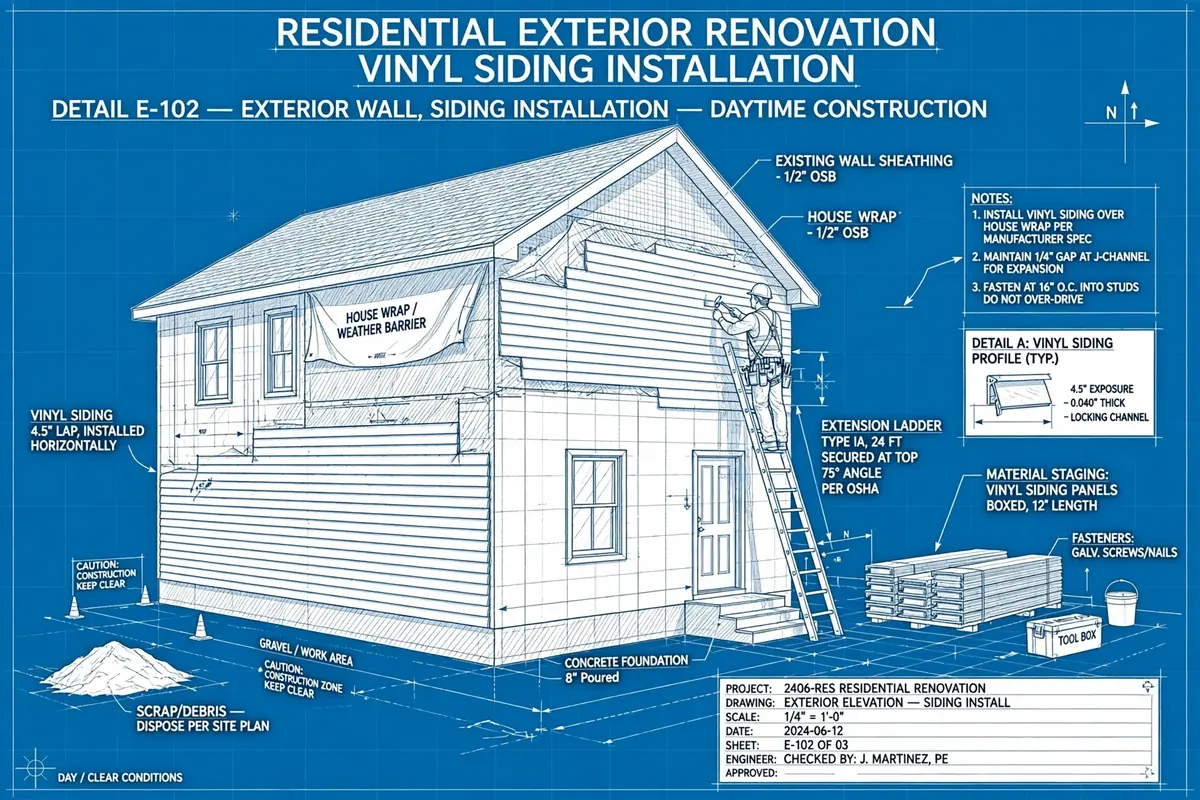
Vinyl siding installation costs $3–$8 per square foot installed. Material, labour and old-siding removal broken down with a worked example.
If you are pricing a re-side, the first number everyone asks for is the cost per square foot — and the honest answer is that it depends on what is hiding behind the old cladding. For a straightforward vinyl siding job in the United States, expect $3 to $8 per square foot installed, with most mid-range homes landing between $5 and $6.50. That range covers the panels, trim, house wrap, labour, and — when the old siding has to come off — removal and disposal. In this guide we break down each piece, explain what pushes a quote to either end of the range, and work through a full example for a typical single-storey house so you can check any contractor's estimate line by line.
What "per square foot" actually means
Siding is priced on wall area, not floor area. A 1,800 sq ft house does not have 1,800 sq ft of siding — it has roughly 1,500 to 2,200 sq ft of wall, depending on the footprint, ceiling height and number of storeys. Contractors also talk in squares: one square equals 100 sq ft of wall. So a 1,530 sq ft wall is about 15.3 squares of siding, and you will see panel prices quoted both ways. Before comparing quotes, confirm whether the price is per square foot of gross wall (measured before deducting windows and doors) or net wall (after deducting them). Gross is the more common estimating basis, because offcuts around openings are real waste — but the two bases can make the same job look 10–15% cheaper or dearer.
The cost breakdown: material, labour, removal
A typical installed price is made of five parts. The figures below are 2026 US national averages for standard horizontal vinyl siding on a straightforward single-storey home.
1. Vinyl panels — $1.00 to $2.50 per sq ft
The panel itself is the cheapest part of the job. Basic 0.040 in. thick clapboard in white or a light colour sits near $1.00–$1.40 per sq ft. Move to a thicker 0.044–0.046 in. panel, a darker colour, or a premium profile such as Dutch lap or board-and-batten, and the price climbs toward $2.00–$2.50. Thicker panels resist warping and oil-canning in hot sun, which is why most good contractors will not fit the thinnest stock on a south-facing wall. Insulated vinyl siding — panels with a foam backing bonded on — adds another $1.00 to $2.00 per sq ft and is priced as a separate upgrade, not as standard vinyl.
2. Trim and accessories — $0.50 to $0.80 per sq ft
Siding is never just panels. Starter strips, J-channels around every window and door, inside and outside corner posts, undersill trim, soffit and fascia all add up. On a plain rectangular house with few openings this runs about $0.50 per sq ft; on a house with lots of windows, gables and dormers it can reach $0.80. Do not let a quote skip the trim — it is typically 10–15% of the material bill, and skimping on it is how cheap jobs end up with water getting in behind the cladding.
3. House wrap and flashing — $0.20 to $0.35 per sq ft
A water-resistive barrier under the siding is not optional. Most vinyl jobs use a spun-bonded house wrap (Tyvek or similar) at roughly $0.20–$0.30 per sq ft, plus flashing tape at penetrations. If the old wrap is torn or missing, replacement is part of the price; if the sheathing underneath is rotten, that is repair work on top, usually billed separately once the wall is opened.
4. Labour — $2.00 to $4.00 per sq ft
Labour is the biggest single cost and the one that varies most by region. A two-person crew in a low-cost market may charge $2.00–$2.50 per sq ft; in high-cost metro areas, or on a two-storey house that needs scaffolding, $3.50–$4.00 is normal. A competent crew installs roughly 100–150 sq ft per worker per day on a straightforward wall, so a 1,500 sq ft job is about 5–7 working days for a two-person crew. Anything that slows the crew — cutting around stone veneer, working around a porch roof, or a wall that is badly out of plumb — shows up here, not in the material price.
5. Old siding removal and disposal — $0.50 to $1.00 per sq ft
If the old siding stays on and the vinyl goes over it, this line is zero — but that is only sensible when the old cladding is flat, sound and dry. Removing old vinyl or aluminium siding costs about $0.50–$0.75 per sq ft including haul-off. Removing wood siding, fibre cement or stucco runs $0.75–$1.00 or more, because it is heavier, often nailed rather than screwed, and fills more dumpster space. One warning: if the house was built before 1978, test for lead paint before anyone starts pulling boards off. Lead-safe removal adds cost, but it is a legal requirement, not an optional extra.
Worked example: a single-storey house
Take a typical single-storey house, 40 ft by 30 ft in plan, with 9 ft walls. Here is how the estimate is built up, step by step.
Step 1 — measure the gross wall area. Perimeter = 2 × (40 + 30) = 140 ft. Gross wall area = 140 × 9 = 1,260 sq ft. Add the two gable triangles: each gable is 30 ft wide and about 6 ft high at the peak, so 2 × (½ × 30 × 6) = 180 sq ft. Gross total = 1,440 sq ft.
Step 2 — deduct openings. Say the house has 12 windows at 15 sq ft each and 2 doors at 21 sq ft each: 12 × 15 + 2 × 21 = 222 sq ft. Net wall area = 1,440 − 222 = 1,218 sq ft.
Step 3 — price it at mid-range rates. Using $1.60 per sq ft for panels, $0.60 for trim, $0.25 for house wrap, $2.75 for labour and $0.75 for removal of the old vinyl siding:
- Panels: 1,218 × $1.60 = $1,948.80
- Trim and accessories: 1,218 × $0.60 = $730.80
- House wrap and flashing: 1,218 × $0.25 = $304.50
- Labour: 1,218 × $2.75 = $3,349.50
- Old siding removal and disposal: 1,218 × $0.75 = $913.50
- Subtotal: $7,247.10
Step 4 — add a waste allowance. Vinyl offcuts around windows, corners and gables run 8–12%. Apply 10% to the material lines only (panels, trim and wrap: $2,984.10), which adds $298.41. That is roughly 1.5 extra squares — in practice you would order 14 squares for this job (1,218 sq ft net ÷ 100, plus waste, rounded up).
Total: $7,247.10 + $298.41 = $7,545.51, or about $6.19 per sq ft of net wall. That is squarely in the middle of the $3–$8 national range. If the old siding had stayed on, the same job would come to roughly $6,632, or $5.44 per sq ft — but only if the old wall was flat and sound enough to take new siding over it.
What pushes the price up (or down)
Height and access. A two-storey wall costs more per square foot than a single-storey one, because the crew works from scaffolding or pump jacks and every panel has to be carried up. Budget an extra $0.50–$1.00 per sq ft above the first storey.
Shape of the house. Long, straight walls are fast. Gables, dormers, bay windows, arched tops and lots of small openings all slow the crew and generate more offcut waste. A house with a complicated elevation can cost 15–25% more per square foot than a plain box of the same area.
Panel choice. Standard clapboard is the baseline. Dutch lap, beaded profiles, vertical board-and-batten and insulated panels all cost more — insulated vinyl in particular can push the installed price to $8–$12 per sq ft, which is a different budget conversation entirely.
Condition of the wall underneath. Rotten sheathing, missing house wrap, or a wall that is badly out of plumb all add repair time that no per-square-foot rate covers. A good contractor will flag this after stripping a test section, not after the whole house is bare.
Region. Labour rates in the Northeast and West Coast run 20–40% above the national average; the South and Midwest are usually below it. Material prices are more uniform, since panels ship nationally, but delivery and dumpster fees vary by market.
How to check a contractor's quote
Ask for the quote broken into the five lines above — panels, trim, wrap, labour, removal — with the wall area stated and the waste percentage shown. Then check three things. First, is the wall area measured gross or net, and does it match your own rough measurement (perimeter × height, minus openings)? Second, is the panel thickness and profile actually named, with a manufacturer and colour? A quote that just says "vinyl siding" is a quote that can be delivered in the cheapest stock available. Third, does it include a waste allowance of at least 8%? If it does not, the crew will either run short or you will be charged for extra material later.
Also confirm what is not in the price: permits (typically $100–$400), painting of any new trim that is not factory-finished, repair of rotten sheathing, and disposal fees if the old siding contains lead paint. Those are the four items most likely to appear as a surprise variation.
Is vinyl siding worth it at this price?
Vinyl is the cheapest cladding you can buy that still looks respectable and needs almost no maintenance — no painting, no sealing, just a wash down once a year. A properly installed job lasts 20–40 years, and the Vinyl Siding Institute's installation standard (ASTM D4756) is the benchmark to hold a contractor to: panels nailed loosely in the centre of the slot so they can expand and contract, with a ¼ in. gap at J-channels for thermal movement. The failure mode to watch for is not the material but the fitting — panels nailed tight split in cold weather and buckle in heat. That is a workmanship issue, and it is exactly why the cheapest quote is rarely the cheapest job.
Frequently asked questions
How much does it cost to side a 1,500 sq ft house?
For a 1,500 sq ft floor area house, the wall area is usually 1,600–2,000 sq ft, so expect roughly $8,000–$13,000 installed at $5–$6.50 per sq ft, before any sheathing repairs. Measure the walls, not the floor plan.
Can vinyl siding go over old siding?
Yes, if the old siding is flat, firmly attached and dry, and local code allows it. It saves the $0.50–$1.00 per sq ft removal cost, but it hides whatever is wrong underneath and can make windows and trim look recessed. Most contractors prefer to strip, inspect and re-wrap.
How long does installation take?
A two-person crew covers about 100–150 sq ft per worker per day. A 1,500 sq ft wall is roughly 5–7 working days; a two-storey house or a complex elevation can take two weeks.
Does insulated vinyl siding cost more?
Yes — about $1.00–$2.00 more per sq ft installed, taking the total to roughly $8–$12 per sq ft. It adds modest R-value and a stiffer, flatter look, but it does not replace wall insulation.
What is the cheapest vinyl siding per square foot?
Thin 0.040 in. white clapboard, installed over existing siding on a single-storey house in a low-cost market, can come in near $3.00 per sq ft. Below that figure, suspect the panel quality, the fitting, or both.
Calculations and engineering guides are for planning and educational reference. Verify final designs against applicable codes with a licensed Professional Engineer.