How Much Does Tile Flooring Cost Per Square Foot?
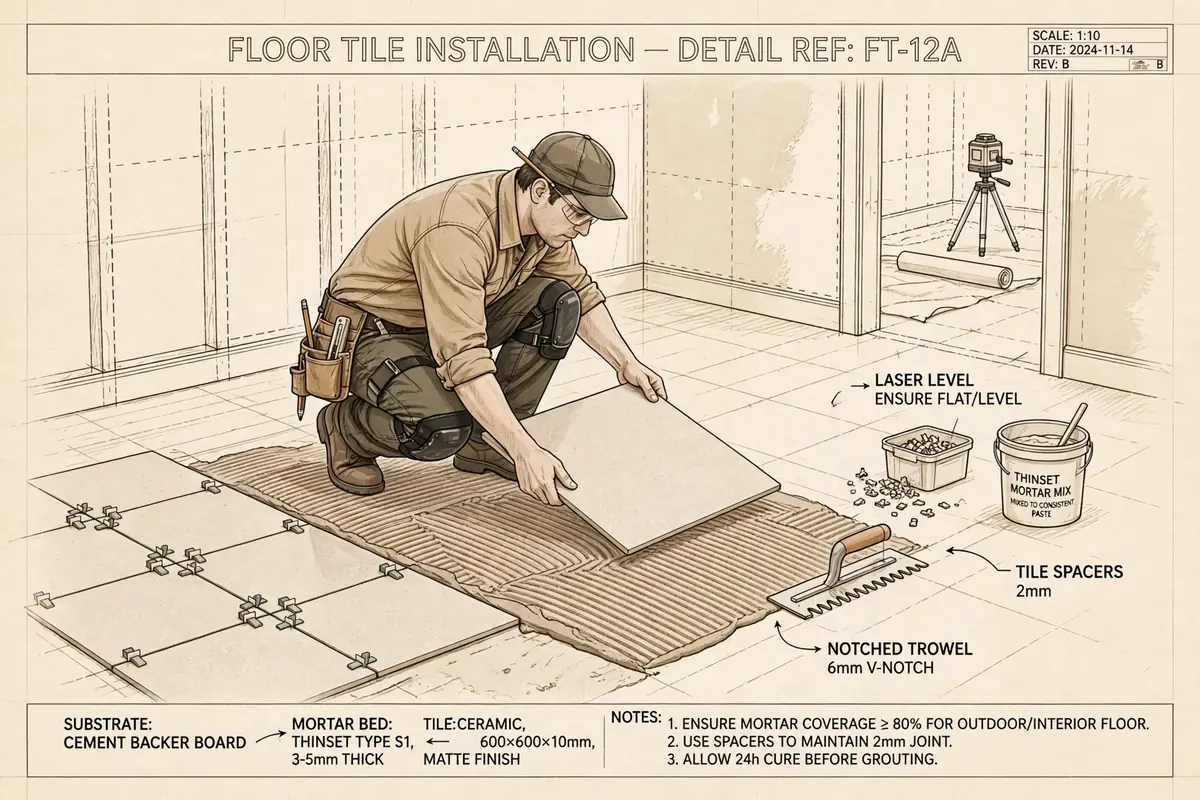
Tile flooring costs $8–$25 per square foot installed. Compare ceramic vs porcelain prices, labour rates and a full worked example for a 200 sq ft room.
If you are pricing a kitchen, bathroom or hallway floor, tile is one of the few finishes where the sticker price of the box tells you almost nothing about what the job will actually cost. The tile itself is often the cheapest line on the quote. Labour, thinset, underlayment, grout, trim and waste add up fast, and the gap between a budget ceramic job and a large-format porcelain job can be two or three times the price per square foot. This guide breaks down every piece of the cost, compares ceramic and porcelain honestly, and finishes with a fully worked example for a 200-square-foot kitchen so you can check a contractor's quote line by line.
Tile flooring cost per square foot at a glance
For a standard residential installation in the United States, expect to pay $8 to $25 per square foot installed, materials and labour combined. That range is wide because it covers two very different jobs: a basic ceramic tile in a square room at the low end, and a large-format porcelain tile with levelling systems and pattern work at the high end.
- Ceramic tile, installed: $8–$15 per sq ft
- Porcelain tile, installed: $12–$25 per sq ft
- Natural stone (marble, travertine, slate), installed: $15–$35 per sq ft
- Labour only: $5–$15 per sq ft, depending on tile size, pattern and region
- Tile material only: $1–$5 per sq ft for ceramic, $3–$10 per sq ft for porcelain
Always get at least three written quotes and check that each one lists the same scope — tile, thinset, grout, underlayment and trim — or you are not comparing like with like.
Ceramic vs porcelain: what the price difference buys you
Ceramic and porcelain look similar on a shelf, but they are different products under ASTM C373, the standard test for water absorption. Porcelain must absorb less than 0.5% water by weight. Standard ceramic absorbs 3–7% or more. That single number explains most of the price gap — and most of the performance gap.
Ceramic tile is made from red or white clay fired at a lower temperature. It is softer, easier to cut and lighter to handle, which is why installers charge less labour for it. It is perfectly adequate for walls, light-traffic floors and dry rooms. Its weakness is water: in a bathroom or mudroom, absorbed moisture can stain the body of the tile and, in freezing conditions, crack it. Most ceramic floor tile carries a PEI wear rating of 3 or 4, meaning it suits normal residential foot traffic.
Porcelain tile is fired hotter and longer from denser clay, so the body is vitrified — almost glass-like. It resists stains, scratches and moisture, and it is the only one of the two that belongs outdoors in a freeze-thaw climate or in a wet room. Most porcelain carries a PEI rating of 4 or 5 and a breaking strength above 250 lbf under ASTM C648. The trade-off is cost twice over: the tile costs more per square foot, and it is harder to cut and heavier to set, so labour runs higher too.
The rule of thumb I give clients is simple. If the room gets wet, gets heavy traffic or sees outdoor temperature swings, pay for porcelain. If it is a dry bedroom or a low-traffic living room and the budget is tight, a good-quality ceramic at PEI 4 will serve you well for years.
Labour cost: where most of the money goes
Labour is usually 40–60% of a tile job, and it is the line that varies most between quotes. A straight-lay 12 × 12 in. ceramic floor in a square room is the cheapest install a setter will price. Change any one of these variables and the rate climbs:
- Tile size. Large-format tiles (12 × 24 in. and bigger) cost more to set, not less. They need a flatter substrate, a larger notched trowel, and often a levelling-clip system to stop lippage — the slight height difference between adjacent tiles. Expect $2–$4 per sq ft extra for tiles over 15 in. on any side.
- Pattern. A herringbone or diagonal layout adds 15–25% to labour and 10–15% to waste, because every edge cut is an angle cut. A brick-bond (running bond) layout is only slightly dearer than straight lay.
- Room shape. Small bathrooms, hallways and rooms with many doorways, niches or fixtures slow a setter down. A 50 sq ft bathroom can cost more per square foot than a 500 sq ft open-plan floor for exactly this reason.
- Removal of old flooring. Tearing out old tile, carpet or vinyl typically adds $1–$3 per sq ft, and removing old tile with its thinset bed can add more if the subfloor needs repair afterwards.
- Subfloor condition. Tile needs a rigid, flat substrate. The Tile Council of North America (TCNA) requires floor deflection no greater than L/360 for ceramic tile and L/720 for natural stone, where L is the joist span. If the floor bounces, the fix — extra plywood, a decoupling membrane or sistering joists — is charged separately and can add $1–$4 per sq ft.
When a quote looks suspiciously cheap, ask the setter how they are achieving full thinset coverage. ANSI A108 requires at least 80% mortar coverage under interior floor tile (95% in wet areas). A setter who back-butters large tiles and checks coverage takes longer — and that time is worth paying for, because hollow spots are what crack tiles six months later.
Materials beyond the tile: the hidden half of the bill
A tile job needs more than tile. On a typical 200 sq ft floor, budget for these materials on top of the tile itself:
- Thinset mortar: $0.50–$1.00 per sq ft. Large-format tile needs a medium-bed (large-format tile) mortar, which costs a little more than standard thinset.
- Grout: $0.30–$0.60 per sq ft, plus sealer for cement grout. Epoxy grout costs roughly three times as much but never needs sealing and resists staining — worth it in kitchens and showers.
- Underlayment: $1.00–$2.00 per sq ft for cement backer board on a wood subfloor, or $0.75–$1.50 per sq ft for a decoupling membrane such as Schluter-DITRA. On a concrete slab in good condition you may need neither, just a primer.
- Tile trim and transitions: $5–$15 per linear foot for metal edge profiles, plus thresholds where tile meets another floor.
- Sealer: $0.25–$0.50 per sq ft if you are sealing grout or natural stone.
- Waste allowance: order 10% extra tile for a straight lay, 15% for diagonal or herringbone. On a 200 sq ft floor that is 20–30 sq ft of tile you will pay for and mostly throw away — but it is far cheaper than running short and finding the dye lot has changed.
Worked example: a 200 sq ft kitchen in 12 × 24 in. porcelain
Here is a complete, line-by-line estimate for a real job: a 10 × 20 ft kitchen, 200 sq ft of floor, 12 × 24 in. porcelain tile at $4.50 per sq ft, straight lay, over a sound concrete slab. All figures are mid-range US prices.
Step 1 — Tile quantity with waste. The room is 200 sq ft. A straight lay needs a 10% waste allowance: 200 × 1.10 = 220 sq ft of tile. Each 12 × 24 in. tile covers 2 sq ft, so that is 110 tiles. At $4.50 per sq ft, tile cost = 220 × $4.50 = $990.
Step 2 — Setting materials. Medium-bed thinset at $0.75 per sq ft over the 200 sq ft of floor = $150. Sanded grout and sealer = $80. On a concrete slab, no backer board is needed; allow $50 for primer and crack-isolation membrane at the control joints.
Step 3 — Labour. Large-format porcelain, straight lay, at $8.00 per sq ft × 200 sq ft = $1,600. This includes setting, grouting and cleaning, but not removal of the old floor.
Step 4 — Trim and extras. One metal edge profile at the doorway and a transition strip to the hallway: $60.
Total: $990 + $150 + $80 + $50 + $1,600 + $60 = $2,930. That is $14.65 per sq ft installed for a mid-range porcelain kitchen. Swap the porcelain for a $2.00 per sq ft ceramic and drop labour to $6.00 per sq ft, and the same room comes to about $2,180, or $10.90 per sq ft. The tile choice alone moves the total by roughly $750 — which is why the box price is only the start of the conversation.
If the same kitchen were laid in a herringbone pattern, waste would rise to 15% and labour to about $10 per sq ft, pushing the total to roughly $3,325 — a useful reminder to price the pattern, not just the tile.
How to estimate your own room
Measure the room in feet, multiply length by width, and add the waste allowance. For an L-shaped room, split it into rectangles, work out each one, and add them together. Then apply the formula:
Total cost = (floor area × 1.10) × tile price per sq ft + (floor area × setting materials per sq ft) + (floor area × labour per sq ft) + trim.
As a quick check, a 12 × 12 ft bedroom (144 sq ft) in budget ceramic at $1.50 per sq ft tile and $6.00 per sq ft labour works out to about $1,286, or $8.93 per sq ft — the low end of the range, and realistic for a simple square room with no demolition.
Five ways to keep the cost down without cutting corners
- Pick a standard size. 12 × 12 in. or 12 × 24 in. tiles are the cheapest to buy and the cheapest to set. Oversized slabs and tiny mosaics both carry a labour premium.
- Keep the layout straight. A straight lay wastes 10% of tile; herringbone wastes 15% and costs more per square foot to install.
- Buy all the tile from one dye lot. Check the lot number on every box before the setter opens them. A mismatched lot means visible shade differences and a reorder at full price.
Frequently asked questions
How much does it cost to tile a 200 sq ft room?
Between $1,600 and $5,000 installed, depending on the tile. Budget ceramic in a square room lands near $1,800–$2,200; mid-range porcelain lands near $2,900–$3,500; large-format porcelain or natural stone with pattern work can reach $5,000.
Is porcelain worth the extra cost over ceramic?
Yes in wet rooms, high-traffic areas and anywhere the floor sees temperature swings — porcelain absorbs under 0.5% water and resists staining and cracking far better. In a dry, low-traffic room, a PEI 4 ceramic gives you most of the look for roughly half the installed price.
Does tile flooring cost include grout and thinset?
A proper quote does, but not every quote is proper. Check that thinset, grout, underlayment, sealer and trim are listed as separate lines or explicitly included. A quote that only lists tile and labour is missing $1.50–$3.00 per sq ft of materials.
How much extra tile should I order?
Order 10% extra for a straight lay and 15% for diagonal or herringbone patterns. Keep a few spare tiles after the job for future repairs — the same tile in the same dye lot may not be available in two years.
Can tile be installed over existing tile?
Sometimes, if the old tile is sound, level and well bonded, and the added height will not cause problems at doors and thresholds. It saves demolition cost, but any loose tile underneath will telegraph through, and many setters will not warranty an over-tile job.
The honest answer to "how much does tile flooring cost per square foot" is that the tile is the easy part. Price the tile, the setting materials, the labour and the waste together, get the scope in writing, and the number on the quote will be the number you actually pay.
Calculations and engineering guides are for planning and educational reference. Verify final designs against applicable codes with a licensed Professional Engineer.