How Much Does Steel Framing Cost Per Square Foot vs Wood Framing?
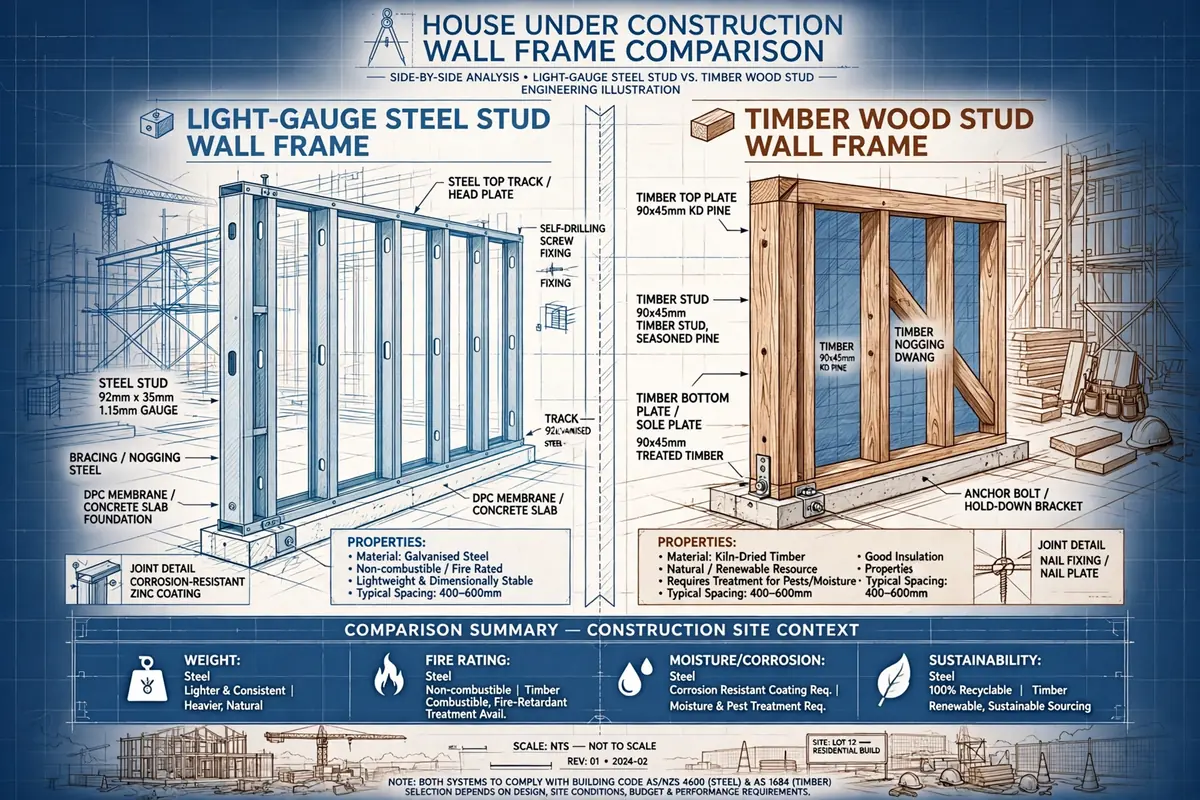
Steel framing costs $9-$14 per sq ft installed vs $5-$9 for wood. Compare material, labour and long-term costs with a worked example for a 2,000 sq ft home.
If you are pricing a new house, the framing decision usually comes down to two numbers: what it costs today, and what it costs you over the next thirty years. Wood framing is the default in most of North America for a reason — it is cheap, familiar, and every carpenter knows how to work with it. Cold-formed steel framing costs more up front, but it does not warp, shrink, or feed termites. This article compares the two on a like-for-like basis, in dollars per square foot, with a full worked example for a 2,000 sq ft house.
Steel Framing vs Wood Framing: Cost at a Glance
For a typical single-family home, installed framing costs run roughly as follows:
- Wood framing: $5 to $9 per sq ft of floor area, installed
- Steel framing: $9 to $14 per sq ft of floor area, installed
- Premium for steel: roughly 40 to 60 percent more than wood on the framing package alone
Those are framing-only figures — studs, plates, joists, fasteners, and labour. They do not include sheathing, insulation, drywall, or finishes, though the framing choice does affect some of those costs, as explained below. Prices vary by region, and steel prices track the scrap and coil markets, so a quote from six months ago may already be stale.
What Drives the Cost of Wood Framing?
Wood framing is a mature, competitive market. Dimensional lumber — typically 2x4 or 2x6 spruce-pine-fir studs at 16 in. on centre — is produced in huge volumes, and the labour pool is deep. The main cost drivers are:
- Lumber prices: the biggest single variable. Framing lumber has swung by 30 percent or more within a single year in recent cycles.
- Stud size and spacing: 2x6 walls at 16 in. centres use roughly 25 percent more board feet than 2x4 walls.
- Labour: a framing crew of four to six carpenters typically frames 1,000 to 1,500 sq ft of floor area per week, depending on complexity.
- Waste: allow 5 to 10 percent for cutting waste, warped studs, and culls. A straight stud is not guaranteed; every bundle contains a few bananas.
Wood's hidden cost is movement. Lumber shrinks as it dries, which is why nail pops and drywall cracks show up in the first year. Good builders budget for a drywall touch-up visit; cheap builders leave it to the homeowner.
What Drives the Cost of Steel Framing?
Cold-formed steel framing uses galvanised C-shaped studs and U-shaped tracks, usually 20-gauge (0.0329 in.) or 18-gauge (0.0428 in.) for load-bearing walls, screwed together with self-drilling screws. The cost drivers are different from wood:
- Material: steel studs cost roughly $2.50 to $4.00 per linear foot installed, versus $1.80 to $2.80 for a wood stud wall. The steel itself is only part of it — screws, clips, and bridging add up.
- Labour: steel goes up fast once the crew is trained — panels can be pre-assembled and a wall goes up in minutes — but an untrained crew is slow and makes expensive mistakes. Specialist labour costs more per hour than a general framing crew.
- Tools: chop saws with metal blades, screw guns, and crimpers. Not a big cost on a whole house, but a barrier for a small builder trying steel for the first time.
- Design and engineering: steel framing must be designed to AISI S100 and detailed per AISI S240. A builder switching from wood needs an engineer familiar with cold-formed steel, and that design fee is real.
Steel's big advantage is dimensional stability. A steel stud is straight when it arrives and straight in twenty years. That means flatter walls, fewer drywall callbacks, and no shrinkage cracks at the ceiling line.
Worked Example: Framing a 2,000 sq ft House
Take a single-storey, 2,000 sq ft rectangular house — 40 ft by 50 ft — with 8 ft ceilings, standard window and door openings, and a simple gable roof. Here is a realistic framing-only estimate for both systems, using mid-range 2026 US pricing.
Wood framing
- Material: $4.20 per sq ft × 2,000 sq ft = $8,400 (studs, plates, joists, rim board, fasteners)
- Labour: $3.10 per sq ft × 2,000 sq ft = $6,200 (framing crew, cutting waste allowance included)
- Total: $8,400 + $6,200 = $14,600, or $7.30 per sq ft
Steel framing
- Material: $6.80 per sq ft × 2,000 sq ft = $13,600 (studs, tracks, bridging, screws, clips)
- Labour: $4.40 per sq ft × 2,000 sq ft = $8,800 (specialist crew, panel assembly and erection)
- Total: $13,600 + $8,800 = $22,400, or $11.20 per sq ft
The difference
Steel costs $7,800 more on this house — a premium of about 53 percent on the framing package. On a $400,000 build, that is under 2 percent of the total project cost, which is worth remembering before the sticker shock sets in. Framing is only 10 to 15 percent of a house build; the premium shrinks to a footnote in the overall budget.
Costs Beyond the Frame
The framing quote is not the whole story. The two systems push costs around in the rest of the build:
- Insulation: steel is a thermal bridge — a steel stud conducts heat about 400 times more readily than wood. Exterior continuous insulation (typically 1 to 2 in. of rigid foam) is effectively mandatory with steel, adding roughly $1.00 to $1.50 per sq ft of wall area. Wood walls can often meet code with cavity insulation alone.
- Electrical and plumbing: steel studs need plastic grommets in every punched hole to protect wiring, and plumbers charge more to work around steel. Budget an extra $300 to $600 on a typical house.
- Drywall and finishes: straighter walls mean less shimming and fewer callbacks. Builders who frame in steel commonly report saving $500 to $1,000 in drywall touch-ups over the first year.
- Termite treatment: steel is not food. In termite-prone regions, a wood-framed house needs soil treatment and ongoing inspections — $300 to $500 initially, plus periodic retreatments. Steel framing eliminates the structural risk, though wood trim and flooring still need attention.
- Insurance: some insurers offer a small discount for non-combustible framing. It is rarely more than $100 to $200 a year, but it is real money over a mortgage.
Add the insulation penalty and the electrical extras, and steel's true premium on our example house rises to roughly $9,500. Subtract the drywall savings and the avoided termite treatment, and the honest net premium is closer to $8,000.
Speed: Where Steel Can Win the Money Back
Steel framing shines on schedule. Pre-cut, pre-punched studs arrive in labelled bundles, and wall panels can be assembled flat on the deck and tilted up in minutes. An experienced steel crew can frame a house 20 to 30 percent faster than a wood crew. On a project where the builder is paying interest on a construction loan, or the owner is paying rent while the house is built, a two-week saving can be worth $1,000 to $3,000 — enough to eat a meaningful chunk of the material premium. On a small, simple house with an owner-builder and no financing pressure, that advantage mostly disappears.
When Steel Framing Is Worth the Extra Cost
- Termite or damp regions: steel removes the single biggest durability risk to the frame.
- Long, straight walls and large openings: steel holds its shape, so big spans stay true.
- Fire-rated construction: steel is non-combustible, which simplifies fire separation and can reduce the cost of fire-rated assemblies.
- Tight schedules: panelised steel can compress the framing programme by weeks.
- Multi-storey or load-bearing work: cold-formed steel performs predictably under load, and design to AISI S100 is well established.
When Wood Framing Is the Sensible Choice
- Budget is the binding constraint: wood is simply cheaper, and the saving is immediate and certain.
- Small or one-off builds: the design, tooling, and learning curve of steel do not pay off on a single small house.
- Curved or heavily custom work: wood is far more forgiving to cut and shape on site.
- Areas with cheap, dry lumber and low termite risk: the durability argument for steel is weakest here.
Frequently Asked Questions
Is steel framing cheaper than wood framing?
No — not on material and labour alone. Steel framing typically costs $9 to $14 per sq ft installed versus $5 to $9 for wood. The gap narrows once you count faster erection, fewer callbacks, and avoided termite treatment, but steel rarely ends up cheaper overall on a standard house.
Does steel framing rust?
Galvanised steel studs carry a zinc coating (typically G60, or G90 in coastal and damp locations) that protects them for the life of the building in normal indoor conditions. Rust is a risk only where the coating is cut and left exposed to persistent moisture, which is why good detailing matters.
Can you hang heavy items on steel-framed walls?
Yes, but not with ordinary nails. Use fine-thread drywall screws into the stud, or fit timber blocking inside the wall where heavy cabinets, TVs, or grab rails will go. Plan the blocking before the drywall goes up.
Is steel framing allowed by building codes?
Yes. Cold-formed steel framing is recognised in the International Residential Code (IRC Section R804) and designed to AISI S100, with installation and detailing per AISI S240. Your local authority may ask for an engineer's design on load-bearing steel framing.
Does steel framing affect Wi-Fi or mobile signal?
The effect is minor. Steel studs are thin and widely spaced, so they do not form a Faraday cage. Dense steel decking or foil-faced insulation has a bigger effect on signal than the studs themselves.
The short version: wood framing wins on price, and it wins clearly. Steel framing wins on straightness, durability, and speed. If you are building one house on a tight budget, frame it in wood and spend the saving on insulation or better windows. If you are building in termite country, on a tight schedule, or you have been burned by callbacks on crooked walls, the steel premium buys something real. Either way, get the quote for both — lumber and steel prices move independently, and the gap between them is narrower today than it was five years ago.
Calculations and engineering guides are for planning and educational reference. Verify final designs against applicable codes with a licensed Professional Engineer.