How Much Does Spray Foam Insulation Cost Per Square Foot?
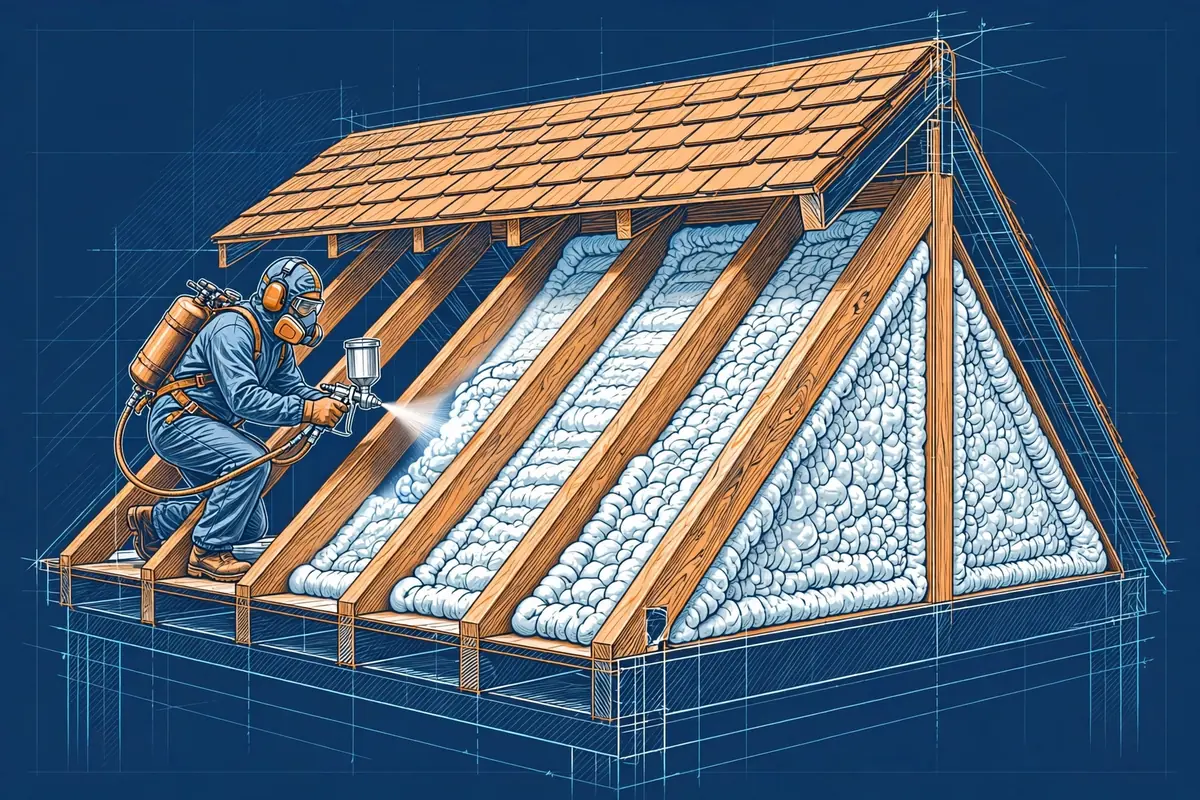
Open-cell spray foam runs $1.50–$3.50 per sq ft and closed-cell $4.00–$7.50. Full cost breakdown, board-foot maths and a worked 1,200 sq ft attic example.
Spray foam is the most expensive insulation you can buy per square foot, and also the one that saves the most money over the life of a house. That contradiction is why homeowners keep asking the same question: how much does it actually cost, and is it worth it? The honest answer is that the price swings wildly — from about $1.50 to $7.50 per square foot depending on the type of foam, the thickness, and how hard the crew has to work to reach the surface. Below is the full breakdown, with real numbers you can check against a quote.
Open-Cell vs Closed-Cell: What You Are Paying For
Spray foam comes in two very different products, and mixing them up is the most common mistake in this whole conversation.
Open-cell foam is soft, spongy, and light — about 0.5 lb per cubic foot. It expands a lot (up to 100 times its liquid volume), fills awkward cavities nicely, and costs roughly $1.50 to $3.50 per square foot installed at the usual 3 to 4 inch depth. Its R-value is about R-3.5 to R-3.8 per inch. It is not a vapour barrier and it will absorb water, so it belongs in dry, interior locations.
Closed-cell foam is rigid and dense — about 2 lb per cubic foot. It expands far less, gives about R-6.0 to R-6.5 per inch, and acts as its own vapour barrier. It also adds real structural strength to a wall or roof deck, and it will not soak up water. That performance costs more: roughly $4.00 to $7.50 per square foot installed at the usual 2 to 3 inch depth.
The rule of thumb on site is simple: open-cell for interior walls and attics where the budget matters most, closed-cell for roofs, basements, crawl spaces, and anywhere moisture or structural racking is a concern. If a contractor quotes one price for "spray foam" without naming the type, ask — the two products can differ by a factor of three.
Cost per Square Foot by Application
Typical installed prices in the US (2026, labour and materials included):
- Open-cell, attic floor or wall cavity: $1.50–$3.50 / sq ft
- Closed-cell, wall cavity: $4.00–$6.50 / sq ft
- Closed-cell, roof deck (unvented attic): $5.00–$7.50 / sq ft
- Closed-cell, basement or crawl space walls: $4.50–$7.00 / sq ft
- Closed-cell, rim joists: $6.00–$9.00 / sq ft (small, fiddly area — high labour per square foot)
These are per square foot of surface covered, not floor area. A 1,000 sq ft attic roof deck is a lot more surface than a 1,000 sq ft house footprint suggests, because the roof slope is larger than the floor plan. Always check which area the quote is priced on.
What Drives the Price Up or Down
Thickness. Foam is sold by the board foot (1 sq ft × 1 inch thick). More inches means more material and more passes. Going from 2 inches to 3 inches of closed-cell adds roughly 50% to the material cost.
Access. An open attic with a walkway is cheap. A low-slope crawl space a crew member has to belly-crawl through is not — expect a 20–40% premium for tight access.
Prep work. Existing insulation removal, air sealing, masking windows and fixtures, and protecting finished surfaces all add labour. Removing old fibreglass batts typically adds $0.50–$1.00 per sq ft.
Location and season. Prices run higher in the Northeast and West Coast and lower in the South and Midwest. Winter work in cold climates can add a premium because the foam chemicals must be kept warm and the substrate must be above about 40°F (5°C) to cure properly.
Job size. The rig, crew mobilisation, and setup cost the same whether the job is 200 sq ft or 2,000 sq ft, so small jobs carry a much higher per-square-foot price. Anything under about 500 sq ft usually attracts a minimum charge of $1,500–$2,500.
Worked Example: Insulating a 1,200 sq ft Attic
Take a typical single-storey house with a 1,200 sq ft attic floor. The homeowner wants the roof deck sprayed to create an unvented attic, keeping the ductwork inside conditioned space. The roof deck measures about 1,450 sq ft once the slope is accounted for.
Option A — open-cell, 5 inches deep (about R-19):
- Area: 1,450 sq ft at $2.75 / sq ft = $3,988
- Ignition barrier coating (required over foam in an attic): $0.75 / sq ft × 1,450 = $1,088
- Total: about $5,075
Option B — closed-cell, 3 inches deep (about R-19):
- Area: 1,450 sq ft at $5.50 / sq ft = $7,975
- Ignition barrier coating: $0.75 / sq ft × 1,450 = $1,088
- Total: about $9,063
Both options hit roughly R-19, but the closed-cell job costs about $4,000 more. What that buys: a vapour barrier, moisture tolerance, and racking strength for the roof deck. In a humid climate, or where the roof has a history of leaks, that is money well spent. In a dry climate with a sound roof, the open-cell job is the better value.
For comparison, blowing R-38 fibreglass over the same attic floor would cost roughly $1.50–$2.00 per sq ft — about $1,800–$2,400 — but it leaves the ductwork in a hot attic and does nothing for air leakage.
Board Feet: The Unit Contractors Actually Price By
If you want to check a quote, learn the board foot. One board foot is 1 sq ft covered 1 inch thick. The formula is simple:
Board feet = area (sq ft) × thickness (inches)
So 1,450 sq ft at 3 inches = 4,350 board feet. At a typical closed-cell rate of $1.80–$2.50 per board foot installed, that is $7,830–$10,875 — which brackets the $7,975 figure in the worked example above. If a contractor's price per board foot falls far outside that range, ask why.
When Spray Foam Pays for Itself
Spray foam's selling point is air sealing. Fibreglass and cellulose slow heat; foam stops air. In a leaky older house, air leakage can account for 30–40% of heating and cooling energy, and foam addresses it in one step.
A reasonable payback estimate: a $9,000 closed-cell attic job on a house with a $2,400 annual heating and cooling bill might cut that bill by 15–25%, saving $360–$600 a year. Simple payback is therefore 15–25 years — honest, but not quick. The case is stronger when the foam also fixes a real problem: ice dams, a freezing bedroom over a garage, ductwork sweating in a hot attic, or a damp crawl space. Where it only replaces adequate existing insulation, the payback stretches too far to justify on energy savings alone.
One more financial point: several US utilities and the federal energy tax credit (check current IRS rules for your tax year) offer rebates for insulation upgrades. A $500–$1,000 rebate changes the maths noticeably on a $5,000 job.
What to Check Before You Sign
- Ask which foam, which brand, and what R-value per inch. Get it in writing — "closed-cell, 2 lb density, R-6.5 per inch" — not just "spray foam".
- Confirm the thickness in writing. Foam shrinks slightly as it cures; a specification of 3 inches should be verified with a depth gauge after application.
- Check the ignition barrier. Building code (IRC Section R316) requires foam in attics and crawl spaces to be covered by an approved ignition barrier unless the foam itself is tested and listed for exposed use. The coating is a real cost — make sure it is in the quote, not added later.
- Plan for the cure time. Fresh foam off-gasses for 24–72 hours. The crew should ventilate the space and you should stay out of the house for at least 24 hours after application, per the manufacturer's instructions.
- Verify the installer. Spray foam is chemistry done on site. A bad mix ratio or cold substrate produces foam that never cures properly and has to be scraped out at great expense. Ask for the installer's training certificate from the foam manufacturer and references from jobs at least a year old.
Frequently Asked Questions
How much does spray foam insulation cost per square foot?
Open-cell spray foam costs $1.50–$3.50 per square foot installed, and closed-cell costs $4.00–$7.50 per square foot, depending on thickness, access, and location. Small jobs and tight spaces cost more per square foot.
Is open-cell or closed-cell spray foam better?
Closed-cell is better where moisture, vapour control, or structural strength matter — roofs, basements, and crawl spaces. Open-cell is the better value for dry interior walls and attics where budget is the priority. Both insulate well; they solve different problems.
How thick should spray foam be?
For walls, 2–3 inches of closed-cell (R-13 to R-19) or 3.5–5 inches of open-cell meets most code requirements. For roof decks in cold climates, 5–7 inches of closed-cell may be needed to reach R-38 to R-49 — check your local code and climate zone.
Does spray foam need a vapour barrier?
Closed-cell foam at 2 inches or more is itself a vapour barrier and needs none. Open-cell foam is vapour-permeable and needs a separate vapour retarder in cold climates.
Can spray foam be installed in an existing wall?
Yes, through small holes drilled in the drywall or exterior sheathing, but it is a slower, more expensive job than spraying an open cavity, and filling a wall evenly is harder to guarantee. It is usually reserved for walls that cannot be opened.
Calculations and engineering guides are for planning and educational reference. Verify final designs against applicable codes with a licensed Professional Engineer.