How Much Does House Demolition Cost Per Square Foot?
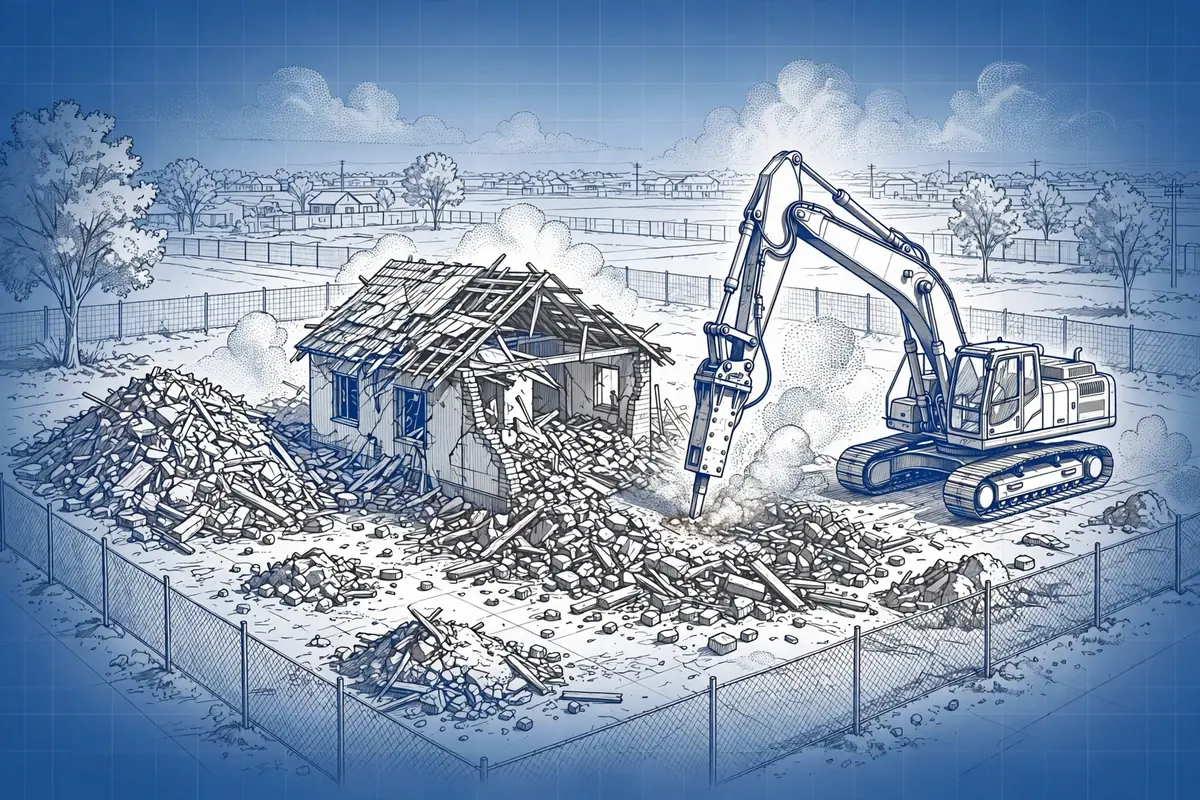
House demolition typically runs $4–$15 per square foot. We break down permits, haul-off, salvage value, and a worked example for a 1,500 sq ft home.
Sooner or later, every builder faces a house that is cheaper to take down than to fix. Maybe it is a fire-damaged bungalow on a lot you want to rebuild, or a derelict rental the city has flagged. The first question is always the same: what will it cost per square foot? The short answer is $4 to $15 per square foot for a full mechanical demolition, with most single-family homes landing around $8 to $10 per square foot. That range is wide because demolition is never just knocking a house down — permits, debris haul-off, asbestos checks and foundation removal all move the number. This guide breaks down every piece, then works a full example for a 1,500 sq ft house so you can price your own job.
What "per square foot" actually covers
When a demolition contractor quotes you a per-square-foot price, make sure you know what is inside it. A complete quote should cover the machine and crew, debris loading and haul-off, landfill tipping fees, and rough site grading when the house is gone. What it usually does not cover is the demolition permit, the asbestos survey, utility disconnects, foundation removal below grade, and any soil remediation. Those extras are where budgets get blown, so ask for them as separate line items before you sign.
Per-square-foot pricing is normally based on the gross floor area of the house — all storeys added together, including the garage if it is being demolished too. A 1,500 sq ft single-storey house and a 1,500 sq ft two-storey house have the same floor area, but the two-storey job usually costs more per square foot because the crew works higher, the debris volume is larger, and the machine needs more time.
Typical house demolition cost per square foot
The table below gives realistic 2026 US price ranges. Your local market, disposal fees and the house itself will shift these numbers, but they are a solid starting point for an estimate.
- Full mechanical demolition, wood-frame house: $4–$10 per sq ft
- Full mechanical demolition, masonry or brick house: $6–$15 per sq ft
- Interior (strip-out) demolition only: $2–$7 per sq ft
- Deconstruction (salvage-first, hand dismantling): $8–$15 per sq ft before salvage credits
- Partial demolition (one wing, garage, or addition): $5–$12 per sq ft of the demolished area
- Basement removal and backfill (add-on): $2–$4 per sq ft of house area
- Concrete slab removal (add-on): $1–$3 per sq ft of slab area
Why does the rate fall as the house gets bigger? Mobilisation is a fixed cost. Bringing an excavator, a crew and a roll-off container to site costs roughly the same whether the house is 900 sq ft or 2,500 sq ft, so the fixed cost spreads thinner over a larger house. A small 800 sq ft cottage can easily hit $12–$15 per sq ft, while a 3,000 sq ft house in an accessible lot can come in under $7.
What drives the price up (and down)
Construction type
A wood-frame house with vinyl siding is the cheapest thing to demolish — an excavator can pull it apart in a day or two. Brick, block or stone walls are heavier, slower to break up and produce far more tonnage to haul away, so expect 30–50% more. A house with a tile or slate roof adds weight and time too, and plaster-and-lath interiors are slower to strip than drywall.
Asbestos and lead paint
Any house built before 1980 is a candidate for asbestos in floor tiles, pipe insulation, roofing felt or textured ceilings, and for lead paint. US federal rules (NESHAP) require an asbestos inspection before demolition of most structures, and if asbestos is found it must be removed by a licensed abatement contractor first. A survey costs roughly $300–$600; abatement, if needed, typically adds $2,000–$5,000 for a small house and much more for a large one. Never let a contractor skip the survey — the fines and health risk are not worth it.
Access and location
A house on a wide, flat lot with room for trucks costs less than one on a steep, narrow urban lot where the excavator has to work in a tight footprint and every load has to be carried out in small trucks. Long haul distances to the landfill push tipping and trucking costs up, and some cities charge higher disposal fees than rural transfer stations.
Utilities and permits
Electricity, gas, water and sewer must be disconnected and capped before demolition starts. The utility companies usually do the disconnects, and fees run $200–$500 in total. The demolition permit itself is typically $200–$600, though some cities charge a flat fee and others price it by the value of the work. Allow two to four weeks for the permit — do not book the machine until it is in hand.
Salvage value
Not everything in a house is waste. Copper pipe and wiring, brass fixtures, hardwood flooring, solid-core doors, windows in good condition and working appliances all have resale or reuse value. A careful salvage pass before demolition can recover $500–$2,000 on a typical house, and a full deconstruction can recover far more. If you donate salvaged materials to a reuse centre, the donation may also be tax-deductible in the US — keep the receipts.
How much debris does a house produce?
Estimating debris is the key to pricing haul-off, and it is also the part most people get wrong. The US EPA estimates that demolishing a house generates about 115 lb of debris per square foot of floor area. For a 1,500 sq ft house:
1,500 sq ft × 115 lb/sq ft = 172,500 lb ≈ 86 tons
At a typical landfill tipping fee of $50 per ton, disposal alone is about $4,300 — before a single truck mile is paid for. That is why haul-off is usually the second-largest line item after the teardown itself. Masonry houses generate more tonnage per square foot; light wood-frame houses with little masonry generate less.
Worked example: demolishing a 1,500 sq ft house
Take a typical job: a single-storey, 1,500 sq ft wood-frame house on a concrete slab, asphalt shingle roof, built in 1975, on a flat suburban lot with good truck access. The owner wants the house, slab and all debris gone, the lot roughly graded, and the asbestos survey clear. Here is how the estimate builds up.
- Teardown — excavator, operator and two labourers, 3 days: $6.00/sq ft × 1,500 sq ft = $9,000
- Debris haul-off and landfill tipping — 86 tons at $50/ton: $4,300
- Demolition permit and inspections: $450
- Utility disconnects and capping: $300
- Asbestos survey (clear result, no abatement needed): $450
- Slab removal and rough site grading: $800
- Salvage credit — copper, fixtures, appliances: −$600
Total: $14,700, or $9.80 per square foot.
That sits comfortably inside the typical $4–$15 range. Now change one variable and watch the number move: if the asbestos survey comes back positive and abatement adds $3,500, the total becomes $18,200, or $12.13 per square foot. If the house is brick instead of wood frame, the teardown rate rises to about $8.50 per square foot and debris rises to roughly 110 tons, pushing the total past $19,000. And if the same house is deconstructed by hand for maximum salvage, the labour bill roughly doubles — but the salvage credit can grow to $2,000–$4,000 and the landfill bill shrinks, so the net cost can end up close to the mechanical option on the right house.
Use this structure for your own estimate: measure the floor area, pick a teardown rate for your construction type, estimate debris at 115 lb per sq ft (more for masonry), then add permits, utilities, survey and foundation work, and subtract a realistic salvage credit.
Demolition vs deconstruction: which is cheaper?
Mechanical demolition is fast — a typical house is down in two to five days — and it is the cheapest option when salvage value is low. Deconstruction takes two to four weeks because the crew strips the house by hand, saving lumber, fixtures and fittings for resale or reuse. Labour costs roughly double, but landfill tonnage can fall by 50–70% and salvage credits are far higher. Deconstruction usually wins on the final bill only when the house has valuable old-growth timber, hardwood floors, quality fixtures or architectural salvage. It also keeps far more material out of landfill, which matters if the project has a green-building or sustainability target.
For most rebuild projects, the practical middle ground is a soft strip first: one or two days of hand salvage — copper, fixtures, appliances, doors, anything resalable — then mechanical demolition for the shell. You get most of the salvage value for a fraction of the deconstruction cost.
What the price does not include
Demolition quotes stop at a cleared, roughly graded lot. They do not include the new house, new foundations, landscaping, driveway reinstatement, or connection of new utilities. If the lot needs imported fill to bring it back to grade after a basement is removed, budget for that separately — a basement void can swallow 40–60 cubic yards of fill. And if soil testing finds contamination, such as an old underground oil tank leaking, remediation is a separate and potentially large cost that no demolition quote covers.
How to get an accurate quote
- Get three quotes from licensed, insured demolition contractors, and make sure each one lists the same scope so you are comparing like with like.
- Ask for line items: teardown, haul-off and tipping, permit, utilities, asbestos survey, foundation removal, grading, and salvage credit.
- Confirm the asbestos survey is included or priced separately — and that demolition will not start before the result is back.
- Check the contractor's insurance covers damage to neighbouring property, and that they will restore any shared driveway or footpath they damage.
- Agree the finished condition in writing: slab removed or left, backfill compacted, lot graded to drain away from neighbours, and all debris removed — not buried on site.
Frequently asked questions
How much does it cost to demolish a 1,500 sq ft house?
Typically $6,000–$22,500, with most jobs landing around $12,000–$15,000. The worked example above comes to $14,700 ($9.80 per sq ft) for a wood-frame house on a slab with a clear asbestos survey. Masonry construction, a basement, or asbestos abatement pushes the total higher.
Is it cheaper to demolish or renovate?
It depends on the condition of the structure. As a rule of thumb, if the renovation cost would exceed 60–70% of the cost of building new, demolition and rebuild is usually the better investment — especially when the existing layout, foundations or services are also compromised.
Do I need a permit to demolish a house?
Almost always, yes. Most US cities and counties require a demolition permit, and many require an asbestos inspection and proof of utility disconnects before the permit is issued. Expect $200–$600 for the permit and two to four weeks of processing.
How long does house demolition take?
Mechanical demolition of a typical single-family house takes two to five days on site, plus two to four weeks for permits and utility disconnects beforehand. Deconstruction takes two to four weeks on site.
Can I demolish a house myself?
Small interior strip-outs are a realistic DIY job, but full structural demolition is not. It needs heavy machinery, licensed operators, asbestos handling, utility disconnects and a permit — and most jurisdictions will not issue a demolition permit to an unlicensed homeowner. The liability risk alone makes it a job for a licensed contractor.
What happens to the foundation?
That is your choice, and it should be priced separately. Removing a slab costs roughly $1–$3 per sq ft of slab; removing a basement and backfilling the void costs $2–$4 per sq ft of house area. If you plan to rebuild on the same footprint, you may keep the foundation — but have a structural engineer inspect it first.
Calculations and engineering guides are for planning and educational reference. Verify final designs against applicable codes with a licensed Professional Engineer.