How Much Does Hardwood Flooring Installation Cost Per Square Foot?
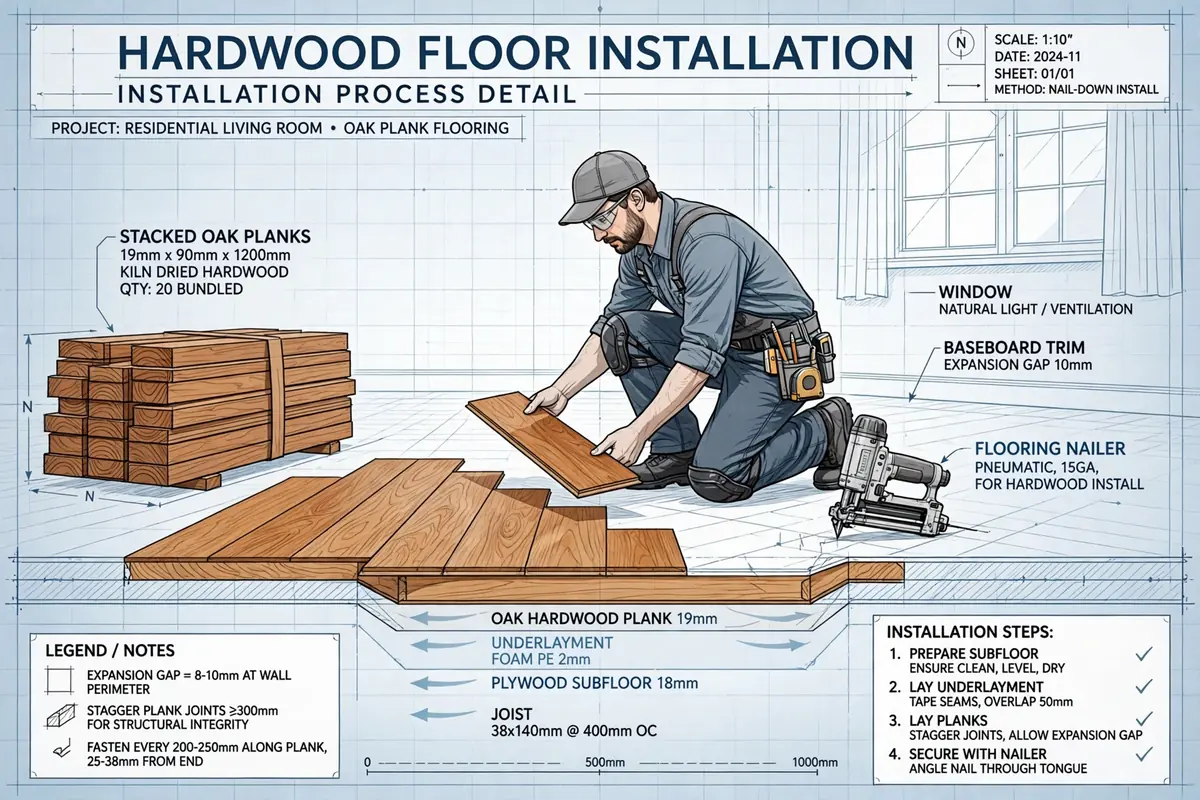
Hardwood flooring installation costs $6–$12 per square foot installed. Compare solid vs engineered pricing, material and labour, plus a full worked example.
Hardwood flooring is one of the few home improvements that pays you back twice: it looks better than almost any other floor, and estate agents consistently rank it near the top of features buyers will pay extra for. The trouble is that the price quoted on a sample board in the showroom is only a fraction of what the job actually costs. By the time you add underlayment, labour, removal of the old floor and the trim, the real number per square foot can be nearly double the price on the tag.
This guide breaks down every cost that goes into a hardwood floor, compares solid and engineered boards honestly, and finishes with a full worked example for a 500-square-foot living room so you can see exactly where the money goes.
The short answer: cost per square foot
For a professionally installed hardwood floor in the US, expect to pay $6 to $12 per square foot for engineered hardwood and $8 to $15 per square foot for solid hardwood, all in. Those figures include the boards, underlayment, labour and the usual extras, but not major subfloor repairs or stair work, which are priced separately.
A typical 1,000-square-foot installation therefore runs roughly $8,000 to $14,000 in total.
The single biggest price driver is not the species of wood. It is the type of board — solid or engineered — and whether the boards arrive prefinished or need sanding and finishing on site.
Solid vs engineered: what you pay for the boards
Solid hardwood is a single piece of timber, usually 3/4 inch thick, milled with tongue and groove. Common red oak runs $5 to $8 per square foot for material alone; white oak, maple and hickory run $6 to $10; walnut and exotic species run $8 to $12 or more. Solid boards are nailed down over a wood subfloor, and unfinished solid needs sanding and finishing after installation, which adds $3 to $5 per square foot.
Engineered hardwood is a thin layer of real hardwood — the wear layer, typically 2 to 6 mm thick — bonded to layers of plywood. It costs $4 to $10 per square foot for the material. The cheaper end is thin-wear-layer oak in narrow planks; the dearer end is wide-plank European oak with a 4 to 6 mm wear layer. Engineered boards can be glued, nailed or floated, and they can go over concrete slabs and radiant heat, where solid wood cannot.
- Solid, prefinished: $6–$10 per sq ft material; $3–$5 labour; total installed $9–$15 per sq ft.
- Solid, unfinished: $5–$9 per sq ft material; $3–$5 labour; $3–$5 sanding and finishing; total installed $11–$19 per sq ft.
- Engineered, prefinished: $4–$10 per sq ft material; $3–$5 labour; total installed $7–$15 per sq ft.
- Engineered, floating click-lock: $4–$8 per sq ft material; $2–$4 labour; total installed $6–$12 per sq ft.
Prefinished boards cost more at the shop but save you the sanding, the finishing and several days of dust and fumes. Unfinished boards cost less to buy but give you a perfectly flat, site-finished surface with no micro-bevels between planks — the look most people picture when they say "hardwood floor".
What drives the labour price
Installation labour for hardwood usually falls between $3 and $5 per square foot, but the rate moves with the details of the job:
- Installation method: nail-down is the standard for solid wood; glue-down costs more in both labour and adhesive; floating click-lock is the fastest and cheapest.
- Plank width: wide planks (5 inches and up) cost more to lay because each board must be glued as well as nailed to stop it cupping, and wider boards show mistakes more clearly.
- Pattern: a straight lay is the base price. Herringbone, chevron or a border adds $2 to $4 per square foot in labour, and waste rises to 12–15% because of all the angled cuts.
- Room shape: hallways, closets and rooms with many doorways slow the crew down. Cutting around door jambs, vents and stair nosings is slow, fiddly work.
- Stairs: stair treads and risers in matching hardwood run $40 to $80 per step, and are usually quoted as a separate line item.
Always ask whether the labour quote includes moving furniture, cutting door jambs and installing transitions. A quote that leaves those out looks cheaper on paper and costs more by the end of the job.
Extra costs most estimates miss
The boards and the labour are only about two-thirds of a typical invoice. These are the line items that catch homeowners by surprise:
- Underlayment: $0.30 to $0.80 per sq ft for foam or felt underlayment; $1 to $2 per sq ft for a moisture barrier over concrete.
- Removing the old floor: $1 to $2 per sq ft for carpet or vinyl; $2 to $4 per sq ft for old hardwood or tile, which is slower and messier to take up.
- Subfloor repair: $2 to $5 per sq ft where boards are soft, squeaky or out of level. A floor that is more than 3/16 inch out of level over 10 feet must be levelled before hardwood goes down, or the boards will bounce and gap.
- Baseboards and shoe moulding: $2 to $4 per linear foot installed. Hardwood needs an expansion gap around the perimeter, and the moulding is what hides it.
- Transitions and thresholds: $30 to $60 each where hardwood meets tile, carpet or a different floor height.
- Waste factor: order 5–10% extra material for straight lays, 12–15% for herringbone. The waste is not a markup — it is the offcuts at walls, the boards rejected for knots or colour, and the spare box you keep for future repairs.
On a 500-square-foot job, these extras commonly add $1,000 to $2,000 to the bill. Budget for them from the start rather than discovering them in the final invoice.
Worked example: a 500 sq ft living room
Here is a complete, realistic estimate for a 500-square-foot living room in engineered white oak, laid straight over a plywood subfloor, with the old carpet removed:
Step 1 — Material quantity. Floor area is 500 sq ft. Add a 10% waste factor for offcuts and spares:
500 × 1.10 = 550 sq ft of flooring to buy
Step 2 — Material cost. Engineered white oak at $6.50 per sq ft:
550 × $6.50 = $3,575
Step 3 — Installation labour. Nail-down installation at $4.00 per sq ft on the actual floor area (waste is not charged for labour):
500 × $4.00 = $2,000
Step 4 — Underlayment. Felt underlayment at $0.50 per sq ft:
500 × $0.50 = $250
Step 5 — Old carpet removal. Carpet and pad removal and disposal at $1.25 per sq ft:
500 × $1.25 = $625
Step 6 — Shoe moulding. The room has about 110 linear feet of wall. Shoe moulding supplied and fitted at $3.00 per linear foot:
110 × $3.00 = $330
Total: $3,575 + $2,000 + $250 + $625 + $330 = $6,780
That is $13.56 per square foot all in — higher than the headline "$6 to $12" because it includes carpet removal and new trim. The flooring itself, material plus labour, comes to $5,575, or $11.15 per square foot. If the room had no old floor to remove and the existing baseboards were reused, the same job would land around $5,800, or $11.60 per square foot. That is the number to compare when you are weighing one quote against another: make sure both quotes include the same extras.
Solid vs engineered: which is cheaper over 20 years?
The purchase price tells only half the story. A solid 3/4-inch floor can be sanded and refinished four to six times over its life, which means it can realistically last 50 years or more. Each refinish costs $3 to $5 per square foot and makes the floor look new again.
An engineered floor can be refinished only as many times as its wear layer allows — once or twice for a 2 mm wear layer, two or three times for a 4 to 6 mm wear layer. A thin-wear-layer engineered floor that cannot be refinished may need replacing after 20 to 25 years of hard use.
So if you plan to stay in the house for decades, a solid floor or a thick-wear-layer engineered floor is usually the better value despite the higher upfront price. If you are renovating to sell within a few years, or you need flooring over a concrete slab, engineered is the sensible choice — just pick a wear layer of at least 3 mm so the next owner can refinish it once.
DIY vs hiring a professional
Doing it yourself saves the $3 to $5 per square foot of labour — $1,500 to $2,500 on a 500-square-foot room. That saving is real, but a flooring nailer and compressor rent for $50 to $70 a day, a first-timer lays roughly half as fast as a crew, and a row laid out of square can cost more to fix than the labour you saved.
Floating click-lock engineered flooring is the most DIY-friendly option: no nails, no glue, and a single room is a weekend job. Nail-down solid hardwood is not a good first project. If you do hire a crew, get at least three written quotes, check that the installer is insured, and ask for the address of a recent job you can walk on before you sign.
How to keep the cost down
- Choose a common species: red oak and white oak are the cheapest hardwoods per square foot and the easiest to match later.
- Pick standard plank widths: 3-1/4 inch and 4 inch planks cost less to buy and lay than wide-plank boards.
- Stick to a straight lay: herringbone looks superb and costs roughly 30% more once labour and waste are counted.
- Do the prep yourself: removing old carpet and moving furniture is easy work that crews charge $1 to $2 per square foot for.
Frequently asked questions
How much does it cost to install hardwood floors in a 12x12 room?
A 12 by 12 room is 144 square feet. At $8 to $12 per square foot installed for engineered hardwood, expect $1,150 to $1,730 for the flooring and labour, plus $150 to $400 for removal, underlayment and trim. Small rooms cost more per square foot because the crew's set-up and travel time is spread over fewer square feet.
Is engineered hardwood cheaper than solid hardwood?
Yes, usually by $1 to $3 per square foot installed. Engineered boards cost less to buy, and floating or glue-down installation is faster than nailing solid boards. The gap narrows when you compare thick-wear-layer engineered against prefinished solid oak.
Can hardwood flooring be installed over concrete?
Engineered hardwood can, with a moisture barrier and either glue-down or floating installation. Solid hardwood should not go directly over a concrete slab — it needs a plywood subfloor, and even then it is risky in basements or anywhere moisture is a concern. Check the slab with a moisture meter first; readings above 3 lb per 1,000 sq ft per 24 hours (calcium chloride test) mean the slab needs sealing.
How long does hardwood floor installation take?
A crew of two lays roughly 300 to 500 square feet per day for a straight nail-down installation. A 500-square-foot room takes one to two days, plus a day for sanding and finishing if the boards are unfinished. Add a day if old flooring has to come out first.
Does hardwood flooring increase home value?
Yes. Hardwood is consistently one of the highest-return flooring choices, with estate agents reporting that homes with hardwood sell faster and at a premium over comparable homes with carpet or vinyl. The return is strongest for solid hardwood in main living areas and bedrooms.
Calculations and engineering guides are for planning and educational reference. Verify final designs against applicable codes with a licensed Professional Engineer.