How Much Does Furnace Replacement Cost? Sizing & Efficiency
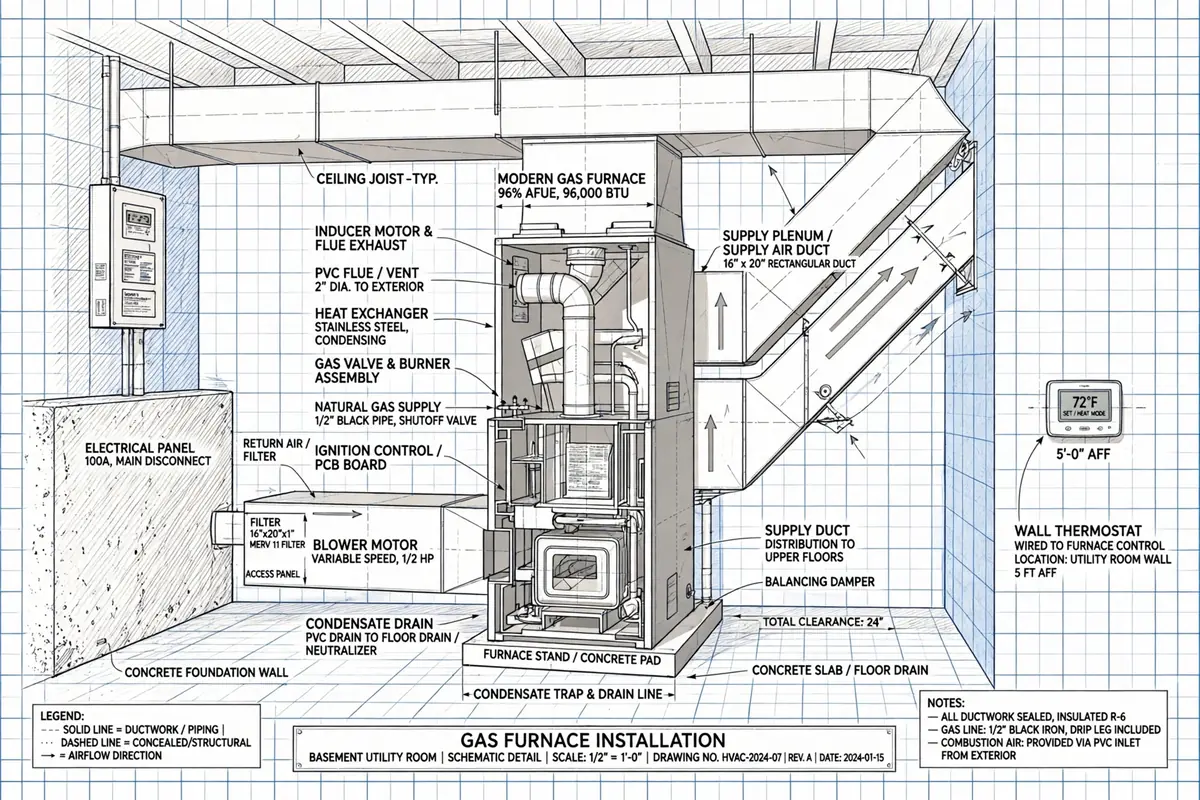
Furnace replacement typically costs $2,500–$7,500 installed. Learn how furnace size, AFUE efficiency rating and installation complexity affect your total.
When a furnace dies in the middle of January, nobody has time to shop around — and that is exactly when most people overpay. The honest answer to "how much does furnace replacement cost" is a range, not a single number: a straightforward gas furnace swap in a typical home runs $2,500 to $7,500 installed, while high-efficiency models, oil furnaces and jobs that need ductwork or venting changes can push past $8,000. This guide breaks down where every dollar goes, how to size a furnace properly, and what efficiency rating is actually worth paying for.
What a furnace replacement costs at a glance
Three things set the price: the furnace itself, the labour to install it, and the extras your house needs (venting, ductwork, permits). Here are realistic installed price ranges for a typical 1,500–2,500 sq ft home:
- 80% AFUE gas furnace: $2,500–$4,500 installed
- 96% AFUE gas furnace (high efficiency): $4,000–$7,500 installed
- Electric furnace: $1,500–$4,000 installed
- Oil furnace: $4,000–$8,000 installed
- Installation labour alone: $500–$2,000
Those figures are national averages for 2025–2026. Prices run higher in cities with expensive labour and in homes where the old furnace is hard to reach, and lower in mild climates where a smaller furnace does the job.
What AFUE means — and which rating to buy
AFUE, or Annual Fuel Utilization Efficiency, is the percentage of the fuel a furnace turns into usable heat. An 80% AFUE furnace wastes 20 cents of every fuel dollar up the flue; a 96% AFUE furnace wastes only 4 cents. The US Department of Energy sets a federal minimum of 80% AFUE for new gas furnaces, and high-efficiency condensing models run from 90% to 98.5% AFUE.
High-efficiency furnaces cost roughly $1,000–$1,500 more than a standard 80% model, and they need a PVC vent out through a side wall plus a condensate drain — a 80% furnace uses a metal flue up through the roof. That extra venting work is part of why the installed price gap is bigger than the equipment gap. If your furnace runs hard for five or six months a year, the fuel savings usually pay back the premium in 5–8 years. In a mild climate where the furnace runs a few weeks a year, the 80% model is often the better buy.
How furnace size is calculated
Furnaces are sold by input capacity in BTUs per hour — common sizes are 40,000, 60,000, 80,000, 100,000 and 120,000 BTU/h. The right size comes from a Manual J load calculation (ACCA Manual J is the industry standard), which accounts for your home's floor area, insulation, windows, air leakage and local design temperature. A contractor who sizes a furnace by square footage alone is guessing.
As a rough check, heating contractors use 30–60 BTU per square foot of living space: about 30–35 in warm climates, 40–45 in temperate regions and 50–60 in cold northern states. An oversized furnace short-cycles — it heats the house in short bursts, wears out faster, and leaves cold spots. An undersized one runs flat out on the coldest nights and never quite catches up. Size it once, size it right.
Worked example: sizing a furnace for a 2,000 sq ft home
Take a 2,000 sq ft two-storey home in a cold-temperate climate (design temperature around 5°F), with average insulation. Using the rule-of-thumb check:
- Heat load = 2,000 sq ft × 40 BTU/sq ft = 80,000 BTU/h of heat output needed
- With a 96% AFUE furnace, input capacity = 80,000 ÷ 0.96 = 83,333 BTU/h
- Nearest standard size: a 90,000 BTU/h input furnace (delivering 86,400 BTU/h output)
With an 80% AFUE furnace the same house would need 80,000 ÷ 0.80 = 100,000 BTU/h input. That is the trap of comparing furnaces by input BTU alone — the same house needs a bigger gas burner at lower efficiency. Always compare output capacity.
Full cost breakdown: a worked example
Here is a realistic line-by-line bill for replacing a gas furnace in that same 2,000 sq ft home with a 90,000 BTU/h, 96% AFUE two-stage model:
- Furnace unit (90,000 BTU/h, 96% AFUE): $2,800
- Installation labour (one day, two technicians): $1,400
- PVC venting and condensate drain: $350
- Gas line extension and shut-off valve: $200
- New programmable thermostat: $150
- Building permit and inspection: $150
- Removal and disposal of the old furnace: $100
- Total: $5,150
Compare that with a like-for-like 80% AFUE swap in the same house: a cheaper unit ($1,700) and no PVC venting work brings the total to about $3,700. The high-efficiency premium here is roughly $1,450.
Is the high-efficiency premium worth it?
Run the fuel maths before you decide. Suppose the house needs 60 million BTU of heat per heating season:
- At 80% AFUE, gas input = 60 ÷ 0.80 = 75 million BTU = 750 therms
- At 96% AFUE, gas input = 60 ÷ 0.96 = 62.5 million BTU = 625 therms
- Annual saving = 125 therms × $1.50 per therm = $187.50 per year
- Payback on a $1,450 premium = 1,450 ÷ 187.50 = about 7.7 years
With gas at $2.00 per therm the saving rises to $250 a year and payback drops to under 6 years. Furnaces last 15–20 years, so in a cold climate the high-efficiency unit usually pays for itself twice over. Also check for rebates: high-efficiency furnaces rated 97% AFUE or higher may qualify for a federal tax credit of up to $600 under the Energy Efficient Home Improvement Credit, and many gas utilities offer their own rebates — check current rules before you buy.
Extra costs that catch people out
- Ductwork repairs or resizing: $500–$3,000 — leaky or undersized ducts waste the new furnace's output.
- Chimney liner: $600–$1,500 — when a new 80% furnace vents into an old masonry chimney, a liner is usually required.
- Electrical work: $150–$500 — a new circuit or disconnect for the furnace and blower.
- Asbestos removal: $1,000–$3,000 — old duct insulation or furnace gaskets in pre-1980 homes must be handled by a licensed abatement contractor.
- Zoning or smart thermostat upgrade: $150–$600 for the thermostat; zoning dampers add $1,000–$2,500.
Gas vs electric vs oil: which furnace type costs least?
Gas is the cheapest to run wherever natural gas is available, and gas furnaces have the widest model range. Electric furnaces are cheapest to buy and install — no flue, no gas line, no combustion safety checks — but electricity costs roughly three times as much per BTU as gas in most US markets, so running costs are high. Oil furnaces suit homes off the gas grid; they cost more to install and maintain, and oil prices swing with the market. If your home has no gas supply, compare an electric furnace against a heat pump before deciding — in moderate climates a heat pump often costs less to run than either.
When to repair instead of replace
Replace the furnace if it is over 15 years old and the repair costs more than about a third of a new unit, if the heat exchanger is cracked (a safety issue — carbon monoxide risk), or if repair bills have become a yearly event. Repair it if the unit is under 10 years old and the fault is a single component like an igniter, flame sensor or blower motor — those are typically $150–$600 fixes. The old rule of thumb still holds: if the repair costs more than half the price of a new furnace, buy the new furnace.
How to get a fair quote
Get three written quotes, and make sure each one specifies the furnace brand and model, AFUE rating, input and output BTU, single-stage vs two-stage vs modulating burner, and exactly what is included — venting, thermostat, permit, disposal and warranty. Ask whether the contractor did a Manual J calculation; a quote based on "same size as the old one" is a red flag, because the old one may have been wrong. Check the warranty: most good furnaces carry a 10-year parts warranty and a lifetime heat-exchanger warranty when registered. And never accept a quote from a contractor who will not put it in writing.
Frequently asked questions
How long does a furnace replacement take?
A straightforward swap takes one day — typically 4–8 hours for a two-person crew. Jobs that need new venting, ductwork changes or a gas line move can take two days.
Can I replace a furnace myself?
Technically possible, legally risky. Gas connections, venting and electrical work require permits and inspections in most jurisdictions, and a DIY install usually voids the manufacturer's warranty. Leave the gas and venting to a licensed contractor.
What size furnace do I need for a 1,500 sq ft house?
As a rough guide, 45,000–75,000 BTU/h output depending on climate — around 60,000 BTU/h in a temperate region. Get a Manual J calculation for the exact figure; insulation and windows change the answer by as much as climate does.
How much does it cost to replace a furnace and air conditioner together?
A combined furnace and central air conditioner replacement typically runs $6,000–$12,000 installed, and doing both at once usually saves $500–$1,500 over separate jobs because the crew, ductwork and electrical work overlap.
Does a new furnace increase home value?
A new, efficient furnace is a strong selling point and can help a home pass inspection, but it rarely adds its full cost to the sale price. Think of it as protecting value and cutting bills, not as an investment that pays back at sale.
Calculations and engineering guides are for planning and educational reference. Verify final designs against applicable codes with a licensed Professional Engineer.