How Much Does Attic Insulation Cost Per Square Foot?
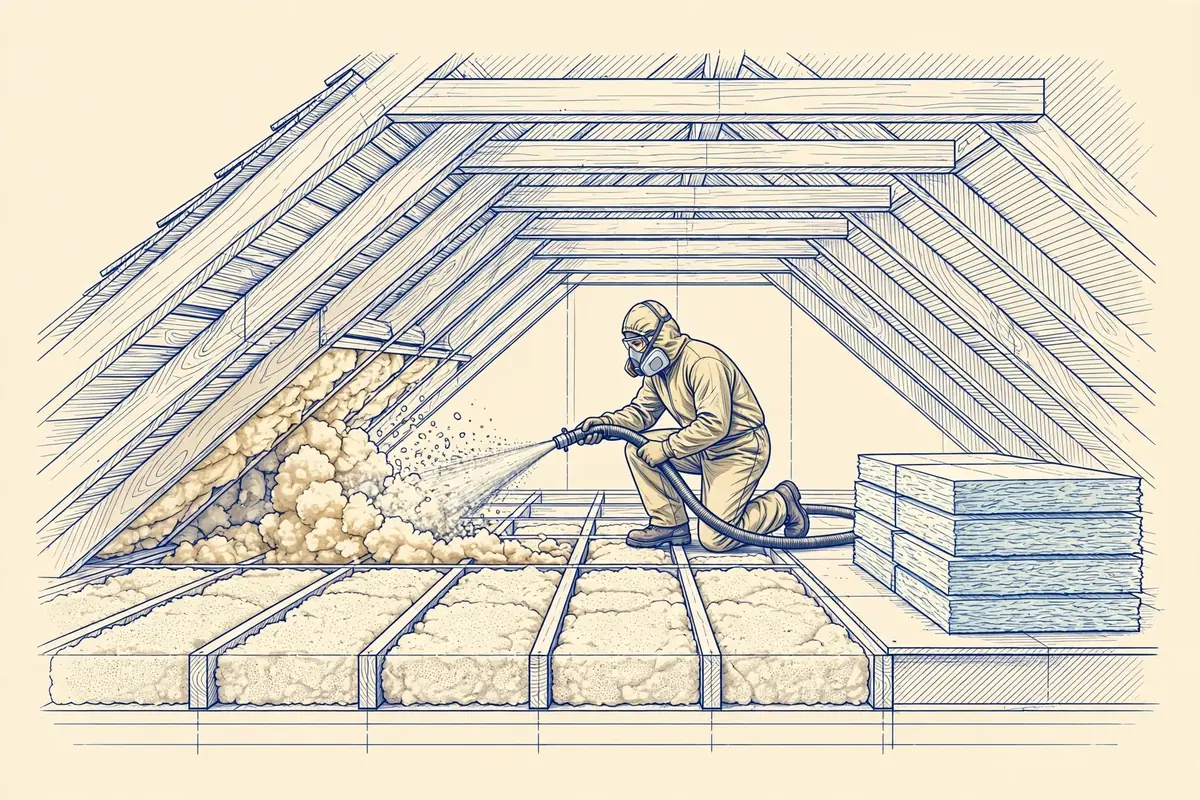
Attic insulation costs $1.50–$3.50 per square foot installed. Compare blown-in vs batt insulation, R-values and a worked example for a 1,000 sq ft attic.
If you have ever stood in an attic in July, you know the problem: it feels like an oven up there, and in January it feels like a fridge. The attic is where most houses lose most of their conditioned air, because heat rises in winter and bakes down through the roof in summer. Insulating it properly is one of the cheapest energy upgrades a house can get — but the price depends heavily on which material you pick and how much of it you need. This article breaks down attic insulation cost per square foot, explains R-value in plain language, and works through a full example for a 1,000 square foot attic.
How much does attic insulation cost per square foot?
For a typical US home, professionally installed attic insulation costs $1.50 to $3.50 per square foot. That range covers the two most common materials — blown-in loose fill and fibreglass batts — in the depths most climate zones need. Spray foam sits well above it, at $3.50 to $7.50 per square foot installed, and is usually chosen for air sealing rather than for pure insulation value.
The spread inside that range comes from four things: the material, the R-value you are targeting, how easy the attic is to access, and whether old insulation has to come out first. A wide-open attic with a proper hatch is a fast job; a cramped attic with a scuttle hole, ductwork in the way and twenty years of compacted insulation to remove can double the labour.
What R-value do you actually need?
R-value is thermal resistance — a measure of how well a material slows heat flow. The higher the number, the better it insulates. In the US, the Department of Energy and the International Energy Conservation Code (IECC) recommend attic R-values by climate zone:
- Zones 1–2 (hot, e.g. southern Florida, southern Texas): R-30 to R-49
- Zones 3–4 (mixed, e.g. the Carolinas, Tennessee, northern California): R-38 to R-60
- Zones 5–8 (cold, e.g. the Midwest, New England, the northern Rockies): R-49 to R-60
Most existing houses sit far below those targets. If your attic has 3–4 inches of old fibreglass, you are probably around R-11 to R-13 — less than a third of what Zone 5 calls for. The good news is that topping up is simple: you almost never remove sound old insulation, you add to it, and the R-values simply add together. An existing R-13 plus a new R-38 layer gives you R-51 in total.
R-value per inch is the number that decides how thick each material has to be:
- Blown-in cellulose: about R-3.7 per inch
- Blown-in fibreglass: about R-2.5 per inch
- Fibreglass batts: about R-3.2 per inch
- Mineral wool batts: about R-3.3 per inch
- Open-cell spray foam: about R-3.6 per inch
- Closed-cell spray foam: about R-6.5 per inch
To reach R-49, cellulose needs about 13 inches, fibreglass batts need about 15 inches, and blown-in fibreglass needs close to 20 inches. That depth difference matters: in a low-pitched roof, 20 inches of blown fibreglass may not even fit under the rafters at the eaves.
Blown-in vs batt insulation: cost comparison
These are the two materials almost every attic job uses, and they price out very differently once labour is included.
Blown-in insulation
Blown-in (loose-fill) insulation is cellulose or fibreglass blown through a hose from a machine parked outside. It flows around joists, wiring and ductwork and fills every gap, which is exactly where batts fail. Installed cost runs $1.00 to $2.00 per square foot for cellulose and $1.00 to $1.80 per square foot for blown fibreglass, at the depths needed for R-38 to R-49. Material alone is roughly $0.40 to $0.70 per square foot, and many home-improvement stores lend the blowing machine free with a minimum bag purchase, so a competent DIYer can cut the bill roughly in half — but it is a dusty, two-person job, and the depth has to be checked with a ruler as you go, because the material settles.
Fibreglass batts
Batts are pre-cut rolls or slabs laid between the joists. Material costs about $0.70 to $1.10 per square foot for R-30 to R-38 batts, and professional installation brings the total to $1.50 to $2.50 per square foot. Batts are tidy and easy to inspect, but they only perform at their rated R-value if they sit flat with no gaps, no compression and no voids around obstructions. On a real attic floor, with wires crossing joists and pipes in the way, that is hard to achieve, and a 5% gap in coverage can cut the effective R-value by far more than 5%.
Spray foam
Spray foam is the premium option. Open-cell foam costs $2.50 to $4.50 per square foot installed and closed-cell $4.00 to $7.50 per square foot. Its real advantage is not R-value per inch — it is air sealing. Foam seals the cracks and gaps that loose fill and batts leave open, and in an attic those air leaks can account for a third of the heat loss. For most homes, the smarter spend is blown-in insulation plus a separate air-sealing pass, which delivers most of the benefit at a fraction of the foam price.
Worked example: insulating a 1,000 sq ft attic to R-49
Take a typical single-storey house in Climate Zone 5 — say, Chicago — with a 1,000 square foot attic floor and 4 inches of old fibreglass already in place, worth about R-13. The target is R-49, so we need to add R-36.
Option A — blown-in cellulose. At R-3.7 per inch, R-36 needs 36 ÷ 3.7 = 9.7 inches of new cellulose, call it 10 inches. The volume required is 1,000 sq ft × (10 ÷ 12) ft = 833 cubic feet. Blown cellulose settles to about 1.5 lb per cubic foot, so the weight is 833 × 1.5 = 1,250 lb, or 50 bags at 25 lb each. At $11 a bag, material is 50 × $11 = $550. Professional installation, including rafter baffles at the eaves and a check of the depth, adds about $700 to $900. Total: $1,250 to $1,450, or $1.25 to $1.45 per square foot.
Option B — fibreglass batts. R-38 batts are roughly 12 inches thick, so one layer over the old insulation brings the total to about R-51, slightly above target. Material at $0.90 per square foot is 1,000 × $0.90 = $900. Labour is higher than blown-in because every batt has to be cut and fitted around obstructions — allow $800 to $1,200. Total: $1,700 to $2,100, or $1.70 to $2.10 per square foot.
Option C — open-cell spray foam. R-36 at R-3.6 per inch needs 10 inches of foam, which is impractical on an attic floor — foam is normally sprayed on the roof deck instead, turning the attic into conditioned space. At $3.50 per square foot for a 5.5-inch application, the same 1,000 sq ft costs $3,500 before any drywall or ignition barrier the code requires over foam in a living space.
The comparison is stark: blown-in cellulose does the job for about $1,350, batts for about $1,900, and foam for $3,500 or more. For a straightforward attic floor, blown-in is the value pick in almost every case.
What else adds to the bill?
The per-square-foot price is only the starting point. Budget for these extras, which catch a lot of homeowners by surprise:
- Air sealing: $200 to $600 for a typical attic — caulk and foam around plumbing penetrations, wire holes, the chimney chase and the attic hatch. The DOE estimates air sealing plus insulation can cut heating and cooling costs by about 15% combined, and sealing first is essential: insulation slows heat flow, but it does almost nothing to stop air leaking straight through it.
- Removing old insulation: $1.00 to $2.00 per square foot if it is wet, mouldy, or contaminated with droppings. Dry, sound insulation stays put.
- Rafter baffles (vent chutes): $2 to $5 each, installed at the eaves so the new insulation does not block the soffit vents. Blocking those vents traps moisture and can rot the roof deck.
- Attic hatch and duct sealing: $100 to $300 for a weather-stripped, insulated hatch cover and mastic on duct joints.
- Recessed lights: non-IC-rated can lights must not be buried in insulation — either fit a fire-rated cover or swap the fitting. Allow $25 to $50 per light.
How to measure what you already have
Before getting quotes, measure the existing insulation yourself. Take a tape measure into the attic, push it down through the insulation to the ceiling drywall in three or four places, and average the readings. Multiply the depth in inches by the R-value per inch for the material you can see — fibreglass is pink or yellow and fluffy, cellulose is grey and papery, mineral wool is dense and grey-brown. If you measure 6 inches of old fibreglass, you have roughly R-19, and topping up to R-49 needs about R-30 more, or 8 inches of cellulose. Contractors quote on the finished R-value, so knowing your starting point stops you paying for insulation you do not need — and stops a low quote that quietly delivers half the depth.
Payback: when does it pay for itself?
On the worked example above, $1,350 of blown-in cellulose in a Zone 5 house typically saves $250 to $400 a year on heating and cooling, based on DOE figures for under-insulated attics. That is a payback of roughly 3 to 5 years, after which the saving is pure profit for the life of the house — and insulation does not wear out. In hot climates the saving is smaller, typically $150 to $250 a year, pushing payback to 5 to 8 years, but the comfort gain — a bedroom that no longer bakes in August — is immediate.
Frequently asked questions
Can I install attic insulation myself?
Yes, for blown-in cellulose and batts — both are common DIY jobs, and a machine rental is often free with a minimum bag purchase. Budget a full day for 1,000 square feet, bring a partner, wear a respirator and coveralls, and check the depth with a ruler every few feet. Spray foam is not a DIY job: the chemicals are hazardous and the application is unforgiving.
Is blown-in or batt insulation better?
Blown-in wins on coverage and cost in most attics, because it fills the gaps around wires and pipes that batts leave open. Batts win where the attic floor is clean, flat and unobstructed, and where you want to be able to lift a section later to reach wiring.
How thick should attic insulation be?
It depends on the material and your climate zone, but the headline numbers are: R-49 needs about 13 inches of cellulose, 15 inches of fibreglass batts, or 20 inches of blown fibreglass. Check the IECC recommendation for your zone and measure the finished depth — installed thickness is the only number that matters.
Do I need to remove old insulation before adding new?
Usually no. Dry, sound insulation stays, and the R-values add together. Remove it only if it is wet, mouldy, fire-damaged, or contaminated. Adding new material over old is standard practice and is how most top-up jobs are done.
Will attic insulation stop ice dams?
It helps a great deal. Ice dams form when heat leaking through the ceiling melts snow on the roof, which refreezes at the cold eaves. Proper insulation plus air sealing keeps the roof deck uniformly cold, which is the single most effective prevention — more reliable than heat cables or roof raking.
Attic insulation is one of the rare home improvements where the cheap option is also the best one for most houses: blown-in cellulose or fibreglass, installed to your climate zone's R-value, with the air leaks sealed first. Get three quotes, ask each contractor to state the finished R-value and depth in writing, and measure the depth yourself when the job is done.
Calculations and engineering guides are for planning and educational reference. Verify final designs against applicable codes with a licensed Professional Engineer.