How Much Does a French Drain Cost Per Linear Foot?
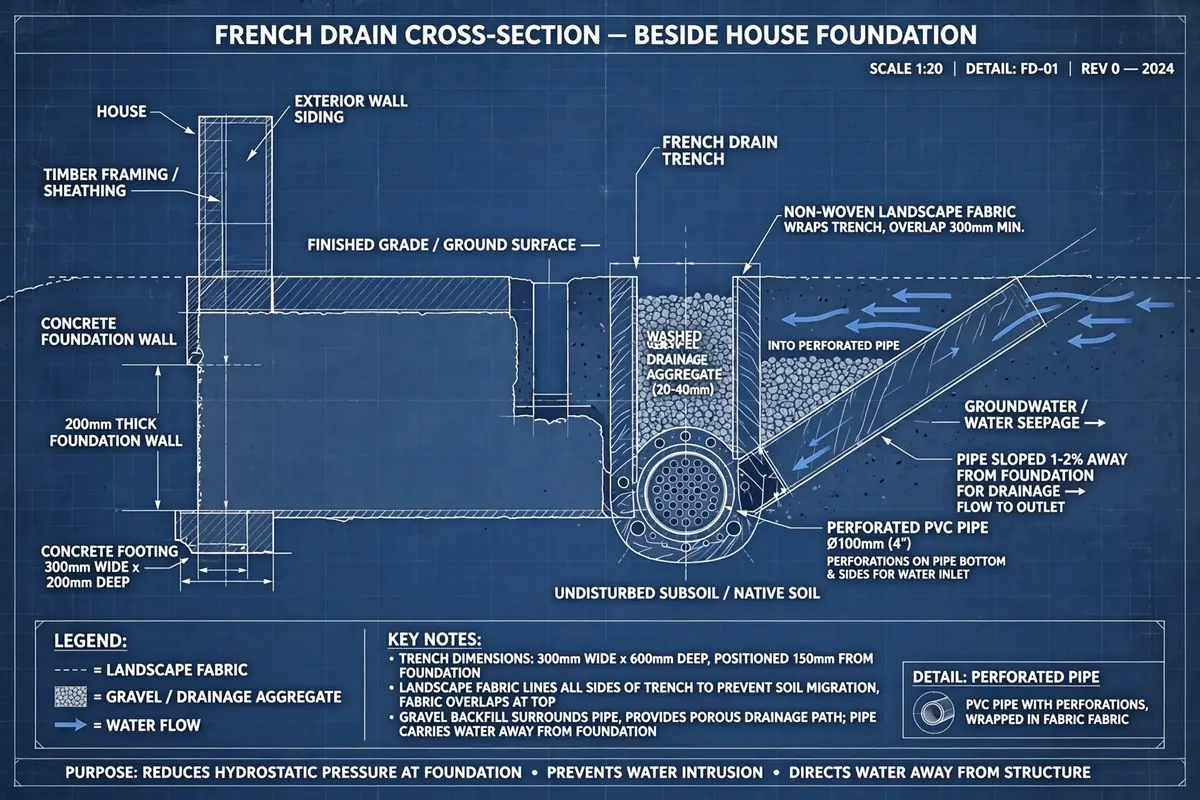
French drain cost runs $10–$50 per linear foot installed. See the trench, pipe and gravel breakdown, plus a full worked example for a 100-foot drain.
If water keeps pooling against your foundation, soaking a basement wall or turning a side yard into a swamp after every storm, a French drain is usually the fix a site engineer reaches for first. It is a simple idea — a gravel-filled trench with a perforated pipe at the bottom that collects groundwater and carries it away — but the price can swing widely depending on where the drain goes, how deep it runs and who digs it. This guide breaks down French drain cost per linear foot, piece by piece, so you can check a contractor's quote line by line or price a do-it-yourself job properly.
French drain cost at a glance
For a typical exterior French drain installed by a contractor in the United States, expect $25 to $50 per linear foot, with most straightforward jobs landing around $30 to $35 per foot. A short, shallow yard drain in easy soil can come in near $20 per foot, while a deep drain around a foundation, an interior basement drain or a job in rocky ground can push past $60 per foot.
Materials alone — pipe, gravel, fabric and fittings — run roughly $10 to $15 per linear foot. The rest of the installed price is excavation, labour and restoration. That split matters: if a quote looks high, the extra money is almost always in the digging and the finishing, not the pipe.
- Exterior yard or foundation drain (contractor): $25–$50 per linear foot
- Interior basement perimeter drain: $40–$100 per linear foot (includes breaking the slab and a sump pump)
- DIY materials only: $10–$15 per linear foot
- Typical total for a 100-foot exterior drain: $2,500–$5,000
What a French drain actually is
A French drain is not a French invention and it is not really a drain in the plumbing sense. It is a trench, usually 12 to 18 inches wide and 18 to 24 inches deep, lined with a non-woven geotextile fabric, filled with washed gravel and with a perforated pipe laid at the bottom. Groundwater seeps through the gravel, enters the pipe through its holes and flows downhill to a safe outlet — a daylight outlet, a dry well, a storm drain or a sump pump.
Two details decide whether the system works or fails within a year. First, the pipe needs a steady fall: aim for a 1 percent grade, about 1 inch of fall every 8 feet, so a 100-foot run needs roughly 12 inches of fall from start to outlet. Second, the fabric must wrap the gravel, not just line the trench bottom — it is the filter that keeps fine soil out of the gravel voids. Skip either one and the drain silts up and stops working.
Cost breakdown per linear foot
Here is where each dollar per foot goes on a normal exterior drain. Prices are 2026 US averages for a 4-inch perforated PVC or corrugated HDPE system; regional labour rates move the installed figures up or down by 20 percent or more.
Excavation: $5–$12 per linear foot
Digging is the biggest variable. A mini-excavator with an operator costs $75 to $125 an hour, and a competent operator digs 20 to 30 feet of 18-by-24-inch trench per hour in ordinary soil. That works out to roughly $5 per foot in soft ground and $12 or more per foot where the trench hits rock, tree roots or an old concrete footing. Hand-digging a short run is possible, but a 100-foot trench by shovel is two hard days for two people — most homeowners hire the machine.
Perforated pipe: $1.20–$2.50 per linear foot
Four-inch perforated pipe is the standard for residential work. Corrugated HDPE (the flexible black pipe) costs about $1.20 to $1.80 per foot and is easy to lay around gentle curves. Rigid perforated PVC to ASTM D2729 or D3034 costs $1.80 to $2.50 per foot, holds its grade better and is the better choice beside a foundation, where a sagging pipe creates a low spot that holds water. Perforations go on the bottom of the pipe, not the top — water rises into the pipe from below, and holes on top let soil wash in.
Washed gravel: $3–$6 per linear foot
The trench is filled with clean, washed 3/4-inch stone — no fines, no crusher dust, because fines clog the voids the water needs to travel through. A typical 18-inch-wide by 24-inch-deep trench takes about 2.9 cubic feet of gravel per linear foot once the pipe volume is subtracted. At $40 to $60 per cubic yard delivered, that is roughly $4 to $6 per foot. Round river rock costs more and drains no better, so stick with angular washed stone.
Geotextile fabric: $1–$2 per linear foot
Non-woven geotextile fabric wraps the whole trench — sides and bottom — with enough overlap at the top to fold closed over the gravel like an envelope. Budget about $0.30 per square foot of fabric. Cheap woven landscape fabric is not a substitute: it clogs faster and tears when the gravel goes in.
Labour, fittings and restoration: $10–$25 per linear foot
Setting the pipe to grade, laying fabric and gravel, connecting the outlet and backfilling takes a two-person crew roughly a day for 100 feet. Add couplings, elbows, a cleanout, a pop-up emitter or outlet grate (around $100 to $150 total) and restoration — topsoil and sod or regrading — which runs $2 to $4 per foot on a lawn. On a driveway or patio the restoration cost jumps sharply, because the surface has to be cut and reinstated.
Worked example: 100-foot exterior French drain
Take a real job: a 100-foot French drain along the back of a house, trench 18 inches wide and 24 inches deep, 4-inch perforated PVC pipe, outlet to daylight at the side of the lot.
Step 1 — Gravel quantity. Trench cross-section is 1.5 ft × 2 ft = 3.0 sq ft. The 4-inch pipe occupies π × (2 in)² = 12.6 sq in, or 0.09 sq ft. Gravel needed per foot is 3.0 − 0.09 = 2.91 cu ft. Over 100 feet that is 291 cu ft, and 291 ÷ 27 = 10.8 cubic yards. Add 10 percent for waste and settlement and order 12 cubic yards.
Step 2 — Grade check. At a 1 percent fall, the pipe drops 1 foot over the 100-foot run. Confirm the outlet end sits at least a foot lower than the start, or the water will not move.
Step 3 — Price it out.
- Excavation (mini-excavator + operator, one day): $500
- 4-inch perforated PVC pipe, 100 ft at $1.80/ft: $180
- Washed 3/4-inch gravel, 12 cu yd at $50/yd: $600
- Non-woven geotextile fabric, 600 sq ft at $0.30/sq ft: $180
- Fittings, cleanout and pop-up emitter outlet: $140
- Labour (two-person crew, pipe laying and backfill): $1,400
- Topsoil and sod restoration: $300
Total: $3,300 for 100 feet, or $33.00 per linear foot. That sits squarely in the normal range for a contractor-installed exterior drain. Do the digging and backfilling yourself and the same job costs about $1,400 in materials — $14 per foot — but budget a full weekend and a sore back.
What pushes the price up
Depth. A drain that has to run below a footing — 4 to 6 feet deep instead of 2 — needs a wider trench, shoring in loose soil and a bigger machine. Cost can double.
Interior basement drains. Cutting the slab around the inside perimeter, breaking out concrete, installing the drain and a sump pump runs $40 to $100 per foot. The sump pump alone adds $1,000 to $2,500 including the basin and discharge line.
Rock and roots. Hitting bedrock or a mass of tree roots turns an hour of digging into half a day. A contractor who has seen the site will price this in; a phone quote will not.
Long runs and bad outlets. A drain is only as good as its outlet. If there is no downhill daylight outlet, the run needs a dry well ($500 to $1,500) or a sump pump, and long runs need intermediate cleanouts every 50 to 100 feet so the pipe can be flushed later.
Surface restoration. Grass is cheap to put back. Cutting through a concrete driveway, a paver patio or an asphalt strip to lay the drain can add $15 to $30 per foot in reinstatement alone.
Interior vs exterior: which drain do you need?
An exterior drain intercepts water before it reaches the wall, which is why engineers prefer it whenever the ground can be opened up. An interior drain is the fallback when the outside cannot be dug — a driveway hard against the wall, a neighbour's boundary, or a finished landscape you cannot disturb. Interior drains manage water that has already entered; they keep the floor dry but they do not relieve the hydrostatic pressure on the wall itself. If you are choosing between the two and the outside is accessible, spend the money outside.
DIY or hire a contractor?
A short, shallow yard drain — 30 to 50 feet, 18 inches deep, no utilities in the way — is a fair DIY job: call 811 before you dig, rent a trencher for a day, and take your time setting the grade with a string line and a level. Hire a contractor when the drain runs beside a foundation, deeper than 3 feet, under a driveway, or anywhere near gas, electric or sewer lines. A pipe laid without fall is worse than no drain at all, because it collects water against the house and holds it there.
Maintenance that keeps the cost down
A French drain that is built right needs little attention, but two small habits protect the investment. Flush the pipe through the cleanout once a year with a garden hose to push out silt before it sets, and keep the outlet clear — a buried pop-up emitter is useless if grass grows over it. If water starts pooling again after a few years, the fabric has usually clogged or a section of pipe has settled; a camera inspection (around $150 to $300) shows exactly where before anyone digs.
Frequently asked questions
How long does a French drain last?
A properly built drain with washed gravel, non-woven fabric and a pipe laid to grade lasts 30 to 40 years. Drains built with unwashed stone or no fabric commonly clog within 5 to 10 years.
Do I need a permit for a French drain?
Most yard drains need no permit, but many municipalities require one for a drain that discharges to a street, a storm sewer or a neighbour's boundary, and some require an erosion-control plan. A five-minute call to the local building department settles it.
Can a French drain be installed in winter?
Yes, if the ground is not frozen solid. Frozen soil doubles excavation time and cost, so in cold climates the work is usually scheduled from spring to autumn.
How deep should a French drain be?
For surface water and a soggy yard, 18 to 24 inches is enough. For a foundation drain, the pipe invert should sit at or just below the bottom of the footing, so it relieves water pressure at the level where the wall meets the footing.
Is a French drain worth the cost?
Compare it with the alternative. A single basement flooding event costs $5,000 to $15,000 in cleanup, damaged finishes and mould remediation, and repeated wetting shortens the life of a foundation wall. At $25 to $50 a foot, a 100-foot drain pays for itself the first time it prevents one flood.
The number to remember is simple: budget $30 to $35 per linear foot for a contractor-installed exterior French drain, check the quote against the material breakdown above, and make sure the grade and the outlet are right before the gravel goes in. Get those two details right and the drain will quietly do its job for decades.
Calculations and engineering guides are for planning and educational reference. Verify final designs against applicable codes with a licensed Professional Engineer.