How Much Does Foundation Repair Cost? Crack Repair & Underpinning
Foundation repair costs $350–$15,000+ depending on the fix. Compare crack repair, underpinning and piering prices, with a full worked example.
Nothing in a house is cheap to fix once the foundation moves. A crack in a basement wall can be a $400 epoxy job, or it can be the first sign of a $20,000 underpinning project. The difference is what caused the movement, how far the footing has dropped, and which repair method actually reaches solid ground. This guide breaks down what each type of foundation repair costs in the United States, why prices vary so much, and how to work out a realistic budget for your own house — with a full worked example at the end.
A quick warning before the numbers: foundation repair is not a job to price from a phone call. Any contractor who quotes a firm price without a site visit, a level survey and — for anything beyond a hairline crack — an engineer's report is guessing. The figures below are 2026 US market ranges for a typical single-family home, and they are the numbers you should use to sanity-check the quotes you receive.
What Drives Foundation Repair Cost?
Four things set the price more than anything else:
- How far the foundation has moved. A wall that has settled half an inch needs a different fix from one that has dropped two inches and is bowing inward. Settlement is measured with a level survey, not by eye.
- The soil underneath. Expansive clay that swells when wet and shrinks when dry is the single biggest cause of foundation movement in the US. Repairs in clay country cost more because the fix must reach below the active zone — often 8 to 15 ft deep.
- Access. A footing buried under a finished basement, a concrete patio or a mature tree costs more to reach than an exposed crawlspace wall. Excavation alone can add $1,500 to $4,000 to a job.
- The repair method. Injecting a crack is a morning's work for one technician. Underpinning a whole house is a multi-week job with an excavator, a structural engineer and a permit. The method is the price.
Foundation Repair Cost by Method
The table below gives the realistic 2026 US range for each common method. Prices include labour and materials but exclude the engineer's report and permit, which are covered separately below.
Crack repair — epoxy or polyurethane injection
$350 to $800 per crack. A hairline to 1/4-inch crack in a poured concrete wall that is not moving is injected with low-viscosity epoxy (structural) or expanding polyurethane foam (waterproofing). The crew drills ports along the crack, seals the surface, then pumps resin in under low pressure until it fills the full depth of the wall. One crack takes two to three hours. This is the only repair on this list that is genuinely cheap — and it only works if the wall has stopped moving. Injecting a crack in a wall that is still settling is money thrown away.
Carbon fibre straps and wall anchors
$500 to $700 per carbon fibre strap; $600 to $1,200 per wall anchor. A basement wall bowing inward from soil pressure can be stabilised with carbon fibre straps bonded to the inside face, or with steel wall anchors that tie the wall back to undisturbed soil outside. Straps stop further movement but cannot straighten a wall. Anchors can pull a wall back a little — typically up to about an inch over several seasons of gradual tightening. Either option assumes the footing itself is sound.
Helical piers
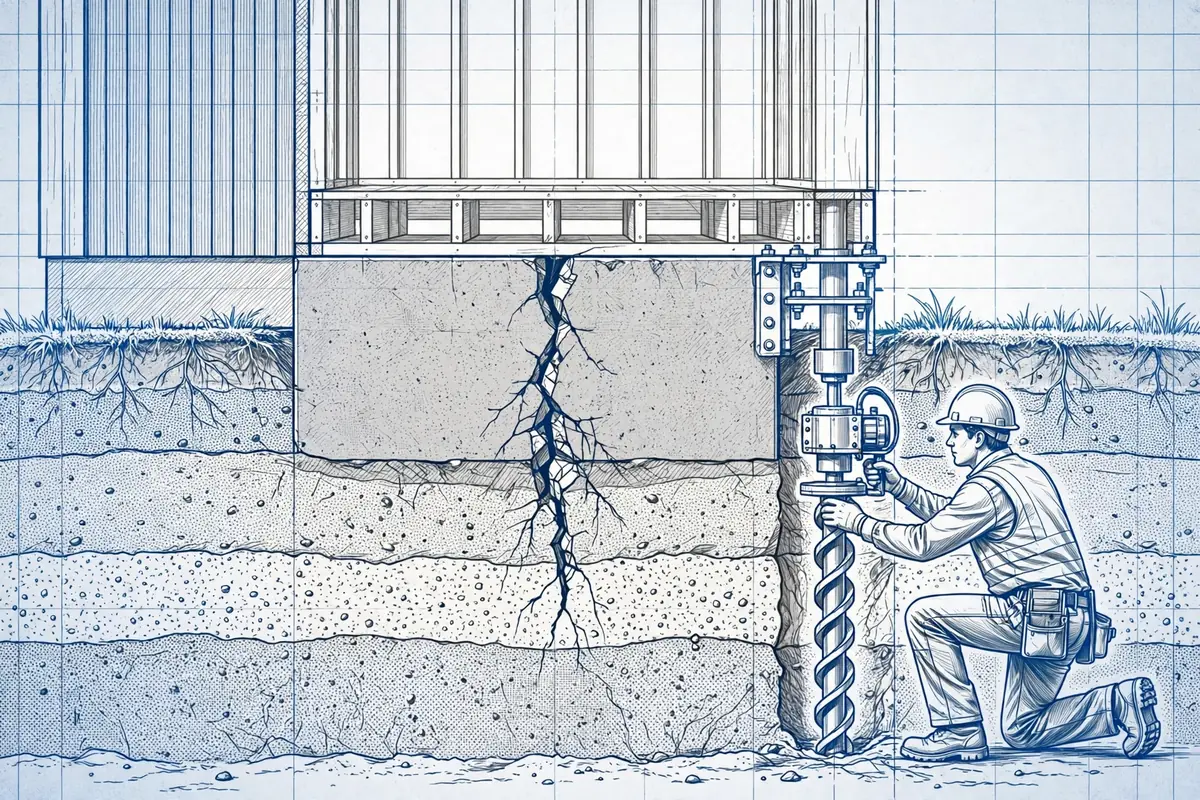
$1,000 to $3,000 per pier installed. A helical pier is a steel shaft with screw-like plates that is rotated into the ground until it reaches load-bearing soil or bedrock. A bracket connects it to the footing, and a hydraulic jack transfers the weight of the house onto the pier. Most houses need 6 to 12 piers. Helical piers are the go-to fix for lighter structures and for sites where vibration from driven piles would be a problem. Installation is fast — a crew can set several piers a day — and there is almost no excavation.
Push piers (resistance piers)
$1,000 to $3,000 per pier installed. Push piers are driven, not screwed: hydraulic rams use the weight of the house itself to push steel pipe sections down to bedrock or a dense bearing layer. They can carry heavier loads than helical piers and are the standard choice for two-storey homes and for deep settlement. The trade-off is that they need enough house weight to react against, and the driving process needs room for the hydraulic rig at each pier location.
Underpinning — mass concrete
$1,000 to $3,000 per underpinning pin, or $10,000 to $30,000+ for a full house. Traditional underpinning excavates beneath the existing footing in short sections — never more than about 4 ft at a time — and pours new concrete down to a deeper, stable bearing layer. It is slow, labour-intensive and disruptive, which is why piers have largely replaced it for settlement repair. It is still the right answer when a footing needs to be deepened to add a basement level, or when the ground is too rocky for piers. ACI 318 requires the new concrete to reach at least 3,000 psi before load is transferred back onto it, and the work must be sequenced so the house is never left unsupported.
Slab jacking and polyurethane foam lifting
$3 to $6 per sq ft for mudjacking; $5 to $25 per sq ft for polyurethane foam. A settled concrete slab — a driveway, a patio, or a slab-on-grade floor — can often be lifted back to level by pumping grout or expanding foam beneath it through small drilled holes. This fixes the slab, not the ground: if the soil is still consolidating, the slab will settle again. Foam is lighter, cures in minutes and needs smaller holes; mudjacking is cheaper and better for very heavy slabs.
Exterior waterproofing and drainage
$100 to $200 per linear foot. Excavating around a foundation, applying a waterproof membrane and installing a new drain tile is often sold alongside structural repair, and in wet climates it is sometimes the repair that matters most. A dry footing on stable soil stops moving; a wet one keeps heaving. If water is the cause, a $12,000 waterproofing job can be a better spend than $12,000 of piers.
Worked Example: A 1,500 sq ft House with a Settling Corner
Take a typical one-storey ranch, 30 ft by 50 ft, with a poured concrete basement. The north-east corner has settled 1.5 inches over three years, and a stair-step crack has opened in the wall above it. The engineer measures the settlement with a level survey, confirms the footing is sound but sitting on soft fill, and specifies 8 helical piers along the 40 ft of affected wall, plus crack injection for two cracks. Here is how the bill builds up:
- Structural engineer's report and pier layout: $800
- Building permit: $450
- Helical piers, 8 at $1,450 each installed: $11,600
- Crack injection, 2 cracks at $600 each: $1,200
- Subtotal: $14,050
- Contingency at 10% (hidden conditions, extra excavation): $1,405
- Total budget: $15,455
A useful check: piers are typically spaced 6 to 8 ft apart along a settled wall. Forty feet of wall at 6 ft spacing gives about 7 piers, so 8 is the right order of magnitude — if a contractor quotes 3 piers for 40 ft, or 15, ask them to show their spacing calculation. A second check is the per-pier price: at $1,450 each, this job sits in the middle of the $1,000 to $3,000 range. A quote of $700 a pier is a red flag for shallow installation or unrated steel; a quote of $3,000 a pier for easy access on good ground is a quote to get a second opinion on.
For a quick budget before any quotes arrive, use this thumb rule: allow $1,200 to $1,800 per pier, plus $1,500 to $2,500 for engineering and permits, plus 10% contingency. Multiply the piers by the length of settled wall divided by 7 ft. It will not be exact, but it will tell you whether you are looking at a $5,000 job or a $25,000 one — and that is the question that matters first.
When Repair Is Not Enough: Replacement
Sometimes the honest answer is that the foundation cannot be saved economically. Full foundation replacement — lifting the house, demolishing the old footings and pouring new ones — runs $20,000 to $100,000+ depending on house size and access. It is justified when the concrete itself is failing: widespread crumbling from sulphate attack, alkali-silica reaction, or decades of freeze-thaw damage. If a contractor proposes replacement for a house with one settled corner and otherwise sound concrete, get an independent engineer's opinion before signing anything.
How to Avoid Paying Twice
- Get the engineer's report first. A $600 to $1,000 report that names the cause is cheaper than a $10,000 repair aimed at the wrong problem.
- Get three quotes, and make them quote the same scope. Hand each contractor the engineer's specification so the prices are comparable — pier count, pier type, depth and load rating.
- Check the warranty. Reputable pier contractors offer a lifetime transferable warranty on the piers themselves. Crack injection is typically warranted for 1 to 5 years. Get it in writing.
- Fix the water first. Re-grade the soil away from the house, extend downspouts at least 6 ft out, and clear the gutters. Roughly a third of foundation movement in the US is driven by poor surface drainage, and it costs almost nothing to fix.
- Do not ignore a crack because it is small. Measure it: mark both ends with a pencil, date the marks, and measure the width with a crack gauge or a coin. A 1/16-inch crack that grows to 1/4 inch in a year is a moving foundation, and a moving foundation only gets more expensive.
Frequently Asked Questions
How much does foundation repair cost on average?
Most US homeowners pay between $2,000 and $7,500 for a typical repair, with the national average around $5,000. Minor crack injection starts near $350, while full underpinning or piering of a settled house runs $10,000 to $25,000 or more.
How much does it cost to fix a cracked foundation wall?
A single non-moving crack costs $350 to $800 to inject with epoxy or polyurethane. If the crack is caused by settlement or a bowing wall, the structural fix — piers, anchors or straps — is priced separately and dominates the bill.
Is foundation repair covered by homeowners insurance?
Usually not. Standard policies cover sudden, accidental damage such as a burst pipe or a fire, but they exclude settlement, soil movement, poor construction and long-term water damage. Flood and earthquake riders are separate policies. Read the exclusions before you call the insurer.
How long does foundation repair take?
Crack injection takes half a day. A pier job on one wall takes 2 to 4 days. Full underpinning of a house takes 2 to 4 weeks because each section must cure before the next is excavated. Add a week or two for engineering and permits before work starts.
Can I sell a house after foundation repair?
Yes — provided the repair is documented. Keep the engineer's report, the contractor's warranty, the permit and the final inspection sign-off. A transferable lifetime warranty on piers is a selling point; an undocumented repair with no paperwork is a red flag that will cost you at the negotiating table.
The cheapest foundation repair is the one you never need. Keep water away from the footing, watch the cracks you already have, and call an engineer — not a salesperson — the first time a crack starts growing. A $800 report today can save a $15,000 pier job tomorrow.
Calculations and engineering guides are for planning and educational reference. Verify final designs against applicable codes with a licensed Professional Engineer.