How Much Does a Fence Cost Per Linear Foot? Wood, Vinyl & Chain-Link
Fence installation costs $15–$60 per linear foot depending on material. Compare wood, vinyl and chain-link prices, with a full 150-foot worked example.
If you are pricing a fence, the number that matters is the cost per linear foot. Contractors quote fences that way for a good reason: once you know the rate for your material and height, the total is a simple multiplication. The trouble is that the rate swings wildly — from about $15 a foot for a basic chain-link fence to $60 or more for a tall vinyl privacy fence — and a quote that looks cheap can hide gates, footings and permits that add thousands.
This guide breaks down what a fence really costs per linear foot in the United States, compares wood, vinyl and chain-link side by side, and walks through a full worked example for a typical 150-foot backyard fence so you can check any quote you receive.
The short answer: fence cost per linear foot at a glance
Installed prices below are typical 2026 US ranges for a standard residential job on flat ground, including posts, concrete footings, panels or fabric, and labour. Material-only prices are roughly half the installed figure.
- Chain-link, 4 ft galvanized: $15–$25 per linear foot installed
- Chain-link, 6 ft galvanized: $20–$35 per linear foot installed
- Wood privacy, 6 ft (pressure-treated pine): $25–$40 per linear foot installed
- Wood privacy, 6 ft (cedar): $30–$50 per linear foot installed
- Vinyl privacy, 6 ft: $30–$60 per linear foot installed
- Aluminium ornamental: $45–$90 per linear foot installed
So a 150-foot fence costs roughly $3,000 in chain-link, $5,400 in cedar and $6,750 in vinyl. Gates, slopes, rocky soil and permits push those numbers up — the sections below show by how much.
What a linear foot of fence actually includes
Before comparing rates, make sure you are comparing the same thing. A proper per-foot price should cover four items:
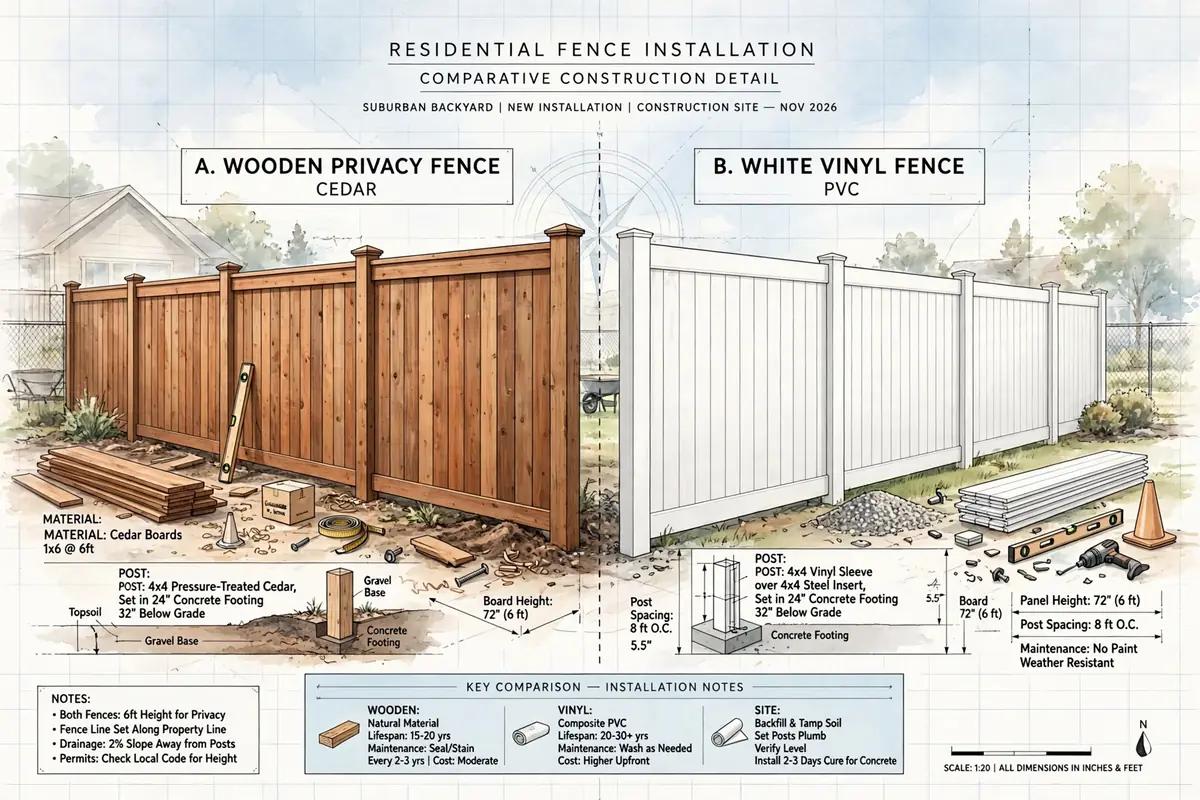
- Posts: typically 4×4 wood posts or steel posts set 8 ft on centre. A 150-foot run needs about 19 posts, plus corner and end posts.
- Footings: each post set in concrete. A standard residential footing is a 10–12 in. diameter hole, 24–36 in. deep depending on frost line, filled with about 1.5–2 bags of ready-mix concrete. ACI 318 requires concrete exposed to earth to have adequate cover and durability, and in cold climates footings should extend below the local frost depth or the posts will heave.
- Panels, pickets or fabric: the visible part of the fence — boards and rails for wood, interlocking panels for vinyl, woven wire for chain-link.
- Labour: digging, setting posts plumb, hanging panels, and cleanup. Labour usually runs $10–$20 per linear foot, and it is the part of the quote that varies most with site conditions.
If a quote is far below the ranges above, ask what is missing. The usual gaps are gates, concrete for the footings, haul-off of the old fence, and the permit fee.
Wood fence cost per linear foot
Wood is the most common residential choice because it is the cheapest way to get a solid privacy fence, and it is easy to repair board by board. A 6 ft privacy fence in pressure-treated pine runs $25–$40 per linear foot installed; the same fence in cedar runs $30–$50, and redwood can reach $55–$70.
Material alone accounts for about $15–$30 per foot: 1×6 pickets, two or three 2×4 rails per bay, 4×4 posts, fasteners and concrete. Cedar costs more than pine but resists rot and insects without chemical treatment, which is why it is the default in many markets despite the premium.
The honest cost of wood is maintenance. A cedar fence lasts 15–20 years if it is sealed or stained every 2–3 years; left bare, it greys, checks and can start failing in 10–12 years. Budget roughly $1–$2 per linear foot per staining cycle, or about $150–$300 for a 150-foot fence every few years.
Vinyl fence cost per linear foot
Vinyl — rigid PVC panels with reinforced posts — is the most expensive of the three common materials upfront, at $30–$60 per linear foot installed for a 6 ft privacy fence. Material alone is roughly $20–$40 per foot, which is why the installed price is so sensitive to the panel brand and wall thickness.
What you buy with that premium is near-zero maintenance: no painting, no staining, no rot, no termites. A quality vinyl fence lasts 25–30 years and needs only an occasional wash. Cheap, thin-walled vinyl is a false economy — it chalks, cracks in cold weather and sags between posts. Ask for the panel's wind-load rating and the post wall thickness before accepting a low vinyl quote.
Vinyl posts are usually 5×5 in. sleeves set over a wood or steel insert, concreted like a wood post. Because the panels are prefabricated in 6 ft or 8 ft sections, a vinyl fence goes up faster than wood, so labour is a smaller share of the total.
Chain-link fence cost per linear foot
Chain-link is the cheapest way to enclose a yard: $15–$25 per linear foot installed for 4 ft galvanized fabric, and $20–$35 for 6 ft. The fabric itself is only a few dollars a foot; most of the price is galvanized steel posts, top rail and labour.
Chain-link is specified by mesh size and wire gauge — 2 in. mesh in 11-gauge wire is the residential standard; 9-gauge is heavier and better for dogs or high-traffic areas. Galvanizing should meet ASTM A392 for zinc-coated fabric. Vinyl-coated chain-link (usually black or green) costs $5–$10 more per foot and is worth it if appearance matters, because bare galvanized wire looks industrial.
The trade-off is privacy: chain-link encloses but does not screen. Privacy slats woven into the mesh add $3–$6 per linear foot and cut visibility by about 75–90%, but they also catch wind, so the posts and footings need to be sized for the extra load.
Worked example: pricing a 150-foot cedar privacy fence
Take a typical job: a 150-foot backyard boundary, flat ground, 6 ft cedar privacy fence, one 4 ft walk gate, no old fence to remove. Here is how the total builds up.
Step 1 — Materials. Cedar pickets, rails, 4×4 posts, concrete and fasteners at $18 per linear foot:
150 ft × $18/ft = $2,700
Step 2 — Labour. A two-person crew sets posts, hangs rails and pickets at $14 per linear foot:
150 ft × $14/ft = $2,100
Step 3 — Gate. One 4 ft cedar walk gate with hinges, latch and a steel frame: $450
Step 4 — Permit. Most US municipalities require a fence permit and a check that the fence sits inside the property line. Allow $150 (fees commonly run $50–$400).
Step 5 — Total.
$2,700 + $2,100 + $450 + $150 = $5,400
Divide by the length to get the true per-foot cost:
$5,400 ÷ 150 ft = $36 per linear foot
That $36 sits comfortably inside the $30–$50 cedar range, which is a good sign — a quote far outside the range for the same specification deserves a question, not a signature.
For comparison, the same 150-foot run priced with the same method gives about $3,000 for 4 ft chain-link at $20 per foot, and about $6,750 for 6 ft vinyl at $45 per foot, before gates and permits.
What pushes the price up (or down)
- Height: a 4 ft fence uses roughly a third less material than a 6 ft fence and shallower footings. Expect 6 ft to cost 30–50% more per foot than 4 ft in the same material.
- Slope: stepping panels down a slope or racking them to follow the grade adds labour and often extra posts. Steep sites can add $5–$10 per foot.
- Soil and rock: augers stop at rock. Hand-digging or a rock drill adds $50–$150 per post hole, and a 150-foot fence has about 19 of them.
- Gates: a walk gate adds $300–$800; a double drive gate with a steel frame can add $1,000–$2,500.
- Old fence removal: tearing out and hauling away an existing fence typically adds $3–$5 per linear foot.
- Permits and surveys: $50–$400 for the permit, and $300–$700 for a boundary survey if the property line is in doubt. Building on a neighbour's land is the most expensive fence mistake there is.
- Access: if a truck and auger cannot reach the fence line, everything is carried in by hand and labour rises fast.
DIY vs hiring a contractor
Doing it yourself saves the labour component — roughly $10–$20 per foot, or $1,500–$3,000 on a 150-foot fence. Against that, weigh the tools (auger rental $75–$150 a day, concrete mixer if you are pouring many footings), the time (a two-person crew finishes 150 feet in 2–3 days; a first-timer should allow a full week), and the risk: posts set out of plumb or too shallow are the reason most DIY fences lean within two years.
A practical middle ground is to hire the post-setting — the part where accuracy matters most — and hang the panels yourself. Many fence contractors will quote post-setting alone.
Lifetime cost: the number most quotes hide
The cheapest fence on day one is not always the cheapest over 20 years. Using the 150-foot example and typical maintenance:
- Chain-link: $3,000 installed, almost no maintenance. 20-year cost ≈ $3,000.
- Cedar: $5,400 installed plus staining every 3 years at about $250 a cycle — roughly $1,500 over 20 years. 20-year cost ≈ $6,900, and the fence may need partial replacement at the end.
- Vinyl: $6,750 installed, occasional washing only. 20-year cost ≈ $6,750.
Over two decades, vinyl often ends up costing about the same as wood — which is why it wins so many jobs despite the higher quote. Chain-link stays the cheapest by a wide margin if you do not need privacy.
Frequently asked questions
How much does a fence cost per linear foot installed?
Expect $15–$25 per foot for 4 ft chain-link, $25–$50 for a 6 ft wood privacy fence, and $30–$60 for 6 ft vinyl, installed. Gates, permits, slope and rock add to those figures.
How do I calculate the total cost of my fence?
Measure the fence line in feet, multiply by the installed per-foot rate for your material and height, then add gates ($300–$800 each), the permit ($50–$400) and old-fence removal ($3–$5 per foot) if they apply.
Is vinyl or wood cheaper in the long run?
Wood is cheaper upfront — about $36 per foot for cedar against $45 for vinyl on a typical job — but staining every 2–3 years closes the gap. Over 20 years the two often cost about the same, while vinyl needs almost no upkeep.
How deep should fence posts be set?
A good rule is one-third of the post length below ground, and never less than 24 in. for a 6 ft fence. In freezing climates the footing must extend below the local frost depth or the posts will heave — check your local building code for the exact depth.
Do I need a permit to build a fence?
Usually, yes. Most US cities and counties require a fence permit, cap residential fence height at 6 ft in backyards (often 4 ft in front yards), and require the fence to sit inside your property line. Check before you dig — and call 811 to mark underground utilities.
Calculations and engineering guides are for planning and educational reference. Verify final designs against applicable codes with a licensed Professional Engineer.