How Much Does Carpet Installation Cost Per Square Foot?
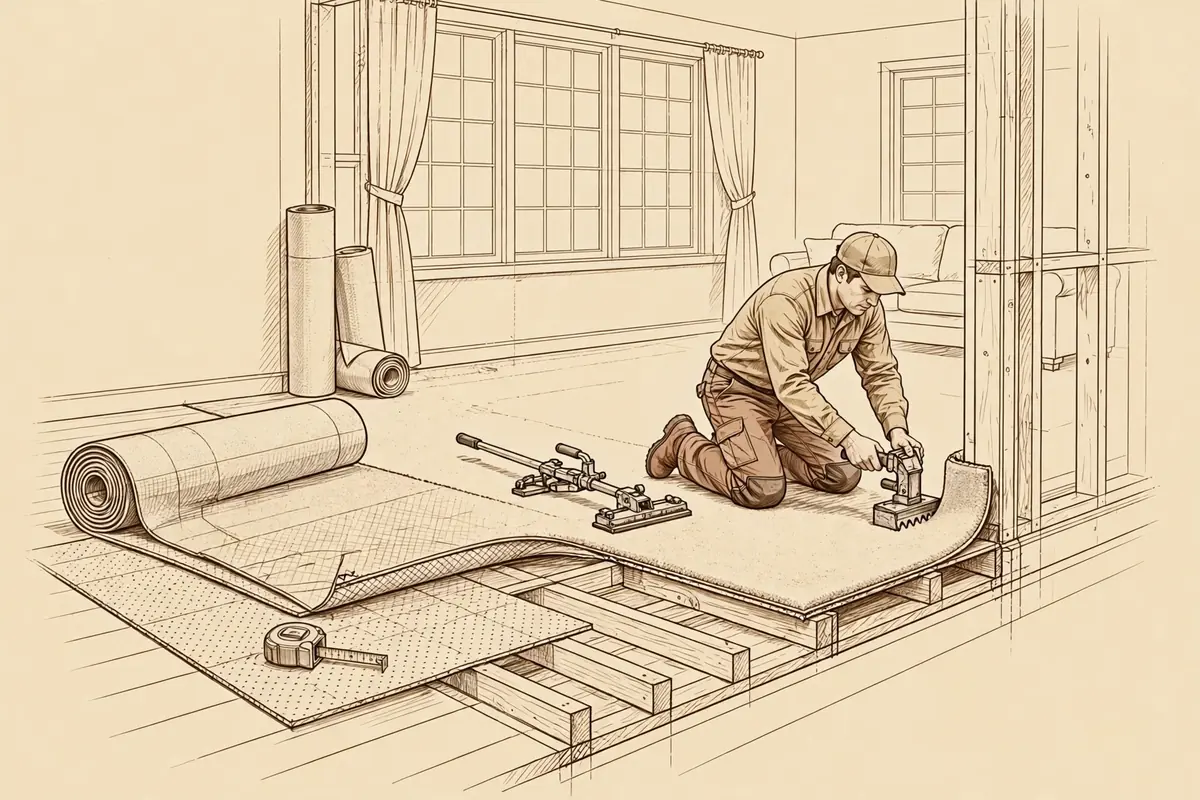
Carpet installation costs $3-$7 per square foot all-in for most homes. See material, padding and labour broken down, plus a full worked example.
Ask ten flooring shops what carpet installation costs and you will get ten different answers — because the honest answer is always "it depends". It depends on the carpet, the padding underneath it, the shape of the room, and what has to come out before the new carpet goes in. This guide breaks the price down into its real parts — material, padding, labour and the extras — so you can price a job yourself and spot a quote that is padding the bill.
All prices here are in US dollars, based on typical 2026 rates; expect to pay 10–20% more in high-cost metro areas.
The Short Answer: Carpet Installation Cost at a Glance
For a standard bedroom or living room, with mid-range carpet and professional installation, budget $4.50 to $7.00 per square foot, all in. A budget job with economy carpet can come in at $3.00 to $4.50 per square foot, while premium wool or high-end nylon with top-grade padding runs $7.00 to $12.00 per square foot installed.
Those figures include the carpet itself, the padding, the labour, and the usual sundries — tack strip, seams and transitions. They do not include removing and disposing of old carpet, moving heavy furniture, or fixing a damaged subfloor, which are charged separately and catch a lot of homeowners by surprise. We cover those below.
Carpet Material: The Biggest Variable
Carpet is sold by the square yard, not the square foot. One square yard equals nine square feet, so to convert a per-square-yard price, divide by nine. A carpet priced at $27 per square yard costs $3.00 per square foot.
Material prices vary mostly by fibre. Here is what to expect per square foot for the carpet alone:
- Olefin (polypropylene): $1.00–$2.50 — the cheapest option. Stain-resistant and fine for low-traffic rooms, but it crushes and mats faster than other fibres.
- Polyester: $1.50–$3.00 — soft underfoot, good stain resistance, widely available in budget and mid-range lines. Tends to lose its shape in hallways and stairs.
- Nylon: $2.50–$5.00 — the workhorse of residential carpet. Tough, resilient, holds its pile height for years. The default choice for busy family rooms.
- Triexta (SmartStrand): $2.50–$4.50 — similar in price to nylon, with built-in stain protection that does not wash out. A strong pick if you have pets or children.
- Wool: $5.00–$10.00 and up — the premium natural fibre. Luxurious, long-lasting and naturally flame-resistant, but it stains more easily and needs professional cleaning.
Berber, the loop-pile style, is not a fibre but a construction: it is made from olefin, nylon or wool and usually lands between $2.00 and $5.00 per square foot.
As a rule of thumb, the carpet itself makes up roughly half of the total installed cost. Spend the money on fibre quality rather than pattern: a plain mid-range nylon will outlast a fancy-patterned budget polyester by years.
Padding: The Hidden Half of the Job
Nobody sees the padding, but it decides how the carpet feels and how long it lasts. Cheap, thin padding lets the carpet backing flex and wear out from underneath; good padding absorbs foot traffic and keeps the pile upright.
- Rebond foam (recycled foam): $0.50–$0.75 per square foot — the standard. Look for 7/16 inch thick, 6-pound density for living areas; 8-pound for stairs and hallways.
- Prime foam (urethane): $0.60–$0.90 per square foot — a step up in comfort and consistency, with fewer lumps and soft spots.
- Memory foam: $0.80–$1.25 per square foot — the softest feel underfoot, popular in bedrooms. It can feel too soft under heavy furniture.
- Felt or rubber slab: $1.00–$1.50 per square foot — the choice under wool carpet and in commercial work. Dense, firm and very durable.
One warning from the field: never let an installer re-use old padding. It has already compressed, it holds dust and odours, and it voids most carpet warranties. New padding is a small part of the bill — about 10% — and skipping it is false economy.
Labour: What Installers Actually Charge
Professional installation typically costs $1.00 to $2.00 per square foot for straightforward rooms, or roughly $250 to $500 per day for a two-person crew. That covers measuring, cutting, seaming, stretching and trimming. Most installers work to the CRI Carpet Installation Standard (CRI 104/105), which calls for power stretching — a power stretcher pulls the carpet tight across the room so it does not ripple later. A knee kicker alone is not enough for a full room, and a carpet that was never properly stretched will bubble within a year.
Labour climbs when the job gets awkward. Stairs are the classic example: expect $4.00 to $8.00 extra per step, because each tread has to be cut, folded and stapled by hand. Patterned carpet adds 10–20% to labour because every seam has to be pattern-matched. Large open rooms are the cheapest per square foot; small cut-up rooms with closets and doorways cost more, because the installer spends more time cutting and less time laying.
Extra Costs People Forget
These are the line items that turn a $2,000 quote into a $2,600 invoice. Ask about every one before you agree a price.
- Old carpet removal and disposal: $0.50–$1.00 per square foot. Includes pulling the old carpet, the old padding and the tack strip, and hauling it away.
- Furniture moving: $50–$150 per room. Some shops include moving standard furniture; pianos, aquariums and pool tables are always extra, or your problem.
- Tack strip: about $0.50 per linear foot around the room perimeter, usually $40–$60 per room. Cheap, but it should be on the quote.
- Transition strips: $10–$25 each where carpet meets hard flooring at a doorway.
- Subfloor repair: $2.00–$5.00 per square foot for the affected area, only if the subfloor is damaged, squeaky or uneven. You cannot price this until the old carpet is up.
- Stair nosing and specialty trim on open-sided stairs, priced per step or per linear foot.
- Delivery: often free within a local area, but some shops charge $50–$100 for a large order.
Worked Example: A 400 Square Foot Living Room
Let us price a real job: a living room measuring 20 ft by 20 ft — 400 square feet — with mid-range nylon carpet, standard rebond padding and professional installation. The old carpet needs to come out, and there are two doorways.
First, the carpet quantity. Carpet comes on 12-foot-wide rolls, and the installer will cut two pieces and seam them. The room needs 400 square feet, which is 44.4 square yards. Add a 10% waste allowance for cutting and matching — standard for a square room — and you should order 49 square yards, or 441 square feet.
- Carpet: 49 sq yd × $27.00 per sq yd = $1,323
- Padding: 400 sq ft × $0.60 per sq ft = $240
- Labour: 400 sq ft × $1.50 per sq ft = $600
- Tack strip: 80 linear ft × $0.50 = $40
- Transition strips: 2 × $15 = $30
- Furniture moving: $75
- Old carpet removal and disposal: 400 sq ft × $0.75 = $300
Total: $2,608, or $6.52 per square foot installed. Strip out the removal and furniture moving and the job is $2,233, or $5.58 per square foot — right in the middle of the mid-range band quoted above. That is the figure to compare when you collect quotes: make sure every quote includes the same extras, or you are not comparing like with like.
How to Work Out Your Own Price
You can estimate any room with one formula:
Total cost = (carpet price per sq yd ÷ 9 + padding per sq ft + labour per sq ft) × room area in sq ft + extras
Three practical points when you use it. First, measure the room properly: measure wall to wall at the longest and widest points, and add 4–6 inches on each side for trimming. Second, use a 10% waste factor for square rooms, 15% for L-shaped rooms, and 20% for stairs, patterned carpet or rooms with lots of angles. Third, always price the carpet in square yards — that is how it is sold, and converting first avoids the common mistake of ordering square feet and coming up short.
Quick check for a 12 ft by 15 ft bedroom (180 sq ft) with budget polyester at $18 per sq yd, padding at $0.50 and labour at $1.25: (18 ÷ 9 + 0.50 + 1.25) × 180 = (2.00 + 0.50 + 1.25) × 180 = 3.75 × 180 = $675, plus removal and transitions. A one-day job for a single bedroom, and a useful sanity check against any quote.
How to Judge Carpet Quality Before You Buy
Price is a poor guide to quality on its own. Two numbers on the specification sheet matter more: face weight and density.
Face weight is the weight of the carpet pile per square yard, in ounces. For a living room, look for 35–50 oz per square yard; below 30 oz is light-duty and will flatten quickly. Density tells you how tightly the fibres are packed, and it is calculated from the face weight and the pile height:
Density (oz per cubic yard) = face weight × 36 ÷ pile height in inches
Take a carpet with a 40 oz face weight and a 0.5-inch pile: 40 × 36 ÷ 0.5 = 2,880 oz per cubic yard. Anything above 3,000 is good; above 4,000 is excellent. A high face weight with a tall, loose pile can still be a poor carpet — density catches that, face weight alone does not.
Also check the fire and emissions ratings. Residential carpet sold in the US must pass the pill test, ASTM D2859, and the Carpet and Rug Institute's Green Label Plus programme certifies low chemical emissions.
Ways to Keep the Cost Down
- Choose nylon over wool unless you specifically want a natural fibre — you get most of the durability for half the price.
- Book a whole floor, not one room. Installers price per day as much as per square foot, so adding a second room spreads the fixed costs.
- Remove the old carpet yourself. It is dusty, unskilled work, and it saves $0.50–$1.00 per square foot — $200–$400 on a 400 sq ft room.
- Buy remnants for small rooms. A leftover roll end that fits a bedroom can cost 30–50% less than ordering fresh, though the choice of colour is whatever is in the warehouse.
- Do not skimp on padding. Saving $100 on cheap padding and replacing the carpet two years early is the most expensive saving in this whole guide.
Frequently Asked Questions
How long does carpet installation take?
A crew of two can usually install 400–600 square feet in a day. A single bedroom takes two to four hours; a whole house takes two to three days, including removal of the old flooring.
Do I need to move furniture before the installers arrive?
Most installers will move standard furniture — sofas, beds, tables — as part of the job or for a small fee. Clear small items, electronics and valuables yourself, and empty wardrobes and bookcases so they are light enough to shift.
How long should new carpet last?
Budget polyester lasts 5–8 years in a busy room; mid-range nylon lasts 10–15 years; wool can last 20 years or more with proper care. The padding underneath matters as much as the carpet: worn-out padding kills a good carpet early.
Can carpet be installed over old carpet?
No — not properly. The old carpet is too soft a base, the tack strip cannot grip through it, and the finished floor ends up too high for the doors. It also voids the manufacturer's warranty.
What is the cheapest carpet to install?
Olefin or budget polyester, at roughly $3.00–$4.00 per square foot installed including padding and labour. It is a sensible choice for a rental, a spare room or a home you plan to sell soon — but expect to replace it sooner than a mid-range nylon.
Calculations and engineering guides are for planning and educational reference. Verify final designs against applicable codes with a licensed Professional Engineer.