How Much Does Brick Veneer Cost Per Square Foot?
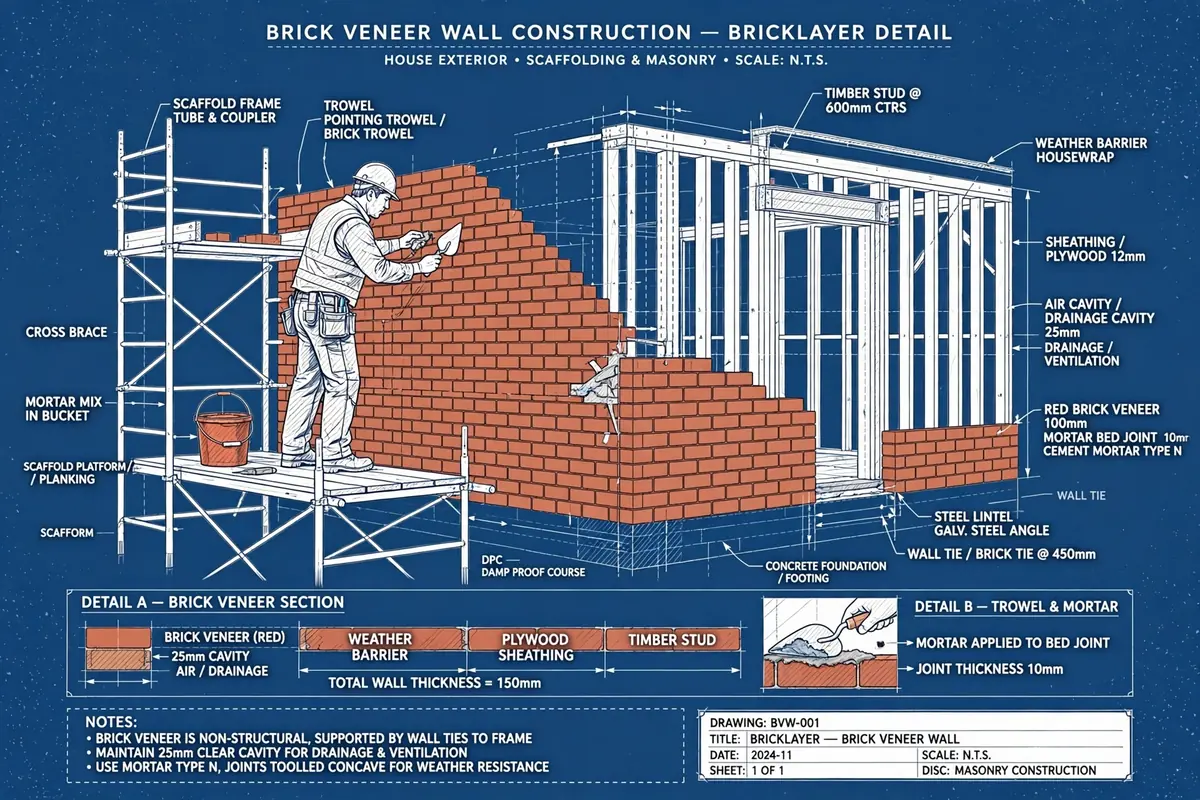
Brick veneer costs 4-2 per square foot installed. Material, mortar, ties, flashing and labour broken down, with a full worked example for a 1,500 sq ft house.
Brick veneer looks like a solid brick wall, but it is not one. It is a single layer of thin brick — usually a standard brick laid on its face, or a thin brick tile — fixed to a wood or steel frame wall, with a cavity and a water-resistive barrier behind it. That distinction matters when you price it, because you are paying for a finish system, not a structural wall. Get the components right and the estimate follows naturally; miss one — the weep holes, the wall ties, the flashing — and the quote that looked cheap turns into a call-back.
This guide breaks down brick veneer cost per square foot into material, labour and the extras estimators forget, then works through a full example for a typical 1,500 sq ft veneer area so you can check a contractor's quote line by line.
What brick veneer costs per square foot in 2026
For a standard clay brick veneer on a framed wall in the United States, expect $14 to $32 per square foot installed. Most residential jobs land between $18 and $26 per square foot. That range covers the brick, mortar, wall ties, flashing, labour and the usual site conditions. It does not cover structural framing, sheathing, house wrap or the foundation ledge — those belong to the wall itself, not the veneer.
Thin brick veneer (half-inch to one-inch thick tiles glued or mechanically fixed to a panel or substrate) is usually cheaper on labour but similar on material: $12 to $24 per square foot installed. It is a good option for interior feature walls or for retrofits where a full 4-inch brick course would need a new foundation ledge.
- Budget job: $14–$18 per sq ft — standard running-bond brick, local supplier, straightforward rectangular walls, minimal cutting.
- Typical job: $18–$26 per sq ft — mid-range brick, some soldier courses or arches, a few openings, normal access.
- Premium job: $26–$32+ per sq ft — handmade or imported brick, complex patterns, tall gables, difficult access, extensive scaffolding.
Material costs: brick, mortar and the parts you cannot see
Brick itself
Standard modular brick (3⅝ in. × 2¼ in. × 8 in.) costs roughly $0.50 to $1.50 per brick at a masonry yard, depending on colour, texture and whether it is extruded or handmade. A square foot of veneer takes about 6.75 bricks in running bond with a ⅜-inch mortar joint, so the brick alone runs about $3.40 to $10.10 per square foot. Handmade, glazed or imported bricks can push past $2.00 each, which is how a premium job climbs so fast.
Always order 5–10% extra for cutting, breakage and colour matching. Brick comes in batches; a shortfall ordered weeks later will not match the first delivery exactly, and on a front elevation that difference shows.
Mortar
Type N mortar is the usual choice for veneer above grade in most of the United States — it is flexible enough to absorb small movements and strong enough for a non-loadbearing skin. Type S is used where higher strength or exposure to severe weather is expected. A bag of pre-mixed mortar (80 lb) costs about $8 to $12 and covers roughly 35–40 sq ft of veneer. Mortar works out to about $0.25 to $0.35 per square foot, including sand if you mix on site.
Ties, flashing and drainage
These are the cheap parts that do the most work. Corrugated metal or adjustable two-piece wall ties anchor the veneer to the frame — typically one tie per 2.67 sq ft of wall area per TMS 402/602 (formerly ACI 530), with a maximum spacing of 24 in. horizontally and 16 in. vertically in most residential work. Ties cost about $0.10 to $0.20 per square foot of wall.
Through-wall flashing at the base, above windows and doors, and at shelf angles runs $0.50 to $1.50 per square foot of wall area, depending on whether you use self-adhered membrane, copper or stainless steel. Add weep vents, a mortar-collection device at the base of the cavity, and a 1-inch minimum air space behind the brick — required by code for drainage — and the "invisible" components add roughly $0.75 to $2.00 per square foot in total. A quote that omits them is not cheaper; it is incomplete.
Labour: where most of the money goes
Bricklaying is skilled, slow work. A good mason lays 300 to 500 bricks a day on straightforward veneer work; on complex patterns, arches or tall gables that can drop below 200. At 6.75 bricks per square foot, one mason covers roughly 45 to 75 sq ft per day.
Labour rates for masons in the US generally run $25 to $45 per hour, plus a tender or labourer at $15 to $25 per hour. All-in, installed labour for brick veneer usually works out to $8 to $14 per square foot. That rate rises with:
- Height: work above 10–12 ft needs scaffolding, which adds $1–$3 per sq ft and slows the crew.
- Openings: every window and door means cutting, lintels, sills and soldier courses — budget 1–2 extra hours per opening.
- Pattern: running bond is fastest; Flemish bond, herringbone accents or soldier courses can add 20–40% to labour time.
- Access: tight urban lots, steep slopes or long carries from the delivery point all add time.
Worked example: 1,500 sq ft brick veneer on a two-storey house
Take a typical two-storey home with 1,500 sq ft of veneer area — front and side elevations, about 30% of it above 12 ft, with 8 window and door openings. Mid-range brick at $0.85 each, Type N mortar, standard ties and self-adhered flashing.
Materials:
- Brick: 1,500 sq ft × 6.75 bricks = 10,125 bricks, plus 7% waste = 10,834 bricks. At $0.85 each = $9,209.
- Mortar: 1,500 sq ft ÷ 38 sq ft per bag = 40 bags, plus 10% = 44 bags at $10 = $440.
- Wall ties: 1,500 sq ft ÷ 2.67 sq ft per tie = 562 ties at $0.45 each = $253.
- Flashing, weeps and drainage: 1,500 sq ft × $1.10 = $1,650.
- Scaffolding hire: two weeks for the upper storey = $1,800.
- Materials subtotal = $13,352, or $8.90 per sq ft.
Labour:
- Laying: 10,834 bricks ÷ 400 per day = 27 mason-days. With a two-person crew (mason + tender) at $520 per day combined = $14,040.
- Openings and details: 8 openings × 1.5 hours at $65 per hour crew rate = $780.
- Labour subtotal = $14,820, or $9.88 per sq ft.
Totals:
- Materials $13,352 + labour $14,820 = $28,172, or $18.78 per sq ft.
- Add a 10% contingency ($2,817) for hidden conditions and small extras, giving a budget figure of $30,989, or $20.66 per sq ft.
That is a realistic mid-range number. If a contractor quotes $12 per sq ft for the same scope, something is missing — usually the flashing, the scaffolding or the contingency. If the quote is $30 per sq ft, ask what is driving it: handmade brick, a complex pattern, or difficult access are all legitimate reasons.
Brick veneer vs other cladding costs
For context, here is how brick veneer compares with common alternatives on the same wall, installed:
- Vinyl siding: $4–$10 per sq ft — cheapest, shortest life, lowest resale impact.
- Fibre-cement siding: $8–$14 per sq ft — good durability, needs repainting.
- Thin brick veneer: $12–$24 per sq ft — the brick look with less weight and no foundation ledge.
- Full brick veneer: $14–$32 per sq ft — the classic, with the best durability and resale value.
- Natural stone veneer: $20–$45 per sq ft — premium look, premium price, heavier detailing.
Brick veneer wins on longevity: a well-built veneer needs almost no maintenance beyond occasional repointing after 25–30 years, and it holds up in freeze-thaw climates where painted sidings need regular work. That is the argument to make when a client balks at the upfront figure.
What to check before you sign the quote
- Cavity and drainage: confirm a 1-inch minimum air space, weep holes at maximum 24 in. spacing at the base and above openings, and flashing that extends to the outside face of the brick.
- Tie spacing: ask for the tie layout — TMS 402/602 limits and the manufacturer's data should be on the drawing or in the specification.
- Brick batch: all bricks from one batch, blended from several pallets as work proceeds to even out colour variation.
- Mortar type: Type N above grade is the default; confirm it in writing rather than discovering Type M (too rigid for veneer) after the fact.
- Control and expansion joints: brick expands with moisture; vertical joints every 20–25 ft on long runs prevent cracking.
- Foundation ledge: a full brick veneer needs a ledge or shelf angle to sit on — check that the footing or angle is priced in, not assumed.
Frequently asked questions
How much does brick veneer cost per square foot installed?
Between $14 and $32 per square foot installed in the US, with most residential jobs at $18–$26 per square foot. Material accounts for roughly $6–$11 per sq ft and labour $8–$14 per sq ft, plus scaffolding and flashing.
Is brick veneer cheaper than full brick?
Yes. A solid double-wythe brick wall needs two layers of brick plus a structural role, and it costs roughly double the veneer figure. Veneer gives the same appearance for about half the material and far less labour, because the frame wall behind it carries the load.
How many bricks are in a square foot of veneer?
About 6.75 standard modular bricks per square foot in running bond with ⅜-inch joints. Add 5–10% for waste, cutting and breakage.
Does brick veneer need a foundation?
A full 4-inch brick veneer needs support — either a brick ledge cast into the foundation or a steel shelf angle bolted to the frame. Thin brick veneer does not; it is glued or fixed directly to the substrate. Check which type your quote covers.
How long does brick veneer last?
Properly built and drained, brick veneer lasts 50–100 years. The brick itself is effectively permanent; the mortar joints are the wearing part and typically need repointing after 25–30 years.
Bottom line
Budget $18–$26 per square foot installed for a typical residential brick veneer job, and hold a 10% contingency on top. Price it by its parts — brick at 6.75 per sq ft, mortar, ties, flashing, labour at roughly 400 bricks a day — and any quote becomes easy to check. The expensive mistakes in veneer work are never in the brick price; they are in the drainage details that were left out of the quote and discovered later, when water is already inside the wall.
Calculations and engineering guides are for planning and educational reference. Verify final designs against applicable codes with a licensed Professional Engineer.