How Much Does Asphalt Paving Cost Per Square Foot?
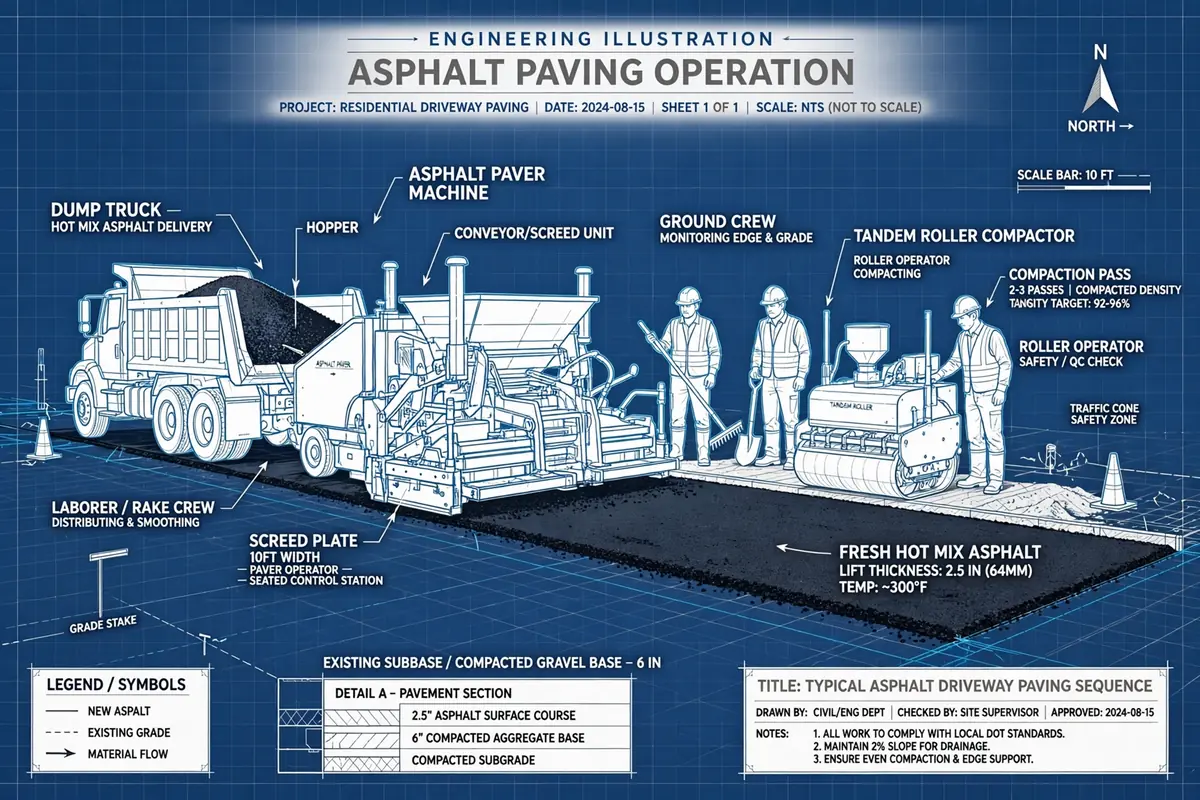
Asphalt paving costs $3–$7 per square foot for a new driveway. Learn what drives the price, how to calculate tonnage, and see two fully worked examples.
If you are pricing a new driveway or a parking lot, the first number everyone wants is the cost per square foot. The honest answer is that it depends — on thickness, on the base underneath, on access, and on where you live — but the range for a standard residential driveway in the US is roughly $3 to $7 per square foot, installed. This article breaks that number down piece by piece, shows you how to work out how much asphalt your job actually needs, and walks through two fully worked examples: a 480 sq ft driveway and a 10,000 sq ft parking lot.
Asphalt paving cost at a glance
These are typical 2026 US installed prices. They include material, labour and equipment, but not permits or drainage work, which are priced separately.
- New asphalt driveway: $3–$7 per sq ft
- New parking lot: $2.50–$5 per sq ft
- Resurfacing (overlay) over sound existing asphalt: $1.50–$3 per sq ft
- Patching and repairs: $3–$6 per sq ft, with minimum charges of $300–$500
- Sealcoating: $0.15–$0.30 per sq ft, every 3–5 years
A typical two-car driveway of about 600 sq ft therefore lands somewhere between $1,800 and $4,200. A small commercial lot of 10,000 sq ft usually runs $25,000 to $50,000. The worked examples below show exactly where those numbers come from.
What drives the cost per square foot
Five factors move the price more than anything else.
1. Thickness of the asphalt layer
Residential driveways are normally paved 2 to 3 inches thick after compaction. Commercial lots and roads take 3 to 6 inches. Every extra inch of asphalt adds roughly $0.60–$1.00 per sq ft, because you are buying more hot mix and paying for more rolling time.
2. The base underneath
Asphalt is only as good as what it sits on. A proper job needs 4 to 8 inches of compacted crushed stone base, graded and rolled before the hot mix arrives. If the ground is soft clay or the old driveway has to be excavated first, the base and earthwork can add $1–$2 per sq ft. Skipping the base is the most common way a cheap quote turns into a cracked driveway two winters later.
3. Size of the job
Small jobs cost more per square foot. A paving crew, a paver, rollers and a truck of hot mix cost roughly the same to mobilise whether the job is 300 sq ft or 3,000 sq ft, so the fixed cost is spread over fewer square feet on a small driveway. That is why a 200 sq ft patch can quote at $8 per sq ft while a 10,000 sq ft lot quotes at $3.50.
4. Access and site conditions
Steep grades, narrow gates, tight turns for dump trucks, trees to work around, and existing concrete or asphalt that must be hauled away all push the price up. Removal and disposal of an old driveway typically adds $1–$2 per sq ft.
5. Oil prices and location
Asphalt binder is a petroleum product, so its price tracks crude oil. A $10 swing in the price of a barrel of oil can move hot mix by $5–$10 a ton. Remote sites also pay more, because hot mix cools in the truck — plants generally will not haul it much beyond an hour, and long hauls mean smaller loads and more trips.
How to calculate how much asphalt you need
Before you can price anything, you need the tonnage. Asphalt is sold by the ton, and the calculation is straightforward once you know the density of compacted hot mix asphalt: about 145 lb per cubic foot (2,322 kg/m³).
Step 1 — area: length × width in feet.
Step 2 — volume: area × thickness in feet (divide inches by 12).
Step 3 — weight: volume × 145 lb/ft³, then divide by 2,000 to get tons.
Step 4 — add waste: add 5–10% for edges, overlaps and compaction.
A useful rule of thumb to check your answer: one ton of asphalt covers about 80 sq ft at 2 inches thick, about 55 sq ft at 3 inches, and about 40 sq ft at 4 inches. If your calculation is far from those figures, recheck the thickness conversion.
Worked example 1: a 480 sq ft residential driveway
Take a single-width driveway, 12 ft wide by 40 ft long, paved 3 inches thick over a 6-inch compacted crushed stone base. The old gravel drive is already stripped and the subgrade is firm, so there is no extra excavation.
Asphalt quantity:
Area = 12 × 40 = 480 sq ft.
Volume = 480 × (3 ÷ 12) = 480 × 0.25 = 120 ft³.
Weight = 120 × 145 = 17,400 lb = 8.7 tons.
Add 10% waste: 8.7 × 1.10 = 9.6 tons, so order 10 tons.
Base quantity:
Volume = 480 × (6 ÷ 12) = 240 ft³ = 8.9 yd³, so order 9 yd³ of crushed stone.
Cost breakdown:
- Hot mix asphalt, 10 tons at $120 per ton: $1,200
- Crushed stone base, 9 yd³ at $40 per yd³: $360
- Labour, paver and roller hire: $900
- Contractor overhead and profit: $300
- Total: $2,760, or $5.75 per sq ft
That sits in the upper half of the $3–$7 range, which is what you should expect for a small job with a proper base. A quote much below $3 per sq ft for this size of job usually means the base is thin or missing, the asphalt is laid cold, or the thickness is really 2 inches, not 3. Ask the contractor to state the compacted thickness and the base depth in writing before you sign.
Worked example 2: a 10,000 sq ft parking lot
Now a small commercial lot, 100 ft by 100 ft, paved 3 inches thick over a 6-inch base, with painted bays afterwards.
Asphalt quantity:
Area = 100 × 100 = 10,000 sq ft.
Volume = 10,000 × 0.25 = 2,500 ft³.
Weight = 2,500 × 145 = 362,500 lb = 181.25 tons.
Add 10% waste: 181.25 × 1.10 = 199.4 tons, so order 200 tons.
Base quantity:
Volume = 10,000 × 0.5 = 5,000 ft³ = 185 yd³ of crushed stone.
Cost breakdown:
- Hot mix asphalt, 200 tons at $110 per ton: $22,000
- Crushed stone base, 185 yd³ at $38 per yd³: $7,030
- Labour, paver, rollers and grading: $5,500
- Line striping for 30 bays: $1,200
- Total: $35,730, or $3.57 per sq ft
Notice how the unit rate drops from $5.75 to $3.57 per sq ft. The material cost per ton is lower on a bulk order, and the fixed cost of bringing the crew and plant to site is spread over twenty times the area. That is the economy of scale every estimator should expect — and it is why comparing a driveway quote to a parking lot quote per square foot, without adjusting for size, is misleading.
How thick should the asphalt be?
- Residential driveway (cars only): 2–3 inches of asphalt over 4–6 inches of base.
- Parking lot (cars and light trucks): 3–4 inches over 6–8 inches of base.
- Heavy vehicle areas, loading bays and roads: 4–6 inches, sometimes in two lifts, over 8–12 inches of base.
Always specify compacted thickness. Hot mix loses about 20–25% of its loose thickness under the roller, so a contractor who lays 3 inches loose is really giving you about 2¼ inches finished. The specification should say "3 inches compacted", and the finished depth can be checked with a core or by measuring at an edge.
New paving vs resurfacing vs sealcoating
Not every tired surface needs to be replaced. If the base is sound and the damage is only surface cracking and fading, a resurfacing overlay of 1.5–2 inches of new asphalt over the old surface costs $1.50–$3 per sq ft and adds 8–15 years of life. But resurfacing over a failed base just hides the problem — cracks reflect through within a year or two, and the money is wasted. If the surface is alligator-cracked, rutted, or sinking in places, the base has failed and full removal and replacement is the honest fix.
Sealcoating is maintenance, not repair. A coal-tar or asphalt-emulsion sealer at $0.15–$0.30 per sq ft protects the surface from water and UV, and should be applied 6–12 months after new paving, then every 3–5 years. It does not fill structural cracks and it does not add strength — it buys time for sound asphalt.
Ways to keep the price down without cutting corners
- Time it well: paving in late spring to early autumn, when plants are running at full capacity and crews are busy but available, usually beats winter or peak-summer emergency pricing.
- Get three comparable quotes: same area, same compacted thickness, same base depth, all in writing. A quote that does not state thickness and base depth is not comparable to one that does.
- Share mobilisation: if a neighbour is paving at the same time, ask both contractors about a combined job — one mobilisation split across two driveways can cut 10–15% off each.
- Keep the shape simple: every extra curve, widening and tight corner slows the paver and adds handwork. A straight rectangle is the cheapest shape to pave.
- Do the prep yourself only if you can do it properly: clearing vegetation and old surfacing can save money, but a poorly graded subgrade will cost far more to fix than the saving.
Frequently asked questions
How long does asphalt paving take?
A standard residential driveway is usually graded and paved in one day, and can be walked on after 24 hours and driven on after 2–3 days, once it has cooled and hardened. A 10,000 sq ft lot typically takes 2–3 days including base preparation.
How long does asphalt last?
A well-built residential driveway lasts 20–25 years with sealcoating every 3–5 years. Parking lots last 15–20 years depending on traffic and maintenance. Poor drainage and heavy vehicles shorten that life more than any other factor.
Is asphalt or concrete cheaper per square foot?
Asphalt is cheaper up front — typically $3–$7 per sq ft against $6–$12 for concrete — but concrete lasts longer and needs less maintenance. Over 25 years the total cost of ownership is closer than the first quote suggests, so the choice should turn on climate, appearance and how long you plan to keep the property.
Can asphalt be laid in cold weather?
It can, but it should not be laid below about 50°F (10°C) air temperature, or on frozen ground. Cold mix cools too fast to compact properly, which leaves a surface that ravels and cracks early. If a contractor offers a winter discount, ask how they will guarantee compaction.
Why do quotes for the same driveway vary so much?
Almost always because the specifications differ: different compacted thickness, different base depth, different tonnage, or different assumptions about excavation and disposal. Compare the written scope line by line, not just the bottom line.
The per-square-foot rate is a useful shorthand, but it is the last number you should trust on its own. Work out your area, fix your thickness and base depth, calculate the tonnage with the 145 lb/ft³ rule, and then compare quotes against that specification. Done that way, a $5.75 per sq ft driveway and a $3.57 per sq ft parking lot are both fair prices — they are simply different jobs.
Calculations and engineering guides are for planning and educational reference. Verify final designs against applicable codes with a licensed Professional Engineer.